Francis Loses The Paddillac

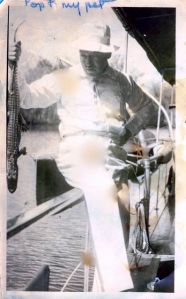
This young man had difficulty in telling a  Cadillac from a Packard

This young man had difficulty in telling a
Cadillac from a Packard

By Cecil C. Hoge

Starting in the late 1920s my father’s family spent their summers in Quogue. They had decided on Quogue for a number of reasons.

My grandmother, Sidney Cecile Cunningham Hoge, was looking for a suitable summer place to bring up her four sons and a daughter. She and her husband had scouted the Hamptons for just the right place. They really would have preferred Southampton or East Hampton, but even then they were quite expensive.

At the time, Quogue was still extremely reasonable to rent a good-sized house for a large family. Sometime in the summer of 1927 they moved into what they called The Benjamin House, a big sprawling, ramshackle 7 bedroom house. This house was set on an acre plot surrounded by a large green lawn and a not so high green hedge. They called it the Benjamin House because of Sally Benjamin, the elegant lady owner who had moved on to Southampton.

My grandmother was determined that her large family have all the social benefits of the Hamptons. She contacted all of her wealthier friends and organized a socially significant summer. If there were country clubs deemed important to my grandmother, she organized a blitzkrieg to join. If there were cocktail parties, dinner parties, balls, social gatherings of any kind, my grandmother insured the she, her husband and her children were invited.

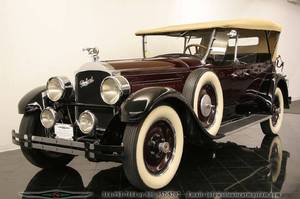
This was the car found at the scene of the crime

This was NOT the car found in the hedge

They did have telephones in the Hamptons back then. The telephone and the dial-up system was somewhat simpler. Basically, you picked up the receiver, gave the phone a few cranks, positioned mouth close to a microphone and said “Dorothy dear would you get me Penelope.”

“Hold on Mrs. Hoge,” Dorothy Dear would say. Dear was not Dorothy’s last name. Dear was the word that my grandmother added to ladies she was asking to help her with something.

“Mrs. Hoge, I have Mrs. Tremont on the line.”

A voice would come then on the line.

“Sidney, is that you?”

“Penelope, I am just at a such a loss,” my grandmother would say, “I just don’t know what to wear. What is the theme?”

In those days every ball and party had a theme. Mrs. Tremont’s theme was birds of the summer. This theme was selected primarily with the ladies in mind, providing them with the splendid opportunity to wear their best three foot hats adorned with bird feathers of different rare species. The men, for their part, would be required to wear white tails.

The weekend of Mrs. Tremont’s ball happened to be the high point of the 1928 social season in the Hamptons. A lot was going on in my family’s social calender. Not only was Mrs. Tremont hosting a gala ball in Southampton, Mr. & Mrs. Witherspoon were having a coming out party for their daughter, Cornelia.

As if that were not enough, my uncle Francis was hosting 2 of his college friends down from Dartmouth.

I am not totally sure what happened on that eventful weekend. I can only offer you my memory of what my aunt and uncles told me. Here, I must caution you. The reminiscing of this illustrious weekend almost always began with my aunt and uncles having a few cocktails – so this may have comprised the truth of the actual events.

This much is clear – on this illustrious weekend, there were different plans for different segment’s of my grandmother’s family. This meant that different members of the family had to take different vehicles. At the time there were two main vehicles, a Cadillac and a Packard, supplemented by two roadsters owned by my uncles Ham and John.

Sidney Cecile and her husband, Huber, sallied forth in the Packard. My father and my aunt Barbara commandeered the Cadillac and headed for the Cornelia Witherspoon’s coming out party. My uncle Hamilton took Amanda Blakesly, his girlfriend of the time, in his roadster to the same party. My uncle John, Francis and his college crammed into the other roadster (it had trunk that when pulled out and became 2 seats) and headed out to explore the pleasures of the local speakeasies – yes, this was the famous period of Prohibition.

Whenever my aunt and uncles discussed the events of that evening, the details of the story seemed to shift and change. Some facts remained the same.

My grandmother and grandfather had a blissfully ignorant and perfectly respectable evening at the Tremont Ball. My uncle Hamilton and Amanda Blakesly departed Cornelia Witherspoon’s débutante party early. John, Francis and his college buddies all got inebriated in search of the most exciting speakeasy in of the Hamptons – apparently, there were several.

In the meantime, my father and my aunt danced and drank the night away at Cornelia Witherspoon’s party in Easthampton. In Southampton, my grandfather Huber broiled in the summer heat and grumbled about how uncomfortable his white tie and tails were. Understandably, Sidney Cecile was not a bit disturbed by her husband’s discomfort and had a perfectly divine time in her 3 foot Ostrich feather hat.

Several hours later, my aunt suggested to my father that they return home before their parents got home. Apparently my father thought that this was a particularly bad idea, but after a few more glasses of Champagne, my father and aunt climbed into the Cadillac and headed back to Quogue. Why my aunt was foolish enough to let my father drive will forever remain a family secret.

I had never known my father to drink more than two drinks or be the slightest bit intoxicated. My aunt and my uncles have assured me that there was a time his life when he was the life of the party. This must have been one of those times. The story is that they almost made it back to Quogue. If it had not been for the tall hedge that appeared as they failed to follow a right hand bend in the road, no doubt there would have been no family tales to tell of that evening.

But the tall hedge did suddenly appear and in crashed the family Cadillac with my father and aunt. One the iconic features of all the Hamptons are the tall hedges surrounding various houses and Quogue was no exception. These hedges have saved many a wealthy man or woman, and not a few celebrities. Not only were my father and aunt not hurt, but they were less than a mile from the Benjamin House in Quogue. The story was somewhat different for the Cadillac which was actually halfway through the tall hedge and firmly stuck.

Once my father recovered his wherewithal he made several attempts to disengage the Cadillac from the hedge. That did not work and the more father tried the worse the plight of the Cadillac became. A summer rain earlier that day had left the ground soft and after a few vigorous attempts, the rear wheels quickly sank up to their previously shiny hubcaps. Worse, my father and my aunt, while unharmed by the collision with the hedge, found themselves trapped in the middle the hedge.

It took considerable time and some physical prowess to wedge themselves out of the one clear window. These efforts caused considerable damage to their evening clothes. From reports that were given by the one or two siblings sufficiently clear-headed enough to remember, my father’s and aunt’s clothes were, to use a modern term, “Toast”.

In the meantime, my grandparents, if not dancing the night away, were having a perfectly splendid evening. By that I mean my grandfather was getting increasingly hotter and more uncomfortable while my grandmother, being a Southern belle and very social creature, was enjoying the glories of the evening.

I know nothing of the drinking habits of my grandfather. I remember being told he was a very reserved gentleman of few words. I do know when Prohibition arrived, my grandfather and grandmother were not “drinkers”. Several years later when Prohibition began to be regarded as an opportunity to drink and when it became obvious that her children were among the participators, my grandmother decided to deal with the problem in an open and modern manner, serving one or two cocktails to her whole family every evening before dinner.

If my grandfather was having a few whiskeys to moderate his boredom with the party and his discomfort with summer heat, I do not know. I do know that they stayed unusually late at Mrs. Tremont’s Ball. This proved a blessing as the events of the evening enfolded.

An hour or so before my grandparents finally sailed home in the grand Packard, other events were taking place in Quogue. John, Francis and his buddies had retired to the Benjamin House after their strenuous tour of the local speakeasies. Comfortably and safely home, they decided to have a few more cocktails.

Meanwhile things were not going well with my aunt and my father. There was some confusion and disagreement as to the exact direction to set out. It was a dark evening and roads and landmarks that they had known all summer somehow looked different. They tried to hitch-hike, but the one or two cars that happened to pass apparently were concerned by my aunt’s and father’s shredded evening clothes.

The police were more efficient than my father and aunt. They were called by the concerned tall hedge owner only a few moments after my father and aunt had struggled free of the hedge. It seems that my father and aunt were favored by the gods overseeing impaired people because the wrong direction in walking home proved to be the right direction in avoiding the cops.

Speaking of the cops, they not only arrived early on the scene, but immediately recognized the Cadillac in the hedge as belonging to the Huber Hoge family. In an unusually swift turn of Justice, they arrived at the Benjamin House to announce that a yellow convertible Cadillac had been found in a tall hedge and to question the residents how this came about.

My uncle Francis answered the door. He was several sheets to the proverbial wind. The interview went something like this.

“Excuse me, sir,” the Police officer said, “It seems that there has been an accident, your Cadillac has been found in the Mortimer’s hedge about a mile from here. Would you know anything about that?”

Francis, though just 22, was a handsome man of considerable dignity. I am sure that he tucked in most of his shirt and summoned all the bearing available.

“I know nothing about a car in a hedge,” Francis said with the greatest dignity, “but I can assure you it is not our car. The Paddillac is in the garage.”

These words were to become immortal in the history of my family.

It was apparently at this point that my grandparents sailed in from the Tremont Ball, my grandmother in her 3 foot Ostrich hat and my grandfather, perhaps a little flushed-faced from the heat of the summer evening, both fortunately in the full command of their senses.

I am told that the matter was quickly sorted out although it took some time for my grandparents to register that their yellow Cadillac was in the Mortimer’s tall hedge. Francis, John and the two college friends headed off to bed for some well-deserved sleep, my grandparents assured the police that the matter of the Cadillac would be sorted out directly with the Mortimers who themselves had only returned from the same Tremont Ball an hour ahead of my grandparents. The Police were quite satisfied with this solution since it meant that there would be no bothersome paperwork – it was, of course, a different age.

In due time my father and aunt returned home in their shredded evening clothes. I am told that my grandmother was most disturbed by the loss of perfectly good evening clothes and the fact that there were several more parties to attend that summer. That evening and this story, full of the mishaps of a Hampton’s summer eve, forever became a part of my family’s lore.

Posted in Uncategorized | Leave a comment

I Graduate To Clam Digger

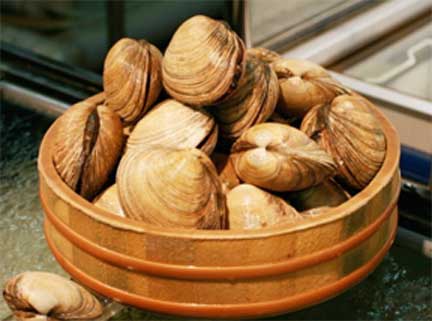
Cherrystoneclamsby Cecil Hoge

It took me 6 years to get my Bachelor of Arts degree from the University of Virginia… two years to flunk out, two years to get back in and two years to graduate. The transition from a Catholic Benedictine Monastery Prep School called Portsmouth Priory to what was then known as America’s most dedicated party school was somewhat jarring. It was like going from the land of all rules to the land of no rules.

After 6 years I did actually graduate, although for 20 years thereafter I woke up with same terrifying dream. I am in line wearing my black cap and gown, waiting to be called when my craggy sociology professor comes up and taps me on the shoulder and tells me I forgot to take Sociology 101. Then he says I can’t graduate and I say “Hunh” and finally I wake up in a cold sweat. It was always terrifying.

After graduating was I invited my college girl friend, Penny Zetterstrong, and four of my best college buddies to my family’s summer house on Great Plains Road in Southampton. At the time, my family (which consisted of 3 brothers, 3 wives, 1 sister, 1 husband and assorted children, including me) all shared a large 12 bedroom house on Great Plains Road. In case you think a 12 bedroom house in Southampton is pretty big you would right if were not for the size of my extended family. When my four friends, my girlfriend and myself descended on the Great Plains House, it was actually quite crowded, especially since some my cousins had a few house guests of their own.

None of that prevented anyone from having a great time. My college friends had a fine week hitting the surf, playing tennis, drinking beer, throwing Frisbees and oogling my long-legged female cousins. They were particularly enraptured with Daphne, my tall blond cousin with a knockout figure. I and my girlfriend had a super week playing tennis, frolicking in the ocean, laying on the beaches of Southampton. My father, his wife, my uncles and aunts all had a super time interacting with all the house guests. Of course, they always had a super time, since our house always had guests coming and going.

As the week wound down, my college buddies began drifting back to something called the real world. They had careers to begin, new lives to set up. Even my super girl friend said goodbye. She had been hoping for some tangible commitment. In those early summer days, just after completing 6 long years of college, it just didn’t seem the right time to make a commitment much longer than one or two days. Penny had her own career plans and had to return South. We said goodbye vowing to meet in 2 or 3 weeks, both probably knowing we would never see each other again.

The next week left just Rich Miller and myself sitting in an almost empty summer house pondering the onset of responsibility. The elders of the house had gone into the city, the remaining assortment of wives and cousins returned to the quiet routine of the week, giving the house an almost eerie silence. What do was the question? We consulted a six pack for the answer. The answer began to form in our minds. Sometimes difficult problems require perseverance. We consulted another 6 pack.

Our dedication paid off. The answer came in sudden burst of inspiration. Yes, that was it. Rich had a 10 year old 5 hp outboard motor, I had a beaten up 16 foot fiberglass skiff. It was just obvious. Like many a stroke of genius, brought by hours of perspiration, the answer was blazingly simple. We would become clam diggers. What better way to keep our endless summer from ending?

Becoming a clam digger in Southampton entails some legal details. Somebody had to get a clam digging license. This proved relatively simple. Since my parents already had a summer residence, all I had to was go down to Town Hall, fill out a form, pay $25 and that was it. I was a legal bone fide clam digger.

There was some logistics involved. Rich had to head off to New Jersey to retrieve the 5 HP outboard. I had to swing through Bellport to collect my old beaten up skiff. Within 48 hours of our inspiration we were gathering up the tools of the trade. This required a little research. We repaired to a landmark of the time called Todd’s Anchorage. For those of you who never heard of it and those of you who don’t care to remember, it was a sleazy saloon located on Main Street about 200 feet down from Hildreth’s Department Store.

We figured it had a nautical sound to it and there must be someone inside who knew something about clam digging. Sure enough our hunch was rewarded.

We sat next to a gentleman we came to call Mr. Death. He had a 15 cent beer, a shot of whiskey and a cigarette in front of him. In case you are wondering whether it could be true that 15 cent beers were sold on Main Street Southampton, yes, it was true, but the year was 1973. Southampton, then as now, was the home of many rich and famous people, but it also had its share of middle and lower class people who were not so fortunate. The man we came to call Mr. Death was one of the less fortunate.

Being fresh out of college and friendly by nature, we struck up a conversation with Mr. Death. He didn’t quite know what to make of us, but once he saw us quaffing down 15 cent beers (they came in 5 ounce glasses), he warmed to us. It seemed that Mr. Death was a retired man, with enough income to keep him in cigarettes and alcohol. When not talking to us he would alternatively pull on his cigarette, his beer and his whiskey and then stare vacantly into the mirror behind the bar. Occasionally he would motion to Todd, the extremely large bartender who presided over the place. Todd would then silently deliver a whiskey or a beer, knowing by some unseen telepathic power what Mr Death required.

Anyway, after some questions of Mr. Death about what kind of equipment was required to dig clams, he volunteered the following information.

“Ray’s your man.”

After some further questioning, it turned out that Ray was Ray Shinshecki, a well-known Hampton Bays clam digger and a local manufacturer of clam rakes. So off we went to Hampton Bays where we found Ray Shinshecki in the back of his garage fashioning some clam rakes and other instruments of the trade.

Ray’s first question to us was this.

“Are you tonging or scratching?”

Ray went on to explain that tongers worked from a boat while in relatively deep water and scratchers waded in two to four foot water. This led to lively discussion between Ray, Rich and myself of the relative merits of the two systems. Ray showed us the two basic devices of the trade. One looked like post diggers with 20 foot handles, the other looked like a giant rake with big basket attached to it. Ray was definitely in favor of scratching which he described as the more elegant, hands on experience. In the end we went with Ray’s suggestion and he outfitted us with two clam rakes at 50 bucks a copy.

What else do we need we asked Ray? Just a few things, he replied – one grader, six bushel baskets and two clam knives. To make a long story short, after reliving ourselves of $158 we were fully equipped for our new profession.

This led us to our next question for Ray. Where do we go clamming? A slow smile followed by a vague look.

“Shinnecock Bay is a good place to start.”

Rich and I looked at each other. We knew Shinnecock Bay covered a lot of territory.

“Where in Shinnecock Bay?” we asked.

The slow smile returned.

“You boys look like nice young men. Go out and take a look around.”

Rich and I looked at each other with some concern.

A look of sympathy crossed Ray’s face.

“I shouldn’t tell you this, but clam diggers keep their locations secret. There are just so many clams out there. Anyway, you got eyes and a boat. Cruise around and see where other clam diggers dig. That don’t mean they know, but it’s a good place to start.”

With this advice we went forth with one grader, two rakes, six bushel baskets and two clam knives.

Before heading out on the Bay, we decided to do some research on where we might sell our bounty from the sea, presuming we were lucky enough to be successful.

We stopped by Catena’s fish market. We knew they sold clams. So we asked Mr. Catena if he would buy clams from us. His response was immediate.

“If you boys bring me nica clams,” Mr. Catena had an Italian accent, “I buy them. If they no nica, you get nothing from me. But if they nica clams I pay you $32 a bushel, that twica the prica you getta from the seafood wholesaler in Moriches.”

This sounded good to us, especially since we did not know where the seafood wholesaler was in Moriches, much less that there was one in Moriches and where Moriches was – obviously, we had a lot to learn.

Now armed with the tools of the trade and having lined up a concrete purchaser for our goods, we decided to go off to Todd’s Anchorage and celebrate with a few 15 cent brews. Not unsurprisingly, we saw Mr. Death seated at the bar.

The next day we decided to launch my 16 foot skiff with Rich’s 5 hp outboard off of Dune Road. The boat and motor combo proved a marriage made in heaven. To our amazement, the little 5 hp engine started on the 3rd or 4th pull despite not having been used in several years. My skiff proved almost watertight – a small problem we were able to resolve with periodic bailing.

Our first day of clam digging was amazingly successful. In less then three hours we were able to dig up three bushels of clams.

I should tell you about the process. We went out several hundred yards and dropped anchor in about three feet of water. We then got into the water up to our waists. The long rakes that we used were equipped with short crossbars. The long handle of the rake rested on our shoulders while we pulled on the short crossbar. This gave us both leverage and pulling power. Pulling on the rake was hard physical work, but if we were lucky our efforts would be rewarded with a clanging, chattering sound and the feeling of much greater weight. This could lead to a deceptive feeling of joy. Let me tell you why.

I mentioned earlier that one of basic tools of the trade was something called a grader, but I did not explain its purpose. I will enlighten you now. There is a law in New York State which says that it is illegal to take clams that are less than an inch across. A grader is designed to quickly separate legal clams from illegal clams. Here is how it works. A grader is an empty box with bars spaced 1” apart. When you pour clams into the grader, the illegal fall back into the water.

This can be a very sad event since you could be raking up the bottom the bay for twenty minutes until you first hear and feel your clams in the clam rake basket. Then you might go along for another five or ten minutes until you think the clam rake basket is really full and really heavy. Then it takes two people to pour the clams through the grader, one to hold the clam rake loaded with clams and one to hold the grader over the water. The moment of truth comes when the clams meet the grader. Sometimes the result is truly tragic because sometimes all the clams simply fall through the grader into the bay. It is at that moment that you learn that all the time you spent and all the aches in your arms, shoulders and back were for naught.

Aside from the frustrating and backbreaking work involved there was also the not so easy task to locate clams. At first used our bare feet to feel for clams which lurked three to five inches under the sand. This was very effective. We could feel anything under our feet and this method made it quite easy to locate clams. The only problem with this was that there were other things on the bottom. Some were slimy and gooey. We came to call these things “umgum” and “ugibatanda”. These were our terms for slimy things of an indeterminate nature.

But that was not all that was lurking on the bottom. In just first few minutes of clamming we noticed things nibbling at our feet. Since these little nibbles did not seem to be life threatening, we kept on clamming. Shortly, thereafter I heard a torrent of curse words from Rich. When I asked him what the problem was he jumped into the boat and began nursing a profusely bleeding foot. Shortly thereafter I was hit by a vicious bite, leading me to also seek shelter in the boat. It seems that the local crab population had discovered there was some fresh meat in town.

This led us develop a new system for feeling clams without having our toes bitten off. The solution proved to be close at hand. We simply put back on the socks and sneakers we had taken off when we first got into the water. The new system was not very beneficial to our socks or sneakers, but it did offer protection against sudden painful jolts from below. While we still would get bites on our sneakers or through our socks, but they were much more bearable.

As mentioned, in spite of the difficulties above, we still managed to be incredibly successful in our first day’s outing. I suppose you could call it beginner’s luck, Within three hours we were able to collect three full bushels of clams. There are 500 to 600 clams in one bushel so this is a lot of clams.

We decided that we should take our harvest to Catena’s and sell our goods. In less than an hour we did just that and found ourselves celebrating our new found fortune with 15 cent beers at Todd’s Anchorage. Not surprisingly, we noticed Mr. Death stationed at the bar with his cigarette, his beer and his shot. Coming to Todd’s after a successful day of clamming was to become a daily ritual of our new profession.

That summer, which passed quickly and which maybe was the most fun summer of my life, acquired a routine of its own. We would get up without the benefit of an alarm clock sometime around eight or nine o’clock. We would have a nice breakfast and then head out to the bay with our rakes, our clam knives, our bushel baskets and our grader. We would strain and pull until we heard the joyful chatter of the clams in our baskets. We would cheer or curse according to how many clams our grader allowed us to keep. We would spend anywhere from three to six hours in the pursuit of clams. Sometimes we felt ambitious and gathered four or five bushels, sometimes we quit with one or two, but most times we got two or three full bushels.

Most of the time, we sold our clams to Catena’s. The old Mr. Catena took a genuine shine to us.

“You-a boys bring me nica clams,” he would say peeling open a clam to show us, “they-a so-a clean, look-a this, they-a all white inside. No-a black, that’s a nica clam.”

Sometimes, Mr. Catena would look sorry at us.

“Sorry boys, I already bought-a some-a nica clams. Come back tomorrow.”

On the days that Mr. Catena could not buy our clams we would drive to Moriches (yes, we found it) and sell our clams to the seafood wholesaler at half price. No matter what our clams brought us for the day we would retire in the late afternoon to some sleazy bar to have a beer or two to celebrate our good luck. This left the rest of day free. Our next step was to retire to the beach for some surfing and swimming.

Evening time we would gather at my family’s summer house, throw around the Frisbee and then go out to dinner to spend whatever proceeds we had not already spent.

There were some ironic features to clamming. Sometimes, after a particularly successful day clamming, we would go splurge on dinner. At the time, a friend of mine, Charlie Munroe, owned, along with Dick Ridgely, one of the best and most expensive steak places in the Hamptons. It was called Ridgely’s and it was known for its marinated steaks along with its bodacious drinks. Located between Watermill and Bridgehampton, it was a favored drink and dinner place of the time.

Going to Ridgely’s required some serious bucks or, in our case, some serious clams. To be clear, we needed to score 4 or 5 bushels of clams in order to have sufficient funds for Ridgely’s. This usually meant working 4 or 5 hours, rather than our more laid back 2 or 3 hours. It has also considerably harder on the back and shoulders. But in the end, we felt doing the extra time was a solid investment in that evening’s entertainment. I can say with some pride that having a steak dinner along with some fine wine at Ridgely’s was always worth the price. Rich and I would come in packing over $100 between us and by the time dinner and drinks were over, we never left with more than $2.

Another oddity of our summer clamming job was that often, after selling 1200 clams or so to Catena’s – total of 2 bushels worth for $64 – we would cruise down to the beach club for a swim in ocean and, afterwards, a drink at the bar. In the bar, we would sit outside, sipping on a couple $6 Carlsberg beers, happily munching on a couple plates of clams on the halfshell at $8 a plate. Somewhere during that summer we discovered from the club bartender that the clams came from Catena’s. Oh, irony of ironies, we sold the clams at 5 cents a Littleneck and bought them back at $2 a piece. It probably showed that we were not the best businessmen on the planet, but we did not care because we were having a great summer.

You could say that we lived day to day. You could say that we lived irresponsibly, with no thought of earth-shaking events happening around us. You could say that we wasted every penny we earned. You could say that nothing we did that summer advanced what we would did later in life. And you know what? You would be absolutely right.

But you know what? That was the most fun, the most productive, best summer of my life.

Posted in Uncategorized | Leave a comment

Cecil Hoge, My Father

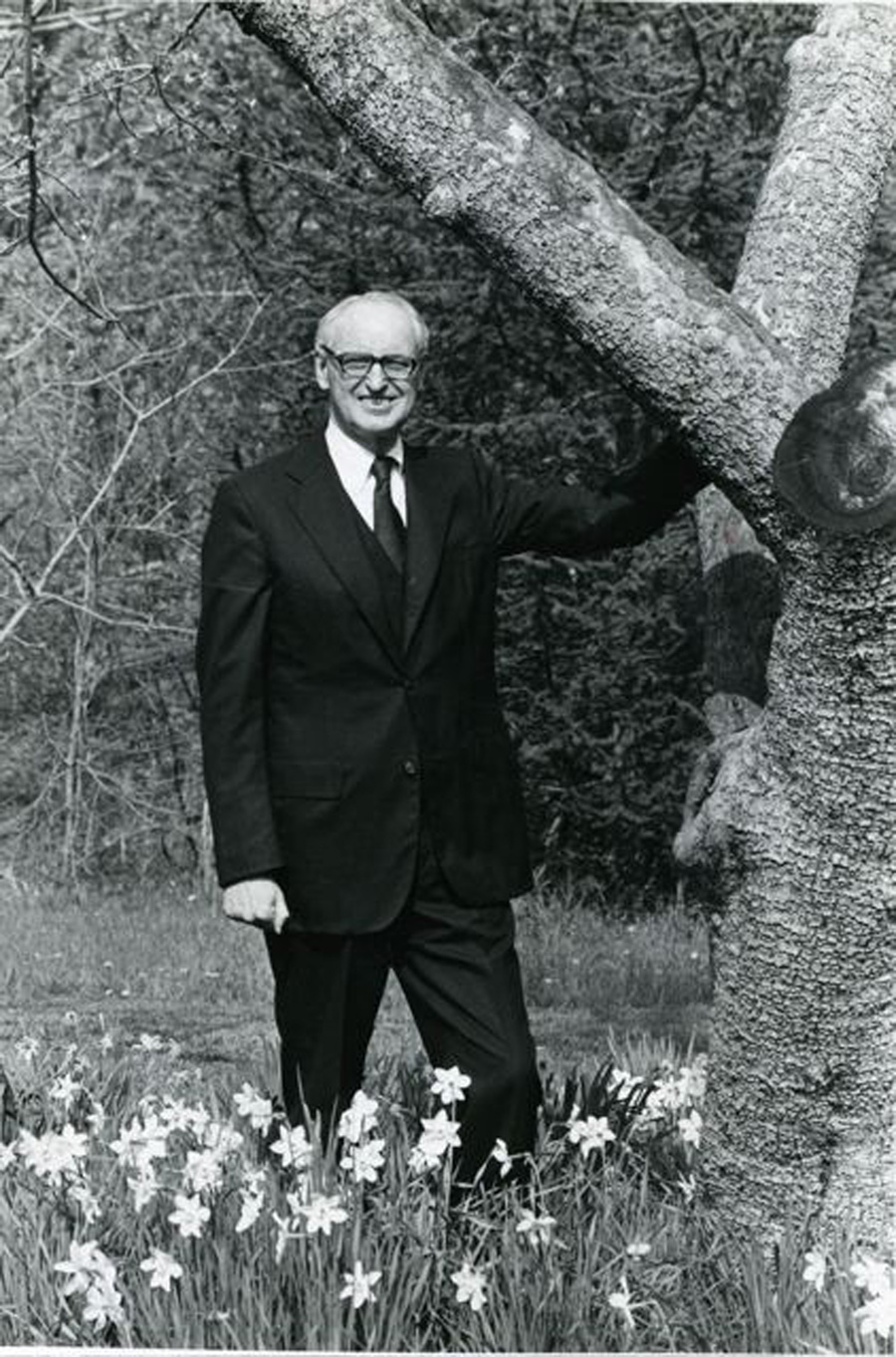
Dad by treeCecil Hoge, My Father

by Cecil C. Hoge, Jr.

My father was a much different guy than me. For one thing he was a tall, thin man. I am not tall and I am not thin, but I am also not fat. So much for our differences.

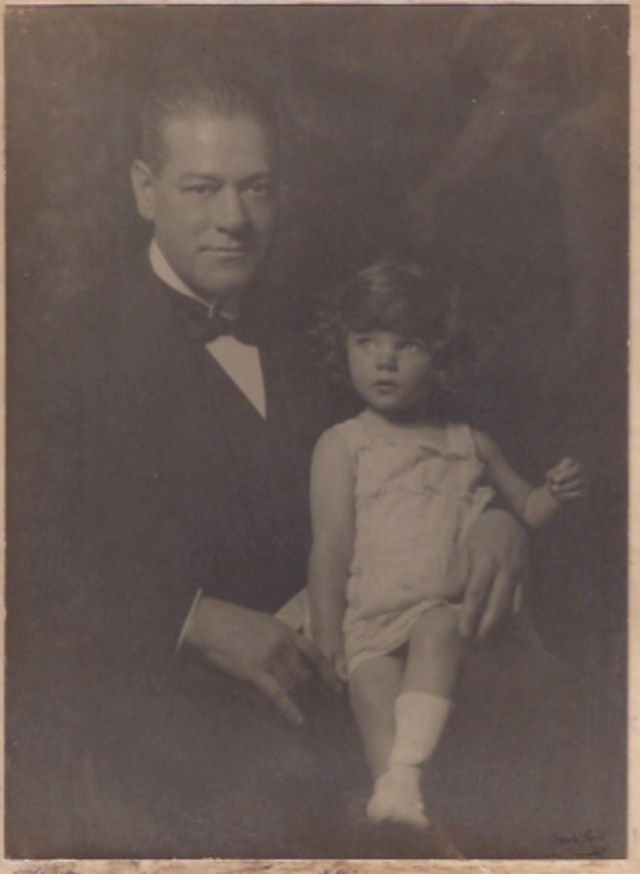
My father married a lady he was fated to divorce. She was, if I may say so, one of the most beautiful women on the planet…at the time. We must condition all statements about ladies on the time that they exist in. It could be said that all ladies are beautiful in their own way and in their own time, but my mother was just plain beautiful. Whether you look at a painting of her when she sat in her crib at the age of 5 or a picture of her sitting on a dock in her 1920s bathing suit, you would know instantly that she was a beauty.

I do not know what attracted my mother to my father and my father to my mother. It must have been a chemistry that no one could see because in truth they were the original odd couple. My mother came from a family of immense wealth and of little family background. My father came from a family of immense respectability and little wealth. Let me say first and foremost that was not the essence of their relationship. There was something more to it.

My father always wanted to make his mark in the world. My mother, whose father had done the repairs for the Atlantic Fleet during World War I, saw little benefit in anyone making more money. She had it and she saw little reason why anyone would want it. My father, on the other hand, thought that the greatest good was to make money. His family had respect and pedigree, but they did not have wealth. He was determined that they should have money.

So you can imagine that there was some tension as to what their life goals should be. As I said I do not know what glance, what introduction, what instant set my father on the path to marry my mother, but marry her he did.

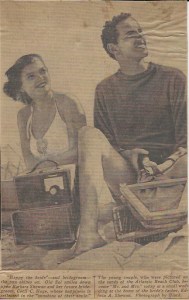
My Mom and Dad in the early days of their marriage

My Mom and Dad in the early days of their marriage

Once married, they had to learn to live together. What that meant for them I do not know, but I am guessing it was not easy for either party. My mother was an Olympic class swimmer and my father was a pioneer in direct marketing. To be sure, each had their own good and loving opinion of the other. At the time my father had an advertising agency that was promoting everything from Arthur Murray Dance Lessons to Jackson and Perkins Roses to Doubleday Books to Kajar the Magician.

My mother’s view of all this was somewhat distant. Let me interpret for my mother some fifty years later. Why bother, she would have said. Let me try to explain. She grew up in 5 houses around the globe. She had a house on Fifth Avenue, she had a house in Southampton, she had a house in Scottsdale, AZ, she had a house in Paris. She had a house in Greenwich. These were all big, grand houses, so what difference did it make to have an apartment in NYC and have a medium size ad agency. I mean it was OK, but it was not the end all for my mother it was for my father.

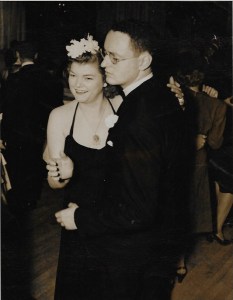
My mother and father dancing in the early days

My mother and father dancing in the early days

About the only compensating benefit for my mother was that the Gabor sisters had a jewelry shop downstairs from my father’s advertising agency. So when my father brought me and his wife to the ad agency, inevitably my mother and I would end up migrating downstairs to look at the new gaudy jewelry on offer from the Gabor sisters. By this time, all three Gabor sisters had married wealthy men, although inevitably one of the three was in the process of disengaging one of their men from their money. As far as I could figure out the real profession of the Gabor sisters was divorce. They were best of best when it came to divorce.

I am pretty sure by the end of their marital careers, they knew considerably more than the lawyers who did their bidding. Personally, I was not the least bit interested in their gaudy jewelry which could be summed up in the phrase, “Flash is everything.” The bosomy Gabor sisters were, on the other hand, a source of endless fascination. Most the time, they were not present in their own store, but on the lucky days when one or another was in, it was a source perpetual wonder to me. Eva was my hands down favorite. In my humble opinion, the other two never held a candle to her. But this could be my pre-adolescent mind running away with itself. In any case, I loved it when Eva happened to be around.

“Barbara dahling, I got just the thing for you.” and Eva would pull out this gigantic rock on top of a thin band of gold that looked like it needed re-inforcement to carry the weight. Modesty was not in Eva’s vocabulary.

“Dahling, this is you. It the perfect thing to get that nincompoop of husband on the path to prosperity,” Eva happily warbled on, “I always say that a man needs to go in debt in order to learn the value of money. And you know Dahling, I am awfully good at getting men to spend money on me. Just one look and they have to buy me the big rock. Is it the hair, is the breasts, it is the legs, God never gave me any money, but he did give me the material to acquire money.”

“Eva, you know that’s not my style.” my mother would interrupt, “I like nice things, good clothes, nice jewelry, but really it is all so meaningless.”

“Dahling, you are going to have to come over to the apartment and have dinner with me and Edward.” Edward was Eva’s current husband or love interest or day job…I am not sure which.

The Gabor sisters had come over to the States just after the Hungarian Revolution, the one the got squashed by what was then known as the Soviet Union. They came with some stage experience and drop dead beautiful bodies. They hit Manhattan like an A bomb attack. A significant portion gross national wealth of New York City got siphoned off to the Gabor sisters.

“Eva, you know Cecil is a complete boor. He has an absolute blindness to fashion and he is supposed to be in the advertising world. My God, he would better off if he just got reborn again and started again.”

Eva nodded sympathetically, “Well, I know he is brilliant, but brilliant doesn’t make the beans. You got to be brilliantly stupid. And being a sonuva bitch doesn’t hurt either. All my husbands were sons of bitches and they all gave me rock after rock. You know it’s the only thing a girl can depend on.”

It was no co-incidence that Marilyn Monroe was extremely popular at the time. And who influenced who the most is anyone’s bet, but surely Eva had both feet in game.

Anyway, my mother had many a tearful and impassioned conversation with Gabor sisters. I got to ogle the blond Hungarian ladies and look at endless pieces of gaudy jewelry. Inevitably, whenever my mother got outside of the Gabor sister’s jewelry store, she would immediately announce how terrible most of it was. I can’t really say, given the fact that as a 9 year’s old, my jewelry sense left a little bit to be desired. One thing I could agree on and that was what a knock-out Eva Gabor was, although my mother was a strong second.

The advertising agency that my father ran was a chaotic and infectious place. People were running around with layouts, sticking things in front of my father’s face and he would say yes, no, go back and redo it. Mostly, he said go back and redo it. My father had assorted advertising crazies working for him. Many of these men and women went on to have significant careers of their own.

At its height, Huber Hoge and Sons Advertising, my father’s agency, had about 120 people working for it. These people lived, breathed and bathed in advertising. But if you thinking about some pretty up brand kind of advertising that was not the stuff my father dealt in. My father and his father before him were into “Direct Marketing” Or to be more precise my father was a pioneer of what was then called “mail order”.

Originally my grandfather did mail order style advertising in the early 1900s for large staid companies, such as Standard Oil, Good Housekeeping Magazine and DoubleDay Books. These ads were pretty stuffy and while they were meant to get orders, they were elegant, staid and respectful.

As they say, things change. In the Depression my grandfather’s advertising agency went bust and the family fell on hard times, working any job that came along, moving from apartment to apartment as the rent inevitably came due, always finding elegant apartment buildings willing to take in down on their luck tenants because that was all that was available to them…down on their luck tenants.

My father, who had been going gaily to the University of Virginia where he had position as chief moonshine requisitioner for his fraternity, found himself out of college, looking for a job in the depths of the Depression, trying to support his extended family of mother, father, 3 other brothers and one sister.

His brothers had been a little luckier in that they got to complete their college educations. I am not quite sure what they did when they finally graduated, maybe they had jobs, maybe not.

It must have been a terrible time to come from a family of wealthy pretensions, knowing that pretensions were the only dreams they could realize. My father described The Depression as 10 years taken out of his life. A kind of black hole that existed from his mid twenties to his mid thirties.

I am told at that time my father was literally the life of the party, an eternally optimistic idealist, utterly convinced in the right of the world. He saw the good side to every event. And in particular he believed in the game. I refer of course to the game of making money. For him, it was a kind competition. Added to this, he was born with a relentless ambition to make his way in the world.

His wife never quite saw things the same way. She came into to this world with enormous wealth and she did not have the slightest respect for all the things that wealth could buy. For her wealth was an empty box. Yes, she liked certain luxuries. I was brought up on artichokes hearts, consommé, champagne, turtle soup and the Stork Club. And yes, occasionally my mother would let herself splurge on a $2500 ring from the Gabor jewelry store, but most of the time, she really could care less about the things that money could buy.

Strangely, my father had much the same attitude about making money. It was not the money he cared for, it was the game of making money. My father loved activity. He loved starting businesses, going into ventures, creating sales where no sales ever existed. He also had a kind of a genius in recognizing things that could be brought from zero sales to millions of dollars of sales.

Over time my father moved away from advertising as a profession to mail order as a profession. He concluded, quite logically, that advertising agencies only earned a commission on advertising placed while mail order allowed, if the product was right, one to profit from advertising. Advertising created the sales that would create the profits from selling things that were advertised.

This is true to an extent, but what it doesn’t include is the aspect of risk. What my father saw was that he made millions for DoubleDay Books, for Jackson and Perkins Roses, for Arthur Murray Studios. What my father did not consider was the fact that when you spent money on your own products, you could make a lot of money, but you could also lose a lot of money.

Anyway, no matter the risks and the rewards, my father determined to sell his own products. And this new direction led to flurry of different businesses, some of which made a lot of money, some of which lost a lot of money. One can’t guess what would have happened if my father had just stuck to his model of an advertising agency because that is not the way he went.

The mail order business proved to be nothing if not exciting. My father sold a bewildering mix of products – paint brushes, pocket adding machines, TV repair books, dance lessons, fishing lures, painting courses, piano lessons, magician courses, toys, dress forms. Let me assure you this is just a partial list. My father had only one rule, if he thought it could be sold by mail order, try it. Most of these businesses came and went in flurry of activity.

When my father branched out into selling garden fertilizer by mail order, my mother said

“Well, he has finally done it. I always knew he would, Now he is selling shit for money. Can you believe it?” she would ask anyone willing to listen, “Yes, he has finally done it. He is selling shit for money. And you know what, people are actually paying money for this shit. I married the God Damned Pied Piper of Shit.”

My mother actually thought it was hilarious. My father was not amused. He thought of the fertilizer business as quite respectable. In truth, the product that my father sold, RX-15 Fertilizer (my father billed it as a scientific breakthrough), is still on sale in Canada, so that proved to be a business with true legs. Unfortunately, along the way, my father got into an unfortunate lawsuit with the company that made the product, who decided to take back the sales of the said RX-15 after my father had created a business doing 20 million dollars in a time when 20 million dollars was, well, 20 million dollars.

Anyway, the selling of mail order products turned out to be quite a wild and woolly ride, with my father making tons of money some years and losing tons of money other years. Today, we still sell things by direct marketing, but I must say my methods are considerably calmer, less brilliant and more reliable.

Along the way, my father divorced his wife, I went to a slew of private boarding schools, my mother became sick with cancer and died. My father, in a strange twist of fate, went off to Berlin to negotiate a better deal on the pocket adding machines he was selling (eventually, he got up to selling 50,000 a week and sold literally tens of millions of what at the time was the world’s first pocket calculator). In Berlin, he hired a young lady from the Chamber of Commerce to translate his wish to get a better price for pocket adding machines now that volume had soared. I suppose he did get a better price, but in the process, he acquired a second wife. As fate would have it, a fog rolled in, his flight back to the States was canceled and my father used the time profitably to fall in love and get married.

Within in few weeks this resulted in me finding myself on one of the first 707 jets back to Berlin to meet my new mother’s family. I got to meet my new extended family, to tool around Berlin in Messerschmidt car (it had 3 wheels and looked like a plane without wings), to go through Check Point Charlie into East Berlin, to visit a Soviet Museum in East Berlin where I learned Vladmir Solitzin had invented the light bulb, Igor Muscoff had invented airplanes and Ivan Putinsky had manufactured the first cars on earth. After my Soviet education, I got to go around the other side of Stalin Alley (the main street in East Berlin), see about 3 miles of open rubble and, in the background the gleaming white new buildings of West Berlin. Even then, I had the idea that the Soviet Dream was not going to last.

Later on that same trip, I got to go to a Bach Music concert in a half bombed out church and a groovy new German nightclub which had telephones on ever table each with a number boldly displayed. Dial that number and you could speak to the beautiful German Frauleins who might be sitting at the next table. While I can’t say that I was on my feet clapping at the Bach Music concert, I can say I enthusiastically embraced the new German nightclub and tried my best to communicate with a few of young German Frauleins. But I digress, this story is about my father.

Many years later, several years after I started to work for my father’s business, my father did something almost no father would ever do. He retired from the business in order to give me chance to find my own way in the business. At the time, I disagreed with the way both my father and my step mother ran the business. If I had been my father, I doubt I ever would have done such an altruistic deed. But my father could see the writing on wall. He knew if I did not become my own man in the business I would never be very happy and I would never evolve into the kind of business person I could be.

He was right and wrong. He was right that I needed the space in order to make my own decisions. He was wrong in thinking this would make me instantly happy. What ended up happening is that he gave his ownership to both my step mother and myself – 50/50. This in turn led to a 20 year battle over the direction and course of the business because my step mother and I disagreed on everything. She wanted to save, I wanted spend, she wanted to downsize, I wanted to expand, she wanted us to have a big margin on every product we sold, I wanted to have low margin on every product we sold.

Well, there were many fights, many spats, many arguments for a period of 20 years, but you know what, the business was better off for it. In the end, as much I hated the reality of having to make a good margin, this was the only way we made money because, like many businesses we had something called costs – costs for inventory, costs for labor, costs for advertising, costs for interest, cost for electricity, cost for rent, cost for taxes. My step mother, who grew up in the rubble of Berlin, knew this. I did not.

In the end, the business was better off with the two diametrically opposed points of view. Perhaps, my father knew this. I am not sure. I think actually he simply hoped we’d come together, warm and fuzzy, and it would work out. But it did not work that way. It was rough and tumble, it was up and down, it was violent and peaceful. In the end, we both came to respect each other’s views, much as we disagreed, much as we sometimes hated what the other was doing. I know that was not what my father really wanted, but that was what really happened.

And what did my father do? He was in his business prime when he announced his retirement to us. You would think he might go off and play golf, but my father liked the game of business, not the game of golf. And so he, like any robust 58 year old, decided to change his career and become a writer. That was what I wanted to become when I graduated from college. I never did it, but he did. He went off and wrote a book called “Mail Order Moonlighting”. It was about starting businesses from scratch using mail order advertising techniques.

I had a cousin who said something once that I agreed with at the time. He said that my father had a bigger mind than the problems that he applied it to. What he meant by this was that his oversize brain should apply itself to problems worthy of its capacity. As I said, at the time, I agreed with my cousin.

It seemed to me that mail order, as it was known then, and direct marketing as it is known today, was not a very important thing. But today I think my cousin and I were wrong. Why you might ask?

Well, for sure, mail order or direct marketing is a crass form of marketing. I know better than most. I practice it. But there is something else to this pursuit and it cuts straight to the American genius of marketing and sales. It goes to the creation of enterprises from little or nothing to something that sometimes become grand and great institutions. I will not say that applies to our company, our institution. But I would not object if you disagreed. We, my father’s business, have been in business for over 50 years. That is impressive for any company, but that is not what I am talking about.

My father started businesses from NOTHING. Sometimes, he started businesses based on idea, from something else or from him alone. From these nothing ideas he formed something, created businesses, sold things, bought things, employed people. I did this myself. I started businesses from nothing but getting an idea. I know it can be done.

Now my father was interested in the game. This never interested me until I had my first hint of success. I was interested in longevity, in continuation, in the gradual buildup of nothing to something. And I saw this happen time after time. In fact, I made this happen time after time. But that didn’t interest my father. What interested him, was the noise, the commotion, the turmoil of creating something from nothing. He created businesses from ideas to substance where hundreds of people could be employed. Employing people did not interest my father specifically. No, it was the turnover, the commotion, explosion of activity that interested him.

As I said at the beginning of this story my father was tall and thin, but I am not. I am not so tall and not so thin. So all people are different in one way or another.

My father became quite well known in his field. He ended up writing four books…all on direct marketing. He, in his late 50s started a new career as writer and as technical expert on direct marketing. He was a kind visionary person. In the 1990s when people began to talk about the Internet, he got idea the we had to set up websites showing our products.

I said that he retired from the business in mid 1970s, but that did not prevent my father from having very hard opinions on what we should do. And when the Internet started to happen, he became hysterical about it. We had to get up and running, he told my brother and myself. It was the future. If you have seen an angry 80 year old, you would know what my father was like on the subject of the Internet. We had to get on it and that was all there was to it.

We did get on the Internet and it did turn out to be our future. Today it is the majority of our business.

That was what my father was like. He was a man with dreams and a vision of the world. Even in his 80s he was never interested in the old ways of doing things. He was only interested in the new ways of doing things. He knew that new media were coming around every few years and it was always the new media that interested him. He advertised things in newspapers, in magazines, on radio, on TV, on cable. My father simply saw the Internet as the new way to market things.

My father was a reader and lover of history. And I guess one of the lessons he took from history was those that adapted to new developments in the world went ahead and those who did not were left behind. This is something he tried to instill in me in brother and over time, in every person he met. For my father, it was not the last war you fought, it was the future war you fought. And that was always my father’s focus.

You could say that my father was simply a man of commerce, a man who was interested in the game, a man who was not interested in building something for the long run. That would be true. But there was another side to my father. He had a genuine noble and altruistic streak in him. He was always trying to get relatives to improve themselves. He told my some of my cousins something that should be self-evident – that the world was unkind to people who did not complete their college education. He knew this because he did not complete his college education. I knew it because I did complete my college education. Some of my cousins considered this and simply concluded it was bullshit.

But my father never gave up. Weekly, monthly, he would tell them to get an education, to finish their education and to go on. Some did, some didn’t. But my father altruistic genes did not end there. He would help out family members who got cancer with all sorts of practical information, not the least of which was to find suitable hospitals for treatment and locate some of the best doctors in the world.

In the end my father was not nearly so good in protecting his own health. After 50 years of skin cancer and various minor surgeries to remove, he failed to recognize that he finally contracted a truly serious form of skin cancer. If it had been a cousin, a brother or a sister, he would have had them in the hospital instantly with the best doctor on planet earth tending. But it was only himself and he had to depend on his two sons and simply put we did not force him to go to the doctor in time to contain his cancer.

Really, in the end, it does not matter. People do what they think is best and sometimes they are right and sometimes they are wrong. My father lived until he was 83. He did not surpass the age of his eldest brother, who despite a lifelong love of cocktail parties and cigarettes, outlived him by one whole year. Go figure.

What I will say is that my father was more than he appeared. He had noble mind and maybe it occupied some of the time by figuring new crass ways to make money, but he also understood that the genius of America was starting something from nothing. More than that he was fanatically interested that other people do as well as they could. He spent a large amount of his time showing people new ways to do things or leading people out of their problems or trying to lead people out of their problems – frankly, I am not sure there is much of a difference. Whatever his efforts, they were for the benefit of other people and I am one of the people who benefited most from his love, his genius and his understanding.

Posted in Uncategorized | 1 Comment

Sailing Clipper Ships Around the World

Normancourtclippersfpl

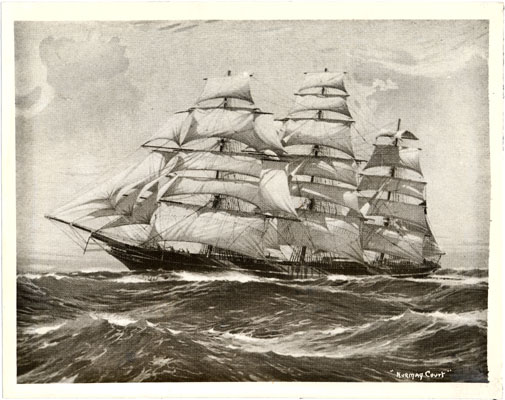
This is a photograph of a painting of the “Norman Court”, the clipper ship that my great, great, great uncle Andrew Shewan sailed around the world.

Sailing Clipper Ships Around the World

by Cecil C. Hoge

On my mother’s side, I am related to a long line of sea captains and pirates. It may seem extreme to call them pirates, but I am positive that this is true. My mother’s name was Barbara Ann Shewan and her side of the family was far richer and considerably less respectable than my father’s side. My father’s family come from a long line of respectable, well-bred preachers and ministers. Now I suppose every family can claim some famous relative or some prominent connections. How truthful the claims of my family is hard to know because much of our family’s heritage has been lost to the dimness of time and the forgetfulness of family members. That understood, my family was fond of claiming illustrious connections on all sides, as perhaps, some other families are.

My mother assured me that I am directly related to Bonnie Prince Charlie. She did mention however that my connection might not be completely on the up and up. This is because Bonnie Prince Charles was apparently very fond of women and in his travels came across a direct descendant of mine, a particularly buxom member of my Shewan family who was trying to make her mark as fledgling actress. I am not sure my descendant succeeded in the actress trade, but, according to my mother, she seems to have made her mark with Bonnie Prince Charles. The result supposedly being that I can legitimately claim that I am illegitimately related Bonnie Prince Charles. Royalty is royalty and however you get there is OK with me.

This is strange because on my father’s side, my grandmother has assured me that I am related to numerous Bourbon princes and the same good Bonnie Prince Charles on the Scottish side of the Hoge family. Recently, I checked this out on one of the many heredity sites that have been set up to assure everyone that they are related to famous people and sure enough I found a letter from William Hoge dating back to 1880 claiming that the Hoge family not only came from a long line of ministers (more than 50 by William Hoge’s account), but also were directly related to Bonnie Prince Charles.

This has got me thinking and wondering as to just how I am related to Bonnie Prince Charles on two sides of my family. Thinking about this too deeply can be disturbing and it seems that I may be related to the good Bonnie Prince Charles in more ways than I want to know.

Ancestry is like a drug. Once you delve into it, you cannot stop. In an effort to stop pondering my true relationship to Bonnie Prince Charlie, I started looking into the history of some of my other Shewan relatives. Here, there was some actual history I could follow. My grandfather Edwin Shewan owned a shipyard that did the repairs for the Atlantic fleet during World War I. He had a cousin Robert Shewan who ran a trading company located in Hong Kong and Shanghai called Shewan, Tomes & Co.
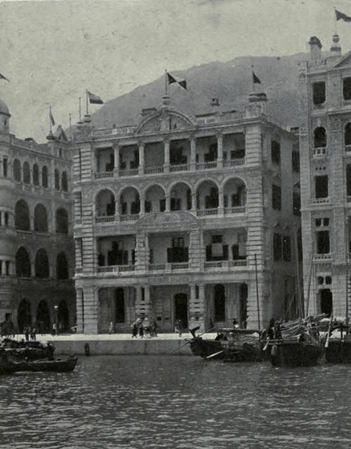
St__George_Building,_Hong_Kong

These are the old offices of Shewan, Tomes & Co., owned by Robert Gordon Shewan.

My wife gave me a book called “The Clipper Ships” because it listed some other prominent Shewans who were sea captains. In the 1850s through the 1870s there were two Shewans, father and son, both called Andrew, who sailed clipper ships from Aberdeen, Scotland or London, England to Hong Kong, Shanghai and other places in the Far East. As you may or not know, the British sailed up the Pearl River around 1842 and appropriated an island in the Pearl River that came to be called Hong Kong. I am not sure the Chinese were particularly happy about this, but the British warships that came to Hong Kong were extremely persuasive. It was called “gunboat diplomacy”.

The net result of this historical action was it gave my Shewan ancestors a place to dock and to trade. At the time of clipper ships, when they arrived from their 3 or 4 month journey across the oceans, traded goods for tea. What goods they traded for tea may be a bit like my possible family relationship with Bonnie Prince Charles…something that you may not wish to ponder too deeply. What can be said for sure is that many things were traded for tea, but over time, the most favored good of exchange came to be opium. I speak in general terms. This was because opium allowed traders to greatly leverage their buying power. Simply put, they got a lot more tea for opium. And while other goods were traded for exchange – American ginseng, animal furs, sugar, rum, pig iron, lead – nothing came close to the buying power of opium.

I do not know what my Shewan ancestors traded for tea, but surely they traded something – maybe it was nails, maybe it was wigs, maybe it was opium. However it happened, they must have found a medium of exchange acceptable to the Chinese sellers of tea. We must remember, whenever there is buyer, there is a seller. This tells me that whatever that medium of exchange was, it was acceptable to both parties. For in the case of my Shewan ancestors, they traveled back and forth from Scotland to Hong Kong and Shanghai nearly twice a year for over 20 years from the 1850s to the 1870s.

I know this because my wife also gave me another a book written by Andrew Shewan, my great, great, great uncle, called “The Great Days of Sail”. This book recounts Andrew Shewan’s reminiscences of sailing many of the great clipper ships of the day. The book, though quite technical, is very readable and quite easy to understand if you do not try figure out the many intricate and complicated parts of a clipper ship that he lists or the complex sailing terms he uses. There are interesting stories about sea shanties (songs sung by sailors), sudden gale winds, black squalls, encountering pirates, wild aboriginal natives, the tea trade, the leading clipper ships of the day, the monsoon season, running aground on reefs or shoals, being lost at sea or, as often happened, just plain disappearing.

This book is interesting to me for a number reasons. It is the personal account of one of my direct ancestors. It gives accounts of many of the trips of his father, Andrew Shewan, and himself, telling of the many hazards they faced, listing times it took to sail from Aberdeen or London to Hong Kong or Shanghai. Andrew lists the clipper ships involved and gives many other details, citing design differences, length, beam, tonnage at sea and number of crew. Most interesting to me were my ancestor’s stories of a ship called the Norman Court.
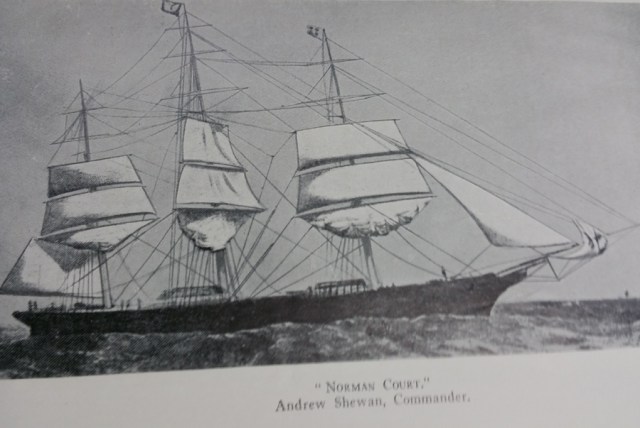
Norman Court

Here is another rendering of the “Norman Court” – it was supposed have been the second or third fastest clipper ship in world in her time.

The Norman Court, depicted above and at the beginning of this article, was one of the truly great clipper ships of the 1870s. Built in 1869 and first captained by Andrew’s father, Andrew Shewan, Sr., it soon came to be captained by Andrew himself. I have looked up the dimensions of this ship and it is quite imposing. She was 197 feet long, had a 33 foot beam and had net weight of 834 tons.

One of the reasons I am so fascinated by this story is the fact that I am importer by trade and I go to China and Korea once or twice a year. Hong Kong, Shanghai, the Pearl River delta, Canton (now known as Guangzhou) are all places that I regularly visit. Today, we import from China and Korea around 70 containers a year. I understand some of the many logistical problems of shipping goods from China today. I can only wonder and imagine what it must have been like to ship and transport goods in the days of clipper ships.

Knowing the length and beam of the ship that my great, great uncle sailed, I came up with some estimate of how many containers it might hold. I realize of course that there are many differences between loading a clipper ship with bulk cargo and loading containers on a modern container ships. A container can be placed on a container ship in 10 or 15 minutes, whereas a clipper ship had to load goods literally by hand. This was done by hundreds of “coolies” in China and hundreds of “stevedores” or “darkies” in Scotland or London. Please excuse my politically incorrect descriptions of the human beings involved – it is only to give you a feeling and perhaps a picture of the actual people who unloaded these goods.

Forgetting the differences of the two different methods of loading the two different kind of ships, I did a little calculation to get an idea of just how much stuff my great, great uncle shipped on a single trip in the Norman Court. I came up with the estimate that the Norman Court could hold the equivalent of 6 40′ containers. Now I realize that this estimate may be off because I do not know exactly the shape of the hold and I do not know the exact space taken by crew’s quarters and the captain’s deck house. In any case, 6 40′ containers is a lot of stuff. I know because we have a 24,000 square feet for our warehouse and if we take in more than 4 containers in a month we have real space problems. It takes us 4 to 6 hours to unload just one 40′ container. That is with 2 to 3 people, using a forklift.

It is also interesting to compare the times of unloading this amount of goods today and yesteryear. In the time of Andrew Shewan a clipper ship was unloaded in a day and half. If I compare this to our relatively mechanized process of loading unloading 6 40′ containers, we can do the same process in 3 to 4 days. There are, to be sure, some major differences. We are unloading goods directly from a 40′ by 8′ by 8′ steel box (called a container) parked at bay of our warehouse. In my grandfather’s time, he was unloading his 6 containers of goods directly out of the hull of a ship. This means, I presume, that goods had to be individually taken out by human beings. Presumably, these people had to carry the bales or boxes of these goods out through the hold of the ship, up to the deck. From there they most probably individually or collectively secured to a rope pulley and swung the goods over the deck and unto the dock. Each of these steps must have taken significant time, yet they they were able to unload the same amount of goods in less than half the time.

What could be the explanation of this strange fact? It really came down to two factors: 1) the huge number of people used to unload a ship in the 1860s and 1870s and the absolute critical importance of speed and time in the tea trade. When we unload a single container we use 2 to 3 men. When my great, great, great uncle unloaded the Norman Court, he used 200 to 300 men. The ship must have looked like an army of ants swarming over a very large fallen prey. Within 24 to 36 hours all the goods that could be unloaded from 6 containers were unloaded from the Norman Court. Of course, what made this possible was the number of people and the low cost of those people in relation to the high selling price of the goods being unloaded. The importance of speed and time in the tea trade was perhaps an even greater factor because the first teas to be unloaded always commanded the highest price.

The tea trade was essentially a race. A race to get to China in time to pick up the new season’s tea, a race to get back to London with the new season’s tea before other clipper ships. And since the quality of the tea was judged on the shortness of the travel (the shorter the trip the fresher and the better the tea), the price varied exponentially with the perceived value of the tea, with the first arrivals of tea always considered the best and always commanding the very highest prices.

For this reason clipper ships of the 1850s, 1860s, the 1870s were designed for speed and their ability to carry tea. The Norman Court was one of the very fastest clipper ships that the sailed in the tea trade. She held the second fastest time from Hong Kong to Aberdeen, Scotland, making the journey in just 93 days. Most journeys from China took 100 to 120 days, some took far longer. The risks taken during these trips were immense and total disaster was a frequent result. Many of these ships were lost at sea, foundered on rocks or reefs, captured by pirates, burned and scuttled, with the crew murdered in cold blood (for as my great, great, great uncle wrote, “Dead men tell no tales “).

You can say the tea trade of second half of the 1800s was somewhat similar to space travel in the second half of the 1900s. As in space travel of last 70 years, very few people actually took part in the trips and proportionally, those who did, experienced a high death rate. And as in space travel, the chances of death and disaster in sailing a clipper ship across the oceans was huge.

In the case of my ancestor and the Norman Court only 20 to 25 people sailed her on any given trip. I have seen a roster from my great, great uncle’s 1877 trip from New South Wales (i.e. Sydney, Australia). It lists 22 people, not including the captain, Andrew Shewan. Their ages range from 16 to 40, including a nephew, Alexander Shewan, who was 16 at the time. At the time of this trip, Andrew would have been 31. As you can see, sailing clipper ships was a younger man’s game.

So imagine 20 ro 25 people on one of the world’s fastest clipper ships, racing along at 15 to 18 knots (18 to 22 mph), in the China seas, in 1877, alone in ocean, except for an occasional sighting of another clipper ship with another 20 or 30 people. Admittedly, the risks were always there. Imagine sleeping only a few hours a day, which apparently the norm for a clipper ship captain, napping just one or two hours at a time, before being called on deck for the 19th appraisal of the ship’s situation of the day.

Imagine being at the helm of the Norman Court as you were racing along in a 40 or 50 mph gale. If it was a bright sunny day, and the seas were not too rough, it must have felt like you were one luckiest humans on the planet. Imagine you were the age of my great, great, great uncle, just 23, when he first captained the Norman Court from England to Hong Kong. You must have felt like the king of the sea.

Now imagine it is night and you are in a raging typhoon sailing through seas higher than you have ever seen, in waters that you not quite sure of. Is there land straight ahead? Are there reefs jutting out the sea in darkness? Are there unseen shoals that will run you aground and split your ship apart? In daylight will you find your ship swarming with pirates, who know the best policy and the best security is to steal all, murder all and burn all, except the valuables, because “dead mean tell no tales”?

Imagine finding yourself thrown from periods of ecstatic elation and high hopes to fear of imminent catastrophe and death, second to second, minute by minute, hour by hour, day by day, week by week, month by month. Imagine days and weeks of calm seas and fair weather. Imagine days and weeks of “dirty weather”, threat of pirates, wailing winds driving you onward, perhaps to rocks of doom.

Being a clipper ship captain must have been the most exciting and most terrifying job in the world.

Consider the following quotation from my ancestor Andrew.

“Though so staunch and tight, yet at times the whole fabric would tremble like a piece of whalebone. When we were driving her into a head sea. I have noted as I lay on the after lockers that after a heavy plunge as she recovered herself the after end would vibrate like a diving board when the pressure is released.”

I would imagine that this was not the best sensation in the world.

Well, I could probably write about my ancestor for many more pages, but I sense I am coming to the bearable limit. Let add a few points.

My great, great, great uncle wrote a 260 page book on “The Great Days of Sail”. He covered a great deal about the ships, the dangers faced, the excitement of the races, sea shanties, ship builders and other matters, but one thing is missing. That is what he was carrying in the Norman Court when he was going to China. Of course, he carried tea on the return from China and in some of the records it is said that he carried bales of cotton and lead from Manchester. But very little is said of what else he carried. There is some mention of rice, but it must be noted that Andrew Shewan went all over the Far East, visiting Japan, Korea, China, Singapore, Australia, India, Saigon, Bangkok and many other Far East locations.

So what was he carrying when he came to China? No doubt he did carry many legitimate cargoes, but it would be my guess that some times he was carrying opium. I do not say this lightly. I am talking about a direct ancestor. I do not wish to malign the gentleman. He was obviously one of the outstanding clipper ship captains of his time and that fact is mentioned by several other sailing books of the time. Nevertheless, in all the literature that I read I sense that there is more to be told and that there is something left unsaid.

We know as a matter of history that the principal commodity traded for tea during this period was opium. Actually, in reality, it worked a little differently. Clipper ship captains brought opium and traded opium for silver with other Chinese traders in Chinese ships. Then the clipper ship captains took the silver and traded it for tea, usually with the aid of an English trading company.

Now I also know that my great, great, great uncle was a prominent trader and shipper of tea. I know also that his brother, Robert Shewan, another relative, was the leading partner of a leading trading company called Shewan, Tomes & Co. I know also that the reason opium was used as a commodity of trade for tea was the simple fact that it bought more than other commodities. It would seem to be logical that my ancestor would use the effective commodity to trade for. Andrew was a principal owner of the ship, the Norman Court. He and Barings and Company were equal owners (both owned 16/64ths of the ship with some partners owning 8/64ths and others owning 4/64ths). I take this to mean my ancestor had an important say in exactly how things were done in the China trade for tea. At least, on the Norman Court.

Sailing Clipper Ships must have required great sailing skill, incredible stamina and great courage. It was a high stake game generally played by younger men. I will tell you the story of how Andrew Shewan came to be Captain of the Norman Court at the age of 23. He started on his first trips to China and the Far East when he just 16. He worked at that young age, first as a deck hand and then, after 3 or 4 years, the first mate on his father’s ship. The first trips father and son sailed on together were on the “Lammermuir” and “Chaa-Sze” clipper ships starting in 1960. In time, Andrew’s father became a partner and owner of the Norman Court with the Barings Company and other investors.

On the second trip out in the Norman Court, Andrew’s father began to feel very sick as they were coming through the English Channel. Father and son had  conference on what to do. Andrew’s father was convinced that he was dying. Father and son put into the nearest port which was Darthmouth. Once ashore Andrew’s father began to feel somewhat better, but still felt unable to sail to China. Andrew told his father that he could take the Norman Court to China. Andrew’s father then went on to London and discussed this idea with the Barings Company. 2 days later Andrew’s father returned with the agreement of the Barings Company and Andrew found himself master and captain of the Norman Court at the age of 23. Father and son parted company. Sadly, Andrew’s father was right – he was dying and Andrew was never to see his father again.

So, if you can imagine thoughts of the young man, in command at 23 of one of the fastest clipper ships in the world, sailing literally to China with a crew of 20 plus other “souls”, knowing that now as captain he was responsible for the ship, the cargo and lives of all on board. Imagine then that Andrew also knew that his father was dying and that he would probably never see his father again. Andrew must have been conflicted with exultation, guilt, hope, sadness and adventure.

The first trip to China as master of the Norman Court proved to be very tough. Coming out into the Atlantic from the English Channel he almost sunk the ship when a halyard got stuck and the wind turned the Norman Court around. Andrew found himself in the extremely dangerous position of first being side swiped by a raging sea and then almost immediately turned completely around sailing backwards. Apparently, a clipper ship, under certain circumstances could sail almost as fast backwards as forwards. This may sound rediculous, but it also was perilous because the stern the ship could swamp in the following sea, upend and literally sink. Fortunately, Andrew acted quickly and was able to get the halyard unstuck and to swing the boat around so it began to sail in the normal way with the bow forward.

This probably was a very embarrassing beginning for the young master and it almost ended his career as captain before it began. Apparently, the trip was beset by many other challenges and dangers, from severe squalls, raging lightning, dead calms and almost running a ground. Andrew only quizzically remarks that it always seems to be the first trip (as captain) is the most challanging. No matter, he made it to China and he brought back tea in one of best times of that year. The Baring Company and the other investors were extremely pleased with his performance. This triumph must have been thrilling and yet dampened by the knowledge that his father had died.

There are two things I would like to know about that I have no information on. One is what Andrew Shewan thought of the countries he was passing through – he speaks of visiting Australia, Nairu Island,  Indonesia, Vietnam, Hong Kong, Foochow, Shanghai and many other locations – and the other is what it really felt like to be at the helm of one of the fastest sailing ships on earth at a time when there were very few other ships crossing either the Atlantic and Pacific oceans.

In the absence of concrete information on these two matters, I can only speculate. And while it is pure speculation I think that my familiarity with trade and boating give me some idea of what Andrew Shewan’s thoughts might have been.

Regarding traveling to foreign countries starting at a very young age, I suspect it must have been a wonder and fascination to see other countries, meet other peoples and come to have some understanding of the greater outside world. I suspect he was both awed and in wonder of what he saw. And when he came home from his trips I suspect he tried to explain to others what he saw and he felt. And in the end, I think he found that those experiences and feelings were simply untranslatable. I think this because that is how I think of my foreign country trips whether they were to Europe or Asia.
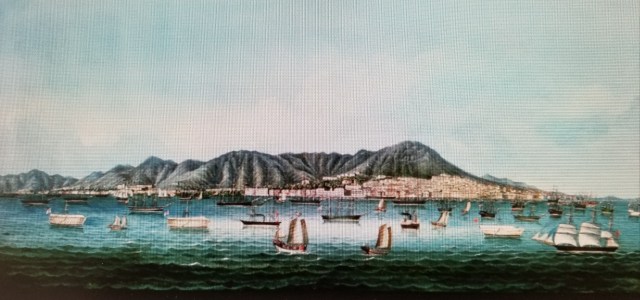
Here is an a picture of an old painting showing Hong Kong in the 1870s

How I would love to sit down with my ancient ancestor and share glass of some brown liquid and trade views, for example, of Hong Kong then and now. I have been to China more than twenty times and I have been to Hong Kong twelve or thirteen of those times. What would he make of the Hong Kong of today with its skyscrapers propelling themselves off of Victoria Peak? What would Andrew think of the Star Ferries, Hydrofoil Ferries, container ships, ocean liners, gambling ships, speedboats, great ocean yachts, ancient Chinese sailing junks, police boats and ancient Chinese motoring junks…all plying back and forth, up and down, in and out of the harbor of Hong Kong. What would he think of the giant bridges lurching across from island to island across the Pearl River, leading to highways taking you directly to mainland China? What would he think of Shanghia, Ningbo, Guangzhou?
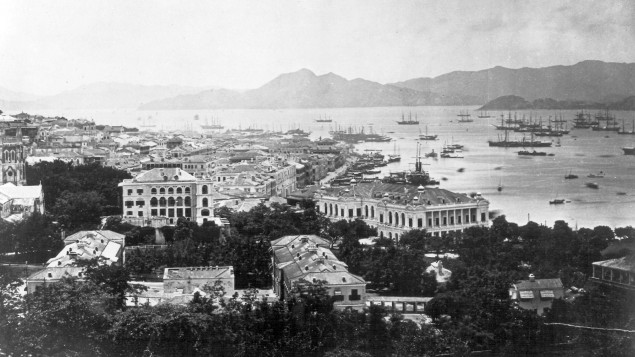
This is an actual photo of Hong Kong in 1870

I wonder what he would think of the yellow brown haze that hangs over those cities today like the gray polluted fog it is. I wonder what he would think if he sat in a restaurant on 37th floor of a new high rise building on Kowloon Island, sitting in a restaurant, eating sashimi and pasta in air conditioned splendor overlooking Hong Kong Island in the evening, with a fine wine or brown beverage while a laser light show emanated from the far larger skyscrapers on Hong Kong Island on a warm sultry Hong Kong evening?

What was Hong Kong like when he saw it just twenty or so years after the British appropriated it from the Chinese? What did it look like? I imagine the sky was blue and clear, the surrounding mountains and lands mostly wooded and virgin. I imagine a few imposing white and gray European style buildings with pillars in front near the harbor on Hong Kong Island with large white European style mansions for the rich traders of the town set up on the hill overlooking the harbor. I imagine large, sprawling ugly warehouses near the harbor’s edge.

I imagine a sea of masts and ships and boats of every style…stately clipper ships, a few far larger British warships, China junks of every size, new and old merchants vessels from all over the world. By the harbor there must have been a chaotic symphony of sights, smells and sounds. Chinese food stands selling fresh fish, live chickens, snakes, insects among a sea of peoples, rickshaws, wagons and carts loading and unloading cargoes, swarming over ships, cargoes picked up in nets from the decks of ships and swung onto the shore in elegant, haphazard arcs.

How many people lived there in the 1860s or 1870s – twenty or thirty thousand, I would guess. Maybe only three or four thousand were British and European. The rest would have come for all over the world, seamen and laborers from all seven continents, hustling and bustling, eating, drinking, working, sweating, singing shanties, Chinese merchants hawking goods, European tradesmen buying and selling goods and services, a sea of laborers and/seamen swarming over the clipper ships, elegant British and European ladies strolling the town or being transported in rickshaws, wealthy traders and townsmen dressed in long jackets, vests and tall hats.

It must have been a scene. What I would give to ask my great, great, great uncle Andrew about what it really was like. What did he do when he arrived after a three or four month journey from England or Scotland? Did he go and have bath in some elegant hotel of the time and then prepare for night on town. Did he stay on his ship, living in his captain’s quarters while his ship was docked in Hong Kong. Imagine arriving in Hong Kong in 1873 at the age of 23, after safely navigating half way around the world, after 110 days at sea, after passing through countless dangers, after delivering safely all the crew and all the cargo. Imagine stepping off on to one of the many the docks of Hong Kong Island, with all the sights, the smells and the sounds I have tried to describe. My guess is that my uncle Andrew would be ready for a few days’ shore leave. Ready to party may not quite capture the pent up energy he must have felt.
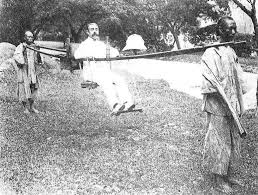
This was one way to get around in old Hong Kong

Yeah, I would have liked to have been there and just follow him around, watching what he did, where he went. I am sure he would have had a certain amount of business to transact. He would have to meet people, maybe catch up with his brother, discuss about when the new teas would be ready for pick up. You must remember, since the time across the oceans varied trip to trip, according weather and sea conditions met, he would have given himself one or two month’s leeway for planning contingencies. This probably meant that each time he came to some Chinese or Asian port he might have to be there for many days or weeks.

Somewhere during his stays, I bet he found time to several enjoy fine and exotic meals, Western and Asian, and, perhaps, a few congratulatory drinks. I suspect, then as now, the compensating fact of long and hard travel was a nice meal and pleasant company. I can hope it was so for my great, great, great uncle Andrew. And I would love the opportunity to trade stories, although asymmetry of the exchange might prove embarrassing. He, perhaps, would not be impressed with my travel travails of losing luggage or missing planes. I feel sure however that some of our experiences could be considered parallel – the experience of visiting a new city halfway around the world, the experience of dealing with different cultures and cuisines, the experience of having things change once you got there – I would guess there are indeed some similarities in what my uncle and myself do when traveling. I also sure that I might find profound differences philosophically, spiritually and physically between myself and my great, great, great uncle Andrew. Since a meeting does not seem imminent, I will worry about sorting that out when the occasion arises.

More than anything I would like to know from Andrew what it was like to be at helm of a fast clipper chipper ship knowing that you are one of a few hundred men who shared that experience. He would, no doubt, have had a lot to say about it. Maybe, he would not be eager to share his experiences, thinking it a private matter, not possible to be shared with others. Maybe, he would try to explain it all – giving me details of what it was like to sail through a typhoon, meet dangerous natives, be becalmed on flat ocean for days, drifting aimlessly, face down pirates who want to murder you for the cargo you are carrying, sail through thunder and lightning with massive waves drenching the whole length of the ship every two minutes.

I can say for sure he did things and saw things that very few did or saw. Those experiences must have been the most important of his life. He wrote a 260 page book about it and yet, after reading it, I feel as if I know only a very small portions of what his real experiences were. I wish I could know more about that man. He must have been some guy. I know he would have much he could tell me, but separation of time and space makes that impossible.

Posted in Uncategorized | 1 Comment

Sidney Cecile Cunningham Hoge

By Cecil Hoge

My grandmother was one of the most terrifying persons I ever knew. She was a large woman in every way. She was tall and in the years I knew her, thickset, but not fat. She was an imposing woman with very strong opinions which she was more than happy to share with anyone within sound of her voice. She was thought to be a beautiful woman in her day. She was a Louisiana Belle and it may be in her youth what constituted beauty was somewhat different than what it is today. To me she was a large scary woman who loved me very much.

I was her oldest grandson and she was most concerned that I be brought up correctly and become an upstanding young man. She had some reason to be concerned. My father’s marriage to my mother had not gone well. They divorced by the time I was eight and for many years I attended private boarding schools and saw little of either my father or mother. When I would come home it was under the guardianship of my father.

My grandmother took it upon herself to complete my education. This started very early and whether it was helping me put together an erector set or learn my catechism or give me advice about not going too far with girls, she was always there through the years to give me stern and depressing advice.

Duty, she told me, was the most important thing. When I asked her duty to what, she gave an answer I did not like. Duty, it seemed, was something you gave to everything and anything but yourself. Being young and yes, I admit it, self-centered, this duty thing did not sound like much fun. Apparently, you were supposed to do things you didn’t like just to obey your parents. You had to sacrifice the things you liked to do and do things you didn’t like for other people.

Duty included going to war for your country when you had just got married to your young and beautiful wife – I was too young to have to worry about this and I did not even have a beautiful girlfriend. Duty included giving all your earnings to your father, mother, grandfather and grandmother when they might not have enough – fortunately, I had no earnings to give. Worst of all, duty included going to Church with my grandmother – alas this was something I could not escape.

So from the age of eight to about the age of eighteen my grandmother dragged me off to the local Catholic Church, for my grandmother was Catholic. This happened sometimes in New York City and sometimes in Southampton. At the time, the Catholic Church favored Latin on the premise that it was better to use a lost language that sounded mysterious and impressive than use a current language that the Church goers might understand and question.

In attending the Catholic Church it was also an important part of my duty to have communion. This is in turn meant that in order to go to communion, I had to first purify myself by having confession. My grandmother gave me long and elaborate instructions on the duty of going to confession. It was, to put it mildly, tough duty. First and foremost, you had to go into the confessional and face the priest, who, as most people know, was happily able to hide behind a screen while you outlined your list of offenses. It always seemed a one-way process to me, this duty of confession.

Worst of all, you had to tell the truth. My grandmother was quite specific on this point. You had to tell the priest everything. If you kissed a girl on the mouth, you had to tell. If you had an impure thought, you had to tell. If you did something impure under sheets in the dark, you had to tell. If you wanted to get back at someone and you hated them for something, you had to tell.

The worst part was fessing up to the priest. It was a big relief when you left the confessional feeling pure and contrite. Then you could go to get your wafer, feeling good about yourself.

I have to admit that my grandmother was a good person at heart and she taught me many useful lessons, which though I hated, I respected after having followed through on her advice.

My grandmother taught me many things about life.

“Do not worry about someone being richer than you,” she would say, “there will always be people richer than you.”

Boy, was she right about that one.

When Sidney Cecile brought up her children, she did everything within her power to see that they had every opportunity. She had come North as Louisiana bride with new husband, Huber Hoge, to live in New York and make a suitable home for her children to be. This meant to her, to know the right families, to join the right clubs, to take her children to church. As time passed, her sons lost their enthusiasm for going to church, so she turned her attention to me. In a way, my grandmother, Sidney Cecile, became a big scary surrogate of a mother.

Sidney Cecile, as I have mentioned, was a lady of strong opinions. Coming from the South, her view of the Civil War and the role of black people was not, to say the minimum, politically correct. Her sense of family and upbringing would seem foreign and in some ways, quite ignorant. About her upbringing as young girl, she would say.

“Father was Attorney General, don’t you know.”

Her voice was high and lilting and she used the phrase “don’t you know” a lot.

“We lived on a plantation. We had 100 colored folks to tend it. It was 5000 acres, don’t you know.”

At look of sadness would cross her face.

“Everybody said he was up for Governor, and he would have been if it had not been for that other woman,” a stern and unsettled look passed over her face, “it was just so unfair. He would have been Governor, but then the newspapers reported about father seeing that other woman. I know it was not his fault. It was her. Mother was truly broken-hearted. She took father back, of course, but it just wasn’t the same. I declare life is sometimes just so unfair, don’t you know.

“Father never did make Governor. Everybody said it was his. Anyway, daddy came back to his practice, but he just could not make the plantation make money. We had to cut back on the colored folks we had.”

“It was just so unfair. Why they found oil on every other plantation around Father’s. Why they found gushers of it just a few hundred acres to right of our house and just few hundred acres to left. They all found oil, but not Daddy. I declare it was just so unfair.”

My grandmother, who held duty and family honor in the highest esteem, also was a hopeless bigot. I do not blame her. She came from a different time and culture, growing up as a young child in Louisiana in the late 1800s. The Civil War was a vivid memory that she and many of her relatives remembered. No doubt her ideas were formed by the recollections and reminiscences of her early childhood.

“The colored men,” she would say in her lilting, high Southern voice, “are savages, but the colored women make fine maid-servants.”

How’s that for a politically incorrect statement. Yes, she was prejudiced, but strangely she bore great love to the very people she maligned.

This is a picture of Mammi, the lady my Grandmother from the age of 4 on

This is a picture of Mammi, the lady who brought my grandmother up from the age of 4

“I was brought up by my Mammi,” my grandmother would say, “She was a wonderful strong woman. She nursed me as a child and she taught to become a woman. She had a fine heart and she was the strongest, wisest woman I ever met. When father went off with that other woman, I cried in her arms for hours.”

“Don’t you fret child,” my Mammi said, “he’ll be back. Sometimes the menfolks got to go away for a time, but they always come back. They needs us womens.”

“That’s what Mammi said and Mammi was right,” my grandmother went on to say, “Father did come back, but it was just not same…mother never forgave father and father lost his chance to be Governor, don’t you know.”

My grandmother never forgot the fact that her father never made governor of Louisiana. She never forgot that they never discovered oil on her plantation. They were two of the great injustices of her life.

She also never forgot that her sons were never able to keep her in the style she thought should be hers.

“If I knew that I’d end my life without a lot of money and lot of maid servants, I doubt I would have married your grandfather. He had such good prospects. I left everything I knew to go with him. And he did so well in the beginning. We had such a good life together, with kids growing up and a new boy every one or two years. And his business was just doing fine. We lived in nice apartments and nice houses. In the winter we lived in the city, in the summer we went to the mountains or the Hamptons – we had such a time deciding which was better. In the mountains the air was wonderful, but in the Hamptons you had the wonderful ocean. For many years, we just couldn’t decide. Finally, we settled on the Hamptons. Life was going so well, don’t you know.”

“But that’s the way life is, just when you think everything is going just fine, something happens to slap you down, don’t you know. It was then that dreadful depression came. Why all the money just disappeared.”

“And what you don’t know is the happiest years for you and your family are the last years of your parents.”

And while my grandmother felt that she should have ended her life as an heiress, she still spent all her living and waking hours trying to figure how to improve her children’s and grandchildren’s lives. This ultimately ended in me listing myself in the New York Social Register. As a college graduate I did not think that there was much point or importance in being listed in the New York Social Register. But my grandmother insisted it was an essential of life and she nearly wrote the check out for me.

My grandmother grew up in an era when people were transported by carriages pulled by horses. She grew up in a time when people had to get up in middle of the night and go outside to what my grandmother called “that smelly little house.” She was raised by people, black and white, whose memories were seared by wrenching changes and burning memories brought forth by the Civil War. She ended up living through the 1880s, 1890s, World War I, The Great Depression, World War II, the 1950s and some of the 1960s. She saw her four sons and daughter grow up, get married and have children. She managed through it all to be mother, grandmother, matriarch, social battleship, ignorant, intelligent, loving, spiteful, driven, honor bound, duty bound, conflicted, confused and totally focused. In short, she was our family center for most of the 84 years she lived.

Posted in Uncategorized | Leave a comment

Grandpa Gets Busted

This an old picture of mygrandfather'sa boat, The Edwina"

One of my grandfather’s boats, “The Edwina”

By Cecil Hoge

While trying to clean up my basement, I came across a crate containing a bunch of musty old photographs and newspaper clippings. It took some rummaging through it until I realized that these must have been pictures and clippings that my mother had collected and preserved over many years. Most of the pictures and clippings were familiar, but one small article caught my attention and made me realize just how colorful my grandfather must have been.

Edwina

Grandpa with drink in hand.

My grandfather was a bit of a drinking man. Well, maybe more than a bit. It was said that you could tell the time of day by the level of the bottle of whiskey behind his desk. My grandfather was also an immensely rich man for his time.

In the first World War, he owned Shewan Shipyards. In addition to building battleships, tugboats, Merchant Marine boats and destroyers, Shewan Shipyards did the repairs for the Atlantic Fleet. It was a good job for my grandfather, Edwin Shewan – “Pops”, as he was known to his daughters, was paid well. In 1929 he sold his business to Bethlehem Steel for $15,000,000. Since this was in a period of almost no income taxes, this was roughly the equivalent of one billion dollars in today’s money.

Being a rich man, my grandfather had many of the accouterments of a rich man. He was married to one of the most beautiful women of the day. He had five houses…one in New York, one in Rye, one in Phoenix, one in Southampton and one in Paris. Last, but not least, like many rich men of his day and of this day, he owned, at one time or another, five separate yachts.

Shewan

This was originally the Southampton summer house of my great, grandfather, James Shewan, the founder of Shewan Shipyards. My grandfather, Edwin Shewan, inherited from his father. This colored picture was probably taken and rendered around 1908.

Life was good to my grandfather and his immediate family. They spent the 1920s cruising back and forth across the Atlantic, dividing their time between their five houses and luxury resorts in the Caribbean and Europe. Summer would find them in Southampton or on the Riviera, fall could bring them to New York or Paris, Winter might be in New York or Phoenix, Spring it was back to Paris or New York.

During the 20’s, my grandfather kept up his drinking, his cruising around the world and his fondness for the high life.

“Pop was Scotch,” was my mother’s explanation of my grandfather’s great appreciation of that beverage. In fact, my grandfather was Scottish, but my mother felt that Scotch was a clearer definition.

I bet this fish was sorry he tried to eat my mother

I bet this fish was sorry he tried to eat my mother!

My grandfather had an interesting way of approaching his duties as a father. When his daughters needed to learn to swim, he stationed a man with a rifle on his 110 foot yacht and threw his two daughters into the sea below. Two other men were stationed in a nearby lifeboat with strict instructions to pick up his daughters if they started to sink or some danger approached. The gentleman with the rifle had strict instructions to shoot any approaching sharks.

However unconventional this system was, it worked. Both my mother and my aunt were Olympic class swimmers. Apparently, fear of sharks is a great aid to learning to swim fast.

When the great crash came in 1929, my grandfather decided that he, his two daughters and his beautiful wife should remove themselves from the unpleasantness in the States and live in his Paris house. To take care of my mother and her sister, my grandfather hired a French Mademoiselle to teach them all things French. This gave my mother flawless French, a great love of Artichokes and a fondness for red wine. My grandfather stuck with his Scotch.

My grandfather, in spite of his large wealth for that day, had been hurt by the crash of stock market, losing over 50 percent of the monies he had accumulated in owning and operating Shewan Shipyards. This situation was worsened by my grandfather’s insistence on not changing his lifestyle one iota and trying to compete in the purchase of antiquities with William Randolf Hearst. My grandfather’s lifelong envy of William Randolph Hearst best expressed itself in his insistence in trying to outbid Mr. Hearst at every art auction that the two gentlemen attended. This was particularly unfortunate because Mr. Hearst was considerably wealthier.

My mother wrote on this picture "Pop with my Pet"

My mother wrote on this picture “Pop + my Pet”

Be that as it may, my grandfather continued his high life unabated, acquiring many beautiful artifacts from his competitions with Mr. Hearst, spending his fortune as he went.

Around this time, a new development arose. That was called Prohibition. You can imagine the fear and animal spirits that this new situation created. For a drinking man used to his cup being full, the coming of Prohibition must have aroused fear, loathing and not a little sense of adventure.

Given my grandfather’s eclectic approach to teaching swimming, it is probably not surprising that he would approach the problem of Prohibition with the same dramatic flair. After all, he had at his disposal some ways of dealing with this problem that were not available to the common man. Having spent all his life working his way up from one luxury yacht to another, going from 60 feet to 70 feet and increasing every 5 or 10 years another 10 feet or so. This left him in possession of his latest and his most magnificent yacht called “Edwina” – 110 foot beauty that took up quite a bit of real estate in Sag Harbor every summer.

I am not sure just how much whiskey a 110 foot yacht can carry, but my guess is quite a lot. My explanation of my grandfather’s mindset is that he must have been quite concerned about this Prohibition thing. How else is one to explain my grandfather’s later actions?

As mentioned at the beginning of this story, I found out about my grandfather’s incident when I was rummaging through some old newspaper clippings that my mother had saved. One article was quite clear on what had happened.

1370 CASES OF LIQUOR TAKEN OFF SHELTER ISLAND (By United Press, Special to Daily News.)

The article went on to describe the action.

“Sag Harbor, NY., May 18, 1931. – United States custom officials raided the palatial yacht “Edwina” here today, seizing 1,370 cases of whiskey, valued at $120,000.
The yacht was released by orders of the Internal Revenue Agents. It was stated by Edwin Shewan, who was in command, that the yacht was under British registry and exempt from American seizure.”

All of this was quite a surprise to me. It seems my grandfather was a felon, involved in the desperate occupation of smuggling. Since this is the sole printed evidence, I really do not know what the outcome of his run-in with the Feds was. Coming on this story almost 100 years after the fact, a bunch of questions come to mind. Did he go to jail? Did he beat the rap? Did his alibi work? Did he get to keep the booze? If so, did he get to drink the evidence? These were some of the questions this small article brought to mind.

PastedGraphic-3

Here is a picture of a painting of my Grandpa with my Mom

I don’t know the answer to any of the above questions. Both my mother and aunt, my grandfather’s only two daughters, have passed away and I do not know any other living relatives who might know the answer to these pressing questions, but I do remember my aunt mentioning this incident in passing.

“Pops got busted,” she said, “He was testing the goods when the Feds came on board.”

My aunt thought this run-in was quite amusing. Unfortunately, I don’t remember her giving more details. So with only this to go on, I would like write down what I think might have happened.

I imagine my grandfather standing on deck majestically with a drink in his hand (Scotch, I am sure) on his latest and most palatial yacht, “Edwina”, swaying slightly side to side. I am thinking that the “Edwina” was my grandfather’s gift to himself after a nasty divorce that winter. How else to explain my grandfather’s lapse into crime?

I imagine the scene. One rifleman is stationed the deck of the yacht, a high powered rifle trained on the water. Down below my mother and aunt are splashing in Gardiner’s Bay, no doubt screaming that the water is damned cold . Two seamen are stationed in Edwina’s lifeboat, ready to rescue my mother and aunt.

No doubt they are more than little miffed.

“It’s damned cold,” my mother is saying – she used the word “damned” a hell of lot. And other words besides, but that’s another story.

I am sure that my grandfather was not nearly as concerned as his daughters.

“Nonsense, my dears, it’s already the middle of May. Pretty soon you will be complaining about the heat. There’s no satisfying you two.”

Just then I imagine the sound coming from a loud bullhorn being spoken through,

“Rifleman drop your rifle. Edwina prepare to be boarded by U.S Custom agents.”

The rifleman, knowing which side of his bread is buttered, would have immediately thrown down his rifle and raised his arms, preventing the possibility of a more unfortunate confrontation.

I am pretty sure that my mother and aunt would have taken this as a blessing in disguise and a wonderful opportunity to climb hastily into the nearby lifeboat. The two seamen would no doubt do their part and eagerly help the two beautiful young ladies clamor into the lifeboat.

Only my grandfather would have been taken by surprise, no doubt trying to figure out what he should save first – his two beautiful daughters or his 1370 cases of whiskey or the remaining whiskey in his glass. My guess is that he recovered his composure pretty quickly, seeing that his two beautiful daughters were being pulled to safety by two very eager seaman.

And so, I think Captain Shewan, donned his Captain’s hat, drained his whiskey glass, threw it overboard with an authoritative flourish and then turned to face the speeding runabout pulling up deck side.

“Gentlemen, are you aware that this ship is of British registry?” my grandfather would have boomed.

The strength of my grandfather’s voice must have been impressive and surely the whiskey gave it extra power. I imagine the custom agents being impressed with the authority of his voice, although they may have been curious about the fact that my grandfather’s words were slightly slurred.

I suspect that the next thing to happen was that the custom agents boarded the ship and began an inspection that shortly revealed the 1370 cases of whiskey.

As I have said, I do not know if the custom agents bought the British registry story. I suspect that custom agents got to keep the whiskey, my mother and aunt got to change their clothes and that my grandfather ended up going into Sag Harbor after having a face to face chat with the local authorities. And after my grandfather’s lawyer showed up, I am guessing my grandfather got a get out jail card and went off to console himself in a local Speakeasy with a magnificent “I Got Out Of Jail” dinner and after party.

At least, that’s the way I hoped it ended.

Posted in Uncategorized | Leave a comment