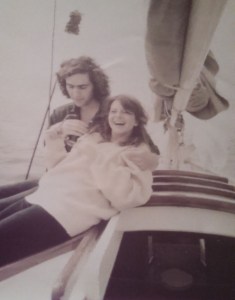
Chris and Svetlana Finally Tie The Knot

Chris and Svetlana in the early days

Chris and Svetlana in the early days

By Cecil Hoge

After both graduating from college, my cousin Chris and I started working in my father’s business. In an effort to pool resources, we decided to rent a house together. The year was 1970. I was beginning my career in my father’s business while my cousin was looking to have something to do so he could think about what he really wanted to do. For several months, we shared a little house on Lake Panamoka in Wading River and worked together in my father’s business.

As the summer was coming to its conclusion, Chris decided that he wanted to become a lawyer. Chris enrolled in American University Law School in Washington, D.C. This left me in full possession of the house on Lake Panamoka and Chris on his way to the nation’s capital.

Chris had been accepted to law school and he had lined up a job in the university bookstore. The only thing he had neglected to do was line up a place to stay. No matter, Chris drove down to Washington and ended up camping out the first night in a nearby park.

Being a responsible worker, Chris showed up at the bookstore for work the next morning. During his first day of work, Chris talked to one of his fellow workers, a happy-go-lucky Hippie stoner who had just graduated from The American University, and explained his problem.

“No problem man, you can crash with us until you sort some things out.” was the response from the Hippie Stoner.

Us turned out to be four stoner guys and one stoner girl and the house turned out to be a funky place with 5 bedrooms and a large backyard suitable for barbecues. Chris decided this was the perfect place for a law student, made a deal to share the rent and that was his home for the next year.

Although I did not find out about all this until many years later, it turned out that Chris’s future wife worked in the same bookstore. He was in the law book section and she was in the literature section. The way that they met is the stuff of legend. Chris was rolling along a cart of heavy law books and his wife to be was standing on a stepladder, trying to put a book away. Chris, not paying too much attention, crashed into the stepladder and knocked his future wife off. Almost instantly thereafter, the heavy books from his cart, which had been stacked haphazardly, one on top of the other, proceeded to cover Svetlana.

Chris was sufficiently concerned to ask about her health and say he was sorry. Svetlana, for that was the lady’s name, told me many years later, that she looked up and saw Chris’s long hair and green eyes, was knocked out by Chris literally and figuratively. And while she was in considerable pain from the heavy law books, Chris’s face, appearing as it did, immediately brought her around. It was love at first crush. Chris was too shy to take the conversation further, but after a few weeks of bumping into to his wife to be, he asked the pretty Romanian lady to go to a movie. That led to going to dinner at Chadwick’s the same evening and the rest as they say is history.

I did not hear much from Chris, except at occasional family gatherings during Thanksgiving or Christmas or during the summer in Southampton, I had little information about what Chris was doing. When I did see Chris he told me that his studies were advancing quite well, thank you, and, oh, by the way, there is this girl I met.

That was about all the information he gave me about his studies and his new girl. At a couple of later family gatherings, I found out that he and this new girl had been dating for almost a year and it was getting serious. Having known Chris all my life and having known some of his former girlfriends, I knew that “getting serious” could mean he was momentarily in love with his latest fling or it could mean something actually serious.

The first time I met Svetlana was when she and Chris came down to my college buddy’s house on the Rappahannock River in Eastern Virginia. I was there with a group of people to photograph some of the new inflatable boats that we had just started selling. The team consisted of my cousin Cecile Havemeyer, Freddy Havemeyer, her new husband and our new photographer, my buddy Rich Miller and myself. Chris was down for moral support, some part-time model work and to introduce me to his new girl, Svetlana. To give our party a little added luster, Svetlana brought along a beautiful married girlfriend, whose husband worked at the UN and who was not supposed to be there.

I quickly learned that Svetlana Bogdan (that was her full name) was Romanian. She talked in long run on sentences, in a Romanian, Slavic accent, each sentence mutating into some additional observations and comments about the previous sentence. Like a train coming out of the station, once the words began to flow, they kept coming and gathered speed as they went. Her sentences could cover a lot of distance in paragraph, touching on music, Romanian history, how much she loved Chris, mini dress fashions and observations of the decadent West.

In that muddled gathering it was probably not the easiest time to get a solid impression of somebody, but I could grasp a couple of things. She was extremely smart, very sharp in her words, very pretty in appearance, full of energy, young and completely in love with Chris. She seemed to be half the height Chris, who stands a good 6′ 2″. In truth, she was probably a little shorter than some American ladies, about 5′ 3″. As she said somewhat later, “There is a foot between us” and I guess that was about right. So, she was not so short. It was just the contrast between her and Chris that made them stand out as a couple.

At the same time I could see something was really going on with Chris and this was “serious”. This impression was aided and abetted by Chris taking me to the side and saying, “This is serious. I really love this girl.” Again and again, he came over and repeated those words. I got the message and I was immediately taken and intrigued by Svetlana.

It turned out that Svetlana had quite a history and quite a background. For one thing she was the step-daughter of the Romanian ambassador to the United States. His name was Corneliu Bogdan. And apparently he was a very good Ambassador. Time Magazine had done a lead story on the four most respected ambassadors working in Washington and Corneliu was one of the four and, according to Time, these particular ambassadors were really good at their jobs. Two of the three other diplomats cited in the article were Yitzhak Rabin and Anatoly Dobrynin, so Svetlana’s step-father was in pretty impressive company.

I should note that the Communist Party in Romania had a policy that Romanian citizens were not supposed to fraternize with foreigners. Decadent Americans were on the top of the forbidden to form friendships with, forbidden to have relationships with list. This was especially true if you happened to be the step-daughter of the Romanian Ambassador to the United States.

Showing up in Virginia with her new American boyfriend was probably not very clever, for Svetlana was supposed to be studying at a friend’s house. Coming with a Romanian girlfriend (a very tall, dark beautiful lady by the name of Victoria), whose husband was in New York when she was supposed to be with Svetlana in Washington was also risky.

Svetlana’s day in, day out cover was that she was at the library to study. She used this cover for the whole first year of her relationship with Chris. She would be driven daily by a driver from the Romanian embassy who dropped her off at The American University. I am sure that she found some time to study because she successfully completed her degree, but most of the time she really was with Chris. As Svetlana said, the driver was not going to wait around 5 or 6 hours for her to come out of school library, so she always told him she had a friend who would give her a ride back. That worked for almost a year.

In the case of coming down to Virginia for an extended weekend to visit young and degenerate Americans, I am not sure what cover she used. Whatever it was, it was not improved by bringing a high level, beautiful, fully married Romanian girlfriend named Victoria along, especially since Victoria had told her husband that she would be in Washington for the week.

That weekend I got to know Svetlana fairly well and I was immediately intrigued by her obvious high intelligence, her good looks and her strange and exotic Slavic accent. But I had work to do. So during the day we would foray out to take pictures, scout locations and get them “in the can”. In the evenings we spent many hours playing Yatzee, drinking vast quantities of beer and enjoying some of the other fads of the time. Svetlana says she was most impressed when all of us sat down and listened to a recording of Aida by Giuseppe Verdi, which my college buddy Rich happened to have. I vaguely remember that but it seemed to me more often we listened to Exile on Main Street by The Rolling Stones.

On the way back to Washington, Chris, Svetlana and Victoria were cruising along in a blue beetle Volkswagen of the period when they were pulled over by the police. I heard about this later. Apparently there were some extremely concerned and paranoid moments when the girls thought the Romanian Securitate (perhaps in league with the Virginia State Highway Patrol) was after them, but Chris told them to keep their Romanian mouths shut, talked to the cop in question and the event passed as quickly as it arose. All’s well that ends well. So the girls got back to DC, their stories intact, with no major hiccups, no major political crisis.

The romance between Chris and Svetlana was fraught with intrigue and deceit. They had to be very careful to keep their stories straight. It seemed that it was not easy to be the step-daughter of a Romanian ambassador and it was difficult for my cousin Chris to figure out what was the right way to handle his relationship with Svetlana. Chris seemed sure of one thing – he was in love with Svetlana. How that would work out was a whole other question.

In the summer of 1972, Svetlana was told by the Romanian government that she could not continue to study for a master’s degree and had to go back. This was because Romanian citizens could only stay in a foreign country for so long and then they were required to return. Remember, it was strictly forbidden that a relative of a Communist party member of the Romanian government should fraternize or consider marrying a foreigner, especially an American from the land of capitalism.

The saga that was Chris and Svetlana’s relationship went on for the next five years without any clear conclusion. For a while, it simply looked like it would dead-end. Svetlana was back in Romania and Chris was in law school. That was that.

Chris told me that he wanted to marry Svetlana, but that seemed impossible since it was strictly forbidden. In June of 1973, Chris took the bull by the horns and took a trip to Romania to meet with Svetlana. By this time, Svetlana’s parents, Corneliu and Emelia, were aware of the relationship and while it greatly complicated Corneliu’s political life, both of Svetlana’s parents felt that they should get married if they really wanted to. Helping things was the fact that Chris’s own parents, Francis and Helene, supported Chris in his effort to get married.

At that time (many years before the 1989 Romanian revolution) there was something called the State Council, and if a Romanian citizen wanted to get married to a foreigner, he or she had to apply to the State Council to get permission. Unfortunately, the State Council would not give permission because Svetlana was the step-daughter to the Romanian ambassador to the U.S. and because they did not want to break their long standing policy.

One of the problems facing Chris and Svetlana is the fact that if they had married in the U.S., as Chris had proposed to do before Svetlana’s departure to Romania in 1972, that would have ruined her step-father’s career and placed her family in jeopardy. This was something Svetlana definitely did not want to do, since she loved Corneliu and her family. So just running off and getting married was not an option.

So, in the summer of 1973, Chris came to Romania to see Svetlana in Bucharest. Shortly thereafter they went off to the Black Sea to enjoy a holiday resort and resume their romance. After three weeks, Chris went back to the U.S., his love reignited, but his future still in limbo.

Chris and Svetlana kept in touch, but nothing much happened other than Chris knew he loved and missed Svetlana. In the fall of 1973 Svetlana told Chris that she was pregnant, which was not something they had planned, but something that added to the urgency of getting back together. At that time Svetlana also filed the marriage application required by the State Council.

One day in March of 1974, Chris drove out with some of his law school buddies to visit his father Francis in Tuscon, Arizona where his father had set up a new business. It was a hard drive out and a hard drive back and when Chris got back to Washington on March 17th, there was a message waiting for him.

“Congratulations, you father. Have daughter.”

Chris, Svetlana and Alexandra in Bucharest circa 1975

Chris, Svetlana and Alexandra in Bucharest circa 1975

The message – short and to the point – had come from a family friend who did not speak very good English. That information changed the facts on the ground, but really did not improve the status of Chris’s situation. He was still unable to get married because the Romanian government would not grant permission in this particular case. The Romanian government sent Svetlana repeated notices by the mail telling her that her application for marriage had been refused.

All of this could well have ended tragically for another couple, but not so with Chris and Svetlana. Chris contacted a bunch of different Congressmen and Senator’s offices, including “Scoop” Jackson and Jacob Javits, asking them to write letters and plead his case. In fact, “Scoop” Jackson did write a strong letter on his behalf. This proved insufficient to move the needle, but it did lay the groundwork for further action. The American Embassy in Bucharest was also very supportive and kept making frequent inquiries about the status of the marriage application.

Chris then enlisted the aid of his sister’s husband at the time, Philip Marvel. Philip came from a very well-connected Boston family and Philip’s father made an appeal to Ted Kennedy. Others also became involved in the effort to help Chris and Svetlana and their new daughter become a family. They were some professors and former classmates of Svetlana from The American University who tried to help Chris and Svetlana in their effort to get married.

In the meantime, the case of my cousin trying to marry the step-daughter to the Romanian ambassador became well-known in Romania and Chris and Svetlana became a “Cause Celebre” with many Romanian citizens in favor of the marriage, but also with a careful scrutiny of Svetlana by the Romanian “Securitate” (State Security).

You could say that there were a number of elements working together that finally allowed Chris and Svetlana to get married. Chris heard from someone in the State Department that the renewal of the Most Favored Nation Clause was coming up for Eastern Europe and Romania, in particular, and that Ted Kennedy was the Chairman of the Committee reviewing that legislation. Chris went to an aide of Ted Kennedy and explained his situation to the aide. That aide went to Senator Kennedy, explained the situation, and Ted Kennedy said that he would like to speak to Chris directly and to set up a meeting.

Chris, thinking that Senator Keennedy could come to their aid, was naturally excited by this and so he called Svetlana in July of 1977. He told Svetlana that he had spoken to Ted Kennedy’s aide and that the aide had spoken to Ted Kennedy who requested a meeting to be set up. Chris told Svetlana that he thought this could be important because the Most Favored Nation Clause was being reviewed by Ted Kennedy’s office and maybe Ted Kennedy could use Romania’s interest in having that legislation renewed to persuade the Romanian government to allow Chris and Svetlana to get married.

Now here comes the strange part. Just two hours after Chris talked to Svetlana, Svetlana got a strange, but wonderful call from a Romanian government official. The official on the phone said that the Romanian Government had decided to grant permission for the marraige and that Svetlana and her daughter had to leave the country within two weeks and that they were not to bring any papers or books with them to the United States.

Immediately after telling Svetlana that she could leave the country with her daughter and get married, the official went on to say, by the way, please be sure to tell your husband-to-be, Chris, that he no longer needs to go to the meeting with Senator Kennedy because permission for the marraige has been granted. The official repeated this point a couple of times to be sure Svetlana would tell Chris that a meeting with Ted Kennedy was no longer necessary.

It would seem that the Romanian Government had been listening in on Chris’s call to Svetlana and after hearing that Ted Kennedy might get involved, went to a higher officer and reported that, who in turn, went to a higher official. Apparently, the wheels of government can move rapidly in Romania when it wants to or when it thinks it is in its interest. So two and half hours after Chris had spoken to Svetlana, the Romanian Government gave permission for Svetlana and her daughter to come to the U.S. and get married with Chris. It was a quick and anti-climatic ending to a seven year struggle.

Chris and Leila, his grandchild

Chris and Leila, his grandchild

In the end, love did conquer all and later in the summer of 1977, Chris and Svetlana did get married. The ending was truly happy. They ended up living in DC, the capital city for lawyers in love. The daughter that Chris was told about in March of 1974, Alexandra, is now married and has her own child, Leila. So, we can truly say Chris and Svetlana and their daughter lived happily ever after.

Chris, Svetlana, Alexander, Jeremy and Leila

Leila, Chris, Svetlana, Alexandra and Alexandra’s husband, Jeremy

An important aside occurred a decade after Chris and Svetlana got married. It was a particularly frantic period for Corneliu, Svetlana’s step-father. In the last year of Nicolae Ceausescu, Corneliu had been put on a black list of non-favored party members, and was also placed under house arrest.

During the Revolution of December 1989, which ended with the execution of Nicolae Ceausescu and his wife on Christmas Day, Corneliu was offered the position of Secretary of Foreign Affairs. Svetlana’s step-father instead opted for the position of Deputy Secretary, leaving the higher position to one of the younger diplomats. In the harsh winter of 1990, Corneliu was working ceaselessly to redefine diplomatic relations between the “new” Romania to the U.S. and Canada, which were his departments in the Ministry of Foreign Affairs. Corneliu also worked to expand economic, trade, and cultural ties between Romania and other countries. Sadly, he died of a heart attack shortly after the Revolution, at a time when things were still very chaotic in Romania. Members of the former Securitate and some military personnel loyal to Ceausescu were fighting against the new regime. Unlike the turnovers in other former Communist countries, the Romanian Revolution was bloody and confused. It is interesting to note that Corneliu’s wife and others believe that the circumstances of his death were suspicious.

After Corneliu’s death, Svetlana’s mother, Emelia, Svetlana’s sister, Ileana, Illeana’s husband, Dov, and their daughter, Ioana, emigrated and moved to Washington, DC and stayed with Chris and Svetlana for a number of years. So you could say that Chris not only gained a wife and a daughter, he also gained a whole Romanian family.


Posted in Uncategorized | Leave a comment

Life or Death Moments

This was not one of them

This was not one of them

By Cecil Hoge

I suppose everybody has some life or death experiences. I can identify several myself. Two of these events I can say were clearly my fault. Two I would say were not.

When I was about 19 my parents bought a second car, a classic Volkswagon bug, and assigned it to me. To celebrate I drove that little car that very evening to a friend’s house and proceeded to have as many drinks as I could within a four hour spell. The results were not good. I drove home zigzagging my way from Old Brookville on the North Shore of Long Island to Setauket, also on the North Shore of Long Island. Fortunately or unfortunately, depending on your viewpoint, I stuck to less traveled roads and did not go too fast. So while my driving was clearly erratic, it was at least relatively slow and no one noticed or stopped me.

I say fortunately or unfortunately, depending on your point of view, because if I had stuck to more traveled roads, I would probably have been pulled over and arrested for drunk driving and that Volkswagon might be in service today. You could say that was fortunate or unfortunate, again depending on your point of view. Certainly, I probably would not have broken my collarbone or split the Volkswagon in half, but then, again, I did avoid arrest.

I suppose speculating on events that did not happen is something of a waste of time, although I think all people do wonder what would have happened if some events turned out differently. In any case, I was not pulled over and arrested. What happened was that I was wending my way happily for almost 30 miles until I came to an infamous series of hairpin turns on Route 25A approaching Stonybrook. This series of turns has been the undoing of many a man and/or woman and certainly it proved more than I was able to handle.

I remember the drive and I remember realizing I was swerving off the road on the first hairpin turn, so I naturally corrected that swerve and that worked very well for about 10 seconds until I realized that I was again swerving off the other side of the road. So I naturally corrected that serve. That had the unfortunate result of sending me to the opposite side of the road directly into a tree. I remember seeing the tree approaching quickly and did at the last moment make yet another correcting swerve. That, I think, saved my life. Because I arrived about 8″ ahead a tree trunk that cut the back half of the Volkswagon in half.

I did not really realize the damage that I had done to the vehicle. Frankly, I felt a little groggy and confused, but I could tell one thing for sure. The car had stopped. Anyway, the collision had the result of sobering me up pronto. As I started to take inventory, I could tell the car was no longer functioning and it did not seem to want to start. I did try to start it, but the engine was unresponsive. This was probably because part of the engine had also been severed in half.

Eventually a policeman showed up and wrote down a report of my accident. By that time, I was able to talk pretty well although I was beginning to realize that I had cuts on my face and my shoulder was hurting. It seemed sore to me, but I did not think anything was broken, so I did not pay it too much attention. The police officer probably could tell that drinking may have been involved in this accident, but considering that I was still alive and had not injured anyone else, he probably thought he would let it pass and save some paperwork and a trip to the county precinct. In the end he volunteered to take me to a hospital, but I opted out to go back to my parents house and the officer kindly drove me home.

The next day I woke and realized had more than a bruise because every time I tried to move my arm more than a quarter of an inch to the right or left I screamed in pain. This led me to visit my doctor who shook his head and told me he had a son about my age and he did not want to see his son get into an accident like me and that I was damn lucky to be alive. After some X-rays it became apparent that I had broken shoulder bone. Fortunately, it was a hairline fracture and that meant the shoulder bone was basically intact. There were two courses of action for that. Get put in a three foot cast and stay that way for 3 months or put a sling on and stay still for three months. I opted for the latter and that was one life or death moment for me and it ended as well as it could.

The second life or death moment was also clearly my fault although the degree to which I was to blame was somewhat less. Here is what happened.

It happened to me on a whitewater river in the days that river running was a big part of my life. A group of us (maybe 4 couples) went to the take a trip on the West River in Massachusetts. When we got to the West River was found that the section we wanted to run had been diverted by a new tributary leading into the river that had been dug by the Army Corp of Engineers.

Anyway, we checked out this tributary that had been dug and decided that was the thing to run. It was running a solid class 4 white water. I am not sure you are familiar with the scale of whitewater. It goes from 1 to 6, with 1 and 2 being small riffles to 1 foot waves, class 3 being 2 to 3 foot drops and some hydraulics, class 4 being 4-6 foot drops, little waterfalls, nasty hydraulics, class 5 being near death and class 6 being sure death.

As mentioned, this tributary looked like class 4, but it looked pretty clean, even if it was quite fast. So we decided to run it. The section we went on was about a mile long and it led directly into the West River. So the plan was to go down the tributary and then head into the West River for 4 or 5 miles. That would have been a nice day’s trip.

I should have noticed two things at the time. One, it was raining and had been raining for 2 days. Two, I could hear what sounded like thunder.

Anyway, we prepared ourselves in the normal fashion of the time. Since it had been decided that no ladies would accompany us, the guys had a few shots of Mr. Jack and smoked a couple of funny cigarettes. This was kind of traditional beginning to river trips in that era of confused ethics and river running bravado. The nub of it was that we were feeling no pain. Fortunately, we all had life jackets and we all were wearing either wetsuits or dry suits.

To make a long story short, we started down this tributary and I again noticed the sound of what I thought was thunder. We felt pretty insulated given the fact that we were wrapped up in rubber, so off we went. Immediately, it became clear that I was on a river of another magnitude and the river was really running a solid class 5. At that point, there was no option other than to continue.

About a half a mile down the river, I struck a rock with my paddle blade just as I was trying make a stroke and I was pulling hard down on the blade. As soon as I hit that rock, which must been just under the water, it threw me out of the kayak (I was in an open river-running inflatable kayak). In short, I was the moveable object, the rock under the water was the immovable object. The paddle was the projectile throwing me out into the water, kind of like a pole vault.

This left me floating in the water about ten feet from the river’s shore. The whole river was only about 25 feet across and boiling white water. I looked to the right at the shoreline which mostly composed large sharp boulders 5 or 6 feet across, put there recently by the competent folks at the Army Corp of Engineers. I was thinking to try and grab on to one of those boulders and climb out and I was only 10 feet away.

Then, I looked to my left and saw that my inflatable kayak was floating just 3 feet away and was miraculously upright. In that 2 or 3 seconds, I decided to go for the kayak. I was able to roll into the kayak and immediately I discovered something was very wrong with my shoulder and that I was in great pain. I did not have much time to think about it because I was still running down this class 5 river, so all I did was lay in the kayak and lean one way or another as the kayak bounced down this whitewater river hitting rocks and boulders on one side and then moseying over to the other side and hitting rocks and boulders on the other side. Occasionally, I would try to stick my head up to see where I was going.

Again, all I could do was lean one way or another and bounce off or slide off various rocks and boulders on different sides of the river. Each time the kayak hit a boulder on one side or the other it had a tendency to turn the kayak completely around. So sometimes I was facing forward, sometimes facing backwards. By this time, I realized that I was in quite a bit of pain, but really didn’t have any time to think about it since I was concentrating on just leaning one way or another trying to get down this river and, occasionally sticking my head up, trying to see where the hell I was going.

I went on for about almost a half a mile like that and finally ran aground on one side of the small river where there was some quiet water and a sandy beach to get out. When I did, I found myself trapped by bushes and unable to walk to a nearby road. It took some time for me get out of there, angling my way through briars with a lame shoulder, and it took some time for the other guys to find me, but eventually they did. By that time, I was realizing I had really screwed up my shoulder and I was really in a lot of pain. Fortunately or unfortunately, depending on your point of view, this was not the shoulder I had injured many years before in the automobile accident described above. I was giving other parts of my body a chance to get injured.

Eventually, I got to a hospital and immediately I was told that I had dislocated my shoulder. At the hospital 3 or 4 interns spent a couple hours trying pull my arm back into place with zero luck. They were an impressive team of interns and they pulled as hard as four strong men could, but unfortunately they knew very little about the way dislocated shoulders worked and their efforts were unsuccessful.

Eventually, a country doctor named Dr. Otis, arrived munching on a chicken bone (I kid you not) and he put my arm back in place about 2 minutes. It turned out that this was a ski area and he did 25 to 50 dislocations every ski season, so putting arm back was literally a piece of cake for him or in this case, a piece of chicken. The good doctor turned out to be a distant relative. When one of the interns suggested to give me a shot of pain-killer afterwards, the good doctor said.

“No need, the gentleman has already had his wine.”

Before going back to the motel for the evening, we stopped by the river to take another look. After your arm is put back, the pain disappears and my arm was snugly in a sling so I was no longer in any pain. Standing on the side of the river, I realized what I thought was the sound of thunder was not the sound of thunder. I realized this because the river was still thundering and it was no longer raining. It was then that I understood that thundering was actually the sound of boulders washing down the bottom of river, literally knocking against each other. That is how fast and how forceful this little tributary was. Thank you Army Corps. of Engineers.

When I got back to the motel we were staying at, I dawned on me if I had gone for the rocks as I originally thought I would, I would have been torn to pieces in seconds and I would not be typing this blog story today. So that is another life or death moment.

The two stories above go to show you that life and death turn on very short simple decisions and anyone can guess wrong. They also teach you that it probably better not to complicate things with self-impairment.

In both of the above cases, I had either caused the danger I was in or I had aggravated the danger I was in. There are other cases where we do not have control of moments that can result in our death.

I can give you two examples of that. One time I was flying into some airport in the Midwest and there was a very, very low cloud cover, so the pilot was operating solely on instruments. The approach seemed very long – all we could see out the window was totally dense cloud cover that was so thick you could hardly see the tip of the wing. At the last moment, the runway came into view and that was a problem because we were about 200 feet up and about 75 feet to left of the runway. The airplane pilot made an instant turn, dipping his wing almost to the ground and then righting the airplane and landing perfectly.

Another pilot who happened to be a little slower on the uptake would have crashed that plane and in those few seconds we could have been spewn all over the lawn that was the left of runway, just before we hit the solidly built concrete shacks that were also on the left. The prognosis would not have been good. Game over. So that is an example of a life or death moment that did not happen, that could have happened and if it did happen, that would not have allowed me to write this story. And so it goes.

Of course, I was blessed or fated to have a highly skilled pilot who avoided killing me. There are other instance of events overtaking us which we cannot escape, where you could be killed in seconds. I will give you an another example of one that happened to me.

One time I was in California with Archer, a cousin of mine, who suggested we run the American River and that is what we did. I will not mention how we prepared for that trip. I will only mention we were in California and it was the early 70s. Anyway, we ran down a 12 mile section of the Americsn River and had a grand time. I remember passing multiple couples sitting or standing on the vriver’s edge, either swimming or smoking joints, all completely nude. That was a very popular river running activity in California at the time.

The river trip was uneventful although I considered the scenery pretty interesting. Those hippy, dippy ladies did look pretty good with just long hair and no clothes. After the trip we decided to cruise into San Francisco, which if I remember was not to far. My cousin, who happened to be jazz musician, said we should go listen to this mellow music in this groovy black and white bar.

“It’s a good scene, man,” he said, “we got to make it.”

Archer was both a jazz musician and a New Orleans resident. When someone from New Orleans says you have got to make, well, you just have to make it. So off we went to the mellow bar somewhere in San Francisco. And indeed for the first 20 minutes or so, it was a groovy scene. There was this mellow jazz trio, a piano, a horn and a saxophone and they were going at it. My cousin and I settled into a couple of well-deserved beers and sat down sat down at a table about 12 feet from the trio and 6 feet from the bar.

We were strategically located. I was in the process of ordering another glass of mead, just as Archer slouched off to the bathroom. Archer was 6′ 3″ so his slouching amble made him seem slightly shorter, but still tall. Archer went in search of relief. That left me alone at this little 3 foot table just 12′ feet away from the mellow music. About 3 seconds after my cousin cruised towards the bathroom, a Rastafarian looking black guy with a long coat slid into one the seats at the bar. I did not pay any attention, but a few minutes later I heard the sound of a breaking glass. I know that sound and in a bar, usually it is sign of the beginning of trouble.

Anyway, the bartender and the Rastafarian guy started to have words. Both were black, but the bartender seemed to be a very clean cut, intelligent guy while the black customer seemed disheveled and ominous.

“That’s it, you are cut off,” the bartender said.

I could not make out what the Rastafarian guy said. It was a kind of a snarl – almost immediately, he walked out of the bar.

That’s cool, I thought, the dude is out of here. But that judgment turned out to be wrong because about 2 minutes later the same dude came back carrying wicker basket, which I thought was a little strange as I sipped my beer.

Then the black Rastafarian guy stood up on the foot rail of the bar, pulled a pistol out of the wicker basket and proceeded to shoot at the bartender twice.

Well, I do not know if you have ever tried to hide under a 3 foot table from a guy 6 feet away. It is not easy and the best you can say about such a situation is that you feel exposed. I was not alone. Just beyond me, just 9 feet away from the shooter, was a black girl also trying to take shelter under her 3 foot table. We looked at each other and we looked at the shooter, who was still standing on the bar railing looking over the bar, trying to get a view of the bartender who was no longer standing.

I know what we were thinking. This ain’t cool, this ain’t mellow.

I could tell the black girl was a little more accustomed to the situation than I was. She kind of crouched behind the table and did not bother to try to get fully under it. Perhaps, she understood that it really didn’t matter because if the shooter wanted to shoot bullets he could either take two steps or just shoot through the table and right into us. All I could think of was the headline in tomorrow’s San Fancisco Cronicle – “3 shot dead in mellow jazz bar.”

All during this episode my cousin Archer was nowhere to be seen. I guessed he had heard the commotion and decided it was best to hang back until the dust settled. In the meantime, I and this poor black girl were trying huddle behind our respective tables as best we could. After a few minutes the black Rastafarian guy stumbled out of the bar and seemed to go away.

Then, just as I thought the coast was clear, the black guy comes back in, pistol still in hand and steps back up on the bar railing, again, trying look over behind the bar.

“Is that guy dead yet?” The black guy with the called out. To make sure, he fired 3 more shots down behind the bar and then turned around and faced us. I am trying to think – how can I get more behind this table. But it was a hopeless cause. I was just 5 feet away, literally two steps and a pop away from death.

For whatever reason, the black guy decided this was not the night to kill more people and once again, he staggered out of the bar. This made me feel a lot better. A few minutes later, my cousin ambles up.

“That wasn’t cool, man,” my cousin said.

Lo and behold, who should be seen re-entering the bar. The same black guy with the same pistol. This time, I, the black girl and my cousin all take evasive action. We collectively head for the bathroom in hopes that there is a back door exit. Fortunately, there is. Unfortunately, it is bolted shut with some kind of padlock.

I should mention at this time, the men’s room was pretty crowded, about 8 guys and 3 girls, all screaming. Something happens to people when the fear of death is upon them. They move faster, they push harder, they shove harder. I do not know who did it or how they did it, but miraculously the exit door to the bathroom sprung open and within seconds we were all out of there in the street.

This experience shook me up. When got back to the small rental car that I had rented for the occasion and I got in, my knees shook uncontrollably for about 5 minutes. I said the obvious.

“That was not a mellow bar,” Then I started the car up and drove away, grateful that I had passed through another life or death moment.

In the long run, there are many things that can happen to a person which you have no control over. Not only can you die of any number of things instantly even before you have a chance to think it over, but you can also die slowly if you happen to be unfortunate enough get a debilitating and fatal disease such as cancer or get wounded in war. Fortunately, and I do say fortunately, that has not yet happened to me. I say not yet because we can never know really is in store for us.

I guess the takeaway from all this is that you should reduce the chances of your death as best you can. Some things are unavoidable and just appear. Other things are by your own choice. Certainly, it is not a good idea to increase any risks you take. So, if I have done learned one thing in my older age, it is to minimize risks. However, there is a strange aspect to risk. It is often quite exciting and often you feel most alive when you are closest to death. Going down a whitewater river, riding dangerous waves in the ocean, climbing a high mountain are all risks that people take of their own volition. They do so because they find it exciting, even though sometimes they are just minutes from their death.

Posted in Uncategorized | Leave a comment

I Circumnavigate Long Island – 10 Times

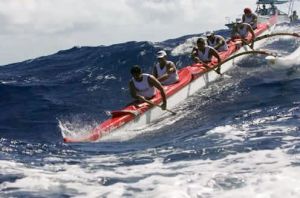
This picture shows a similar craft in a similar situation

This picture shows a similar craft in a similar situation

By Cecil Hoge

Of course, I have to admit my nautical experiences were nothing compared to those of Andrew Shewan, my great, great, great-uncle, who sailed clipper ships in the 1860s and 1870s repeatedly from Scotland and England, across the Atlantic, around South America, across the Pacific Ocean, to Hong Kong, Shanghai, Soochow, Ningbo, Indonesia, parts of India and elsewhere and back again. Andrew wrote a book called “The Great Days of Sail” and I tell some of his story on this website in another blog story called “Sailing Clipper Ships Around the World”.

The story of my trips around Long Island were considerably less ambitious, but they did have their human lessons and they did teach me much about humility.

Trip #1 – Summer 1997

When my insurance agent, Russ Tillman, told me about the idea of circumnavigating Long Island I was immediately intrigued. Russ, in addition to being an insurance agent, was a surfer and an all-around waterman. He had some friends who he was going to paddle along with for part of their journey. He was going to follow them in one of his kayaks for a part of the trip. His friends were going to paddle a 40′ Hawaiian outrigger canoe for what would be the fastest  human-powered circumnavigation of Long Island. Russ told me that some of Long Island’s most daring men and women were to participate in this adventure. I asked Russ if I could get involved with the project in some way and Russ quickly reported back that they were in need of someone to transport the paddlers back and forth from the Hawaiian outrigger canoe to the 38′ support boat. Russ thought that my inflatable boats would make the perfect transport vehicles from outrigger canoe to the larger support boat. He was right about that.

So my qualifications for the voyage were simple: I owned inflatable boats.

The mission was awesome. Four teams of six paddlers each would paddle one 40’ Hawaiian outrigger canoe around Long Island – it was to be the fastest circumnavigation of Long Island by human power. Two power boats, a 38′ trawler and a 22′ Boston Whaler, would escort the canoe on its journey around the island and carry an extra six paddlers and supplies. My two inflatable boats would be the small support boats motoring a fresh team of paddlers from the larger support boats to the canoe every one and a half hours. Every 20 or 30 minutes, I would also motor supplies (Gatorade, water, energy bars, freeze-dried food) from the larger boats to the canoe.

After eight hours or so, the two first teams would be replaced by two second teams – the 22′ Boston Whaler would transport the four teams back and forth to the 38′ trawler. This replacement and replenishment the four teams would take place every eight hours throughout the circumnavigation until the trip was complete. Everything had been planned down to the last detail.

To prepare for this trip, I attended a planning session where all of the paddlers had gathered together to discuss their various training regimes and the logistics of the trip. I should have sensed something was wrong from that first meeting, but at the time I was so wowed by the physical fitness of the guys and gals who would be the paddlers that it did not occur to me question their purpose and the methods they used to train. They were a handsome group and one could sense that they had spent a lot of time thinking and planning for this trip.

The planning meeting was held, appropriately, in a Maritime Museum in Sayville. The participants had gathered in a large hall with long tables. Attending were the 24 paddlers, composed to 10 girls and 14 guys, a gentleman that I came to know as Captain Al, his daughter, who also happened to be one of the paddlers, another boat captain, Russ Tillman, myself and Vinny, my cousin.

Almost immediately, I felt like the small fry in the crowd because it seemed to me that everyone had vastly more experience than I. Russ, as I mentioned, was a surfer, a kayaker and a longtime waterman. Captain Al, who would be piloting the 38′ trawler that would accompany us, was a seaman of world renown and had piloted the his 38′ trawler across the Atlantic and back solo. His daughter was physically fit, very pretty and apparently a young sea lady of great expertise. The captain of the other large support boat, 22′ Boston Whaler, was an offshore fisherman, an experienced boater with much ocean and bay experience.

Most impressive of all were the other 23 paddlers, all in superbly good physical condition ( at least that was my first impression on meeting them), outfitted with the latest in sports energy drinks and health fitness bars. Some were longtime kayakers, some were weightlifters, some were surfers, some were lifeguards. They all talked excitedly of the trip ahead and of the various regimes they were using to get ready for the trip. It was an impressive list – lifting weights, doing push-ups, paddling kayaks in the nearby bays, taking vitamin pills, doing chin-ups, jogging 5 or 10 miles a day, this group was ready to hit the waves and they seemed superbly suited to the task ahead.

There were three points that I should have taken better notice of. These became important later on. One was the fact that several of these people were not actually kayakers or paddlers. They were in great physical condition, but they just had not used a paddle very much. Another point was that all the actual paddling they had done was in the nearby local bay. And the final point was the wonderfully detailed map which listed the times they would pass each spot on Long Island- inlets, lighthouses, towns, bays, Montauk Point, Plum Gut, they all were listed with specific time that they would be passed. A peculiar aspect of this map is that not only did it list the day and hour each landmark on Long Island would be passed, it also listed the minute.

Well, while I had no experience paddling a kayak around Long Island, I had some experience in running rivers in inflatable kayaks. And the one thing I learned about running rivers was that no matter how precisely and how well you planned a river trip, you never really knew when you might pass some location on a river because things happen on a river, things you do not expect and then you find that your best plans are worthless because Mother Mature has thrown you a curveball. Hell, I have been on river trips where we started with 9 people and lost 3 people that we did not find again for 3 days because they took a wrong fork on the river. So I knew the best plans of mice and men were subject to change.

So looking at that map with the day, the hour and the minute listed that you passed each location calculated right down until the day, the hour and the minute you completed the circumnavigation, well, that gave me some cause for concern. So I decided to ask these other folks whether they thought the timetable might be a little aggressive. It called for going around Long Island in 2 and a half days and it assumed that one of the nights the paddlers would paddle through the night. That seemed dubious and not a little dangerous to me.

So, sitting at this long table, I raised my hand and asked “What if the trip takes a little longer than planned?”

I must say I was surprised by the incredulous and downright angry faces that greeted me after I asked this question. I will say that I did notice that Captain Al nodded in agreement, so my opinion, was not totally alone, but it certainly was not in the majority. Almost immediately, a chosen member of the team stood up and explained to me and Captain Al that such a thing was simply not possible. They had done the timings on the bay. They had taken an average of three separate timings and had calculated the times correctly. Yes, it might be possible for the time to be off 5 or 10 minutes by the end of the trip, but anything more was out of the question. The schedule was rock solid. And so that is the way we left it.

On the appointed hour (4am) and day (Saturday, if I remember) I showed up at the appointed place, King’s Point, with my carefully chosen team. It consisted of my surfer cousin, Vinny, my mall rat nephew, Sam, and a 19 year-old French kid just 24 hours off the plane from Paris. To be fair to the French kid, I told him (his name was Xavier) that he might love this trip or hate it, but once he began it, he had to finish it. I think Xavier understood what I told him.

He said what sounded like “pot problem.” This didn’t mean he had a problem with pot. Actually it means “no problem.” French people like to say that when you propose to risk their lives for fun. It is spelled, “Pas de probleme.”

I didn’t try to explain much to my mall rat nephew Sam. His experience of wandering America’s malls day and night might not be pertinent. I told him we were going on a camping and boating trip. I figured that was enough info for him.

I knew we were on safe ground because of my surfer cousin named Vinny. He came into this world floating and he will leave it that way. Our plan was simple: Vinny would take Sam in the smaller 12′ inflatable sport boat with the 15 hp engine and I would take Xavier in the larger 14′ rib inflatable boat with the 30 hp engine.

So off we went. I had taken command of the necessary provisions: flashlights, Heinekens, sodas, bottles of water, tents, steaks, peanut butter & jelly, waterproof bags, rain jackets, rain pants, bathing suits, sun hats, life jackets, VHF radio, FM radio, tanks of gasoline… all the essentials.

The intrepid and extremely physically fit paddlers had other ideas regarding provisions. Gallons of super Gatorade, high protein cookies, freeze-dried food, wet suits, high performance paddles, compasses… these guys and gals were ready to paddle. I would note that this was still before the time of wide use of cell phones, so they were not included as essential equipment. If the trip had been a few years later, you could bet they would have brought at least 24 cell phones.

Even without cell phones, the paddlers were tremendously energetic and full of enthusiasm. They slapped each other on the hands and shoulders, sipped Gatorade, munched energy bars and looked disparagingly at the supplies of beer, soda and food that I loaded into my two inflatable boats.

We got our boats in the water and our gear loaded and were off at 4:30 a.m., which, to my surprise, was exactly as scheduled. It was almost completely dark at the time. We motored out into the inland bay, following the 40′ kayak as closely as possible (I could barely make it out) and the 6 intrepid paddlers, 2 girls and 4 guys, paddled out of the bay, into and along the Sound without incident. Even in the murky light, they were an impressive sight. Paddling in unison, shouting to each other encouragement, I could see the canoe moving ahead at a terrific speed. You would think a Marine platoon was in charge of that canoe the way they shouted and grunted and pushed that giant outrigger canoe forward in early morning light.

It was not long, maybe 40 minutes, before we came up to Hell’s Gate which is located just as you pass under the Triboro Bridge. Captain Al signaled us to come over to the 38′ trawler and pick up the relief crew of six paddlers. We did so quickly, dropping off the new paddlers in the canoe and escorting the first team of paddlers back to the trawler.

The second group of paddlers (3 gals and 3 guys) were just as impressive as the first group. They paddled magnificently in unison right through Hell’s Gate and down the East River. The front paddler shouted when to stroke and when to change sides, so each paddler got to paddle for 10 minutes on one side and 10 minutes on the other side. The 40’ outrigger canoe cut through the water like a Hobie Cat under sail in a stiff breeze. They was cranking!

It was glorious. The sun started coming up around 5:15 as we came into the East River, passing under the Triboro Bridge through Hell’s Gate, passing the Domino sugar warehouse, passing Riker’s Island and the somber prison of that name ringed with metal fence. As we entered the main run through the East River, the light from the rising sun hit the glass windows of the tall steel and concrete buildings to the right, causing beautiful reflections. We passed Gracie Mansion near where I born (Doctor’s Hospital) and brought up (520 East 92nd). The view of the city was the same I had known all my life, yet somehow different, because it was from the water, low on the river and not from a bridge or a highway or a road.
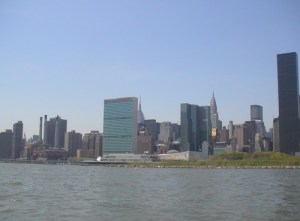
The UN as we went by

The UN as we went by

We passed Roosevelt Island. We passed the UN. We went under the Williamsburg Bridge. We went under the Brooklyn Bridge. As we approached the Verrazano Narrows Bridge, we saw the Statue of Liberty back towards the Hudson River. We saw the original World Trade Center looming up at the end of Manhattan. We passed Brooklyn on the left where my grandfather once had his shipyard. We went under the Verrazano’s Narrows Bridge and out into the Atlantic Ocean – all was going well, it was a piece of cake. To my amazement we were passing each location on the map within minutes of the original schedule.

In New York Harbor we saw giant oil tankers and container ships being pulled and pushed by earnest chugging, seagoing tugs. We saw ferries rushing back and forth between Queens and Staten Island and Manhattan Island. We saw flotsam and jetsam… beer cans, oil drums, branches of trees, chunks of styrofoam, wooden logs… all floating in the water…all in front of Manhattan Island where the East River and Hudson River converge and make their way out to the Atlantic Ocean. We passed Coney Island and Rockaway Beach. We could see the tall buildings of the city back in the distance back from where we had come.

We were about three hours into the trip when Vinny and I completed our second transfer of paddlers back and forth, from the canoe to the 38′ trawler. This had to be done by stages, but it went, like everything so far, smooth as silk. I would pick up 3 paddlers from the canoe, ferry them over to the trawler and then load on the 3 new paddlers and then take them back to the canoe. Mine was the bigger inflatable boat with the bigger engine, so Xavier was in my boat and Sam was in Vinny’s boat. When the paddlers came in, Xavier would scoot over to allow room for the paddlers to get in and out. He would pass them Gatorade and energy bars and happily say, “Pas de probleme.”

After I finished my run, then Vinny and Sam began their ferrying duties, quickly and efficiently, transferring paddlers from canoe to boat and back again. Again, it worked smooth as silk.

We kept charging along the ocean a few hundred yards off the beach. And once again I was amazed. We were running on schedule almost to the minute. It was eerie, this kind of thing had never happened to me on a river trip. We kept cruising along with the 40′ outrigger canoe and Captain Al’s 38′ trawler. We made quite the parade, marching down the beach, a few hundred yards offshore. On the beach, people would see us pass by and wave.

It was about that time that I realized that we were running low on fuel. I motored up to Captain Al and told him we needed to head into Jones Inlet for fuel. He said the timing couldn’t be more perfect. Soon the second group of two teams of paddlers would be motoring out in the 22′ Boston Whaler. By the time they finished that transfer, he would meet us on the other side of Jones Inlet with the two new teams of paddlers.

So we headed into the inlet and soon found a fuel station just inside Great South Bay on the left. It was a nifty little fuel station with a kind of general store for marine supplies – in other words, gas, bait, sandwiches and beer…all the essentials. So we gassed up, picked up some fresh sandwiches and some extra beer, just in case, we might need some more that evening when we set up camp. We were fueled, supplied and headed out to sea in less than 30 minutes.

When we got out back into the ocean, a few things had changed. For one thing a thick fog had rolled in and it was hard to see more than a few hundred feet. I hugged the shoreline, not wanting to find myself on a one-way trip to England. In order to avoid landing on the beach, I had to listen for the breaking surf. In order to avoid going to England, I also had also still hear the ocean waves breaking – that meant I was still near the mainland. It was kind of tricky out there for a while and I was surprised how fast conditions could change on the ocean.

We caught up with the canoe and 2 larger support boats about twenty minutes later when it was still pretty foggy, but in another 20 minutes, the fogged burned off and we were in beautiful clear sunshine. As soon as we could see them clearly, we motored over and introduced ourselves. Watching them from distance, you could see that were not maintaining the quite same speed as the first two teams of paddlers. Even if they were not quite up to the high standards of the first two teams, they were doing really well.

Almost immediately the 22′ Boston Whaler headed back towards the inlet with the first two teams of paddlers. We waved to them as they turned back towards Jones Inlet and sped away. That left Captain Al in 38′ trawler with one team of paddlers in his boat, me in the bigger rib inflatable with Xavier, Vinny in the smaller inflatable sport boat with Sam and other 6 new paddlers in the 40′ canoe.

I was one happy inflatable boat captain. I would ask Xavier how things were going for him and he would smile looking over the endless scenery of sandy beaches and breaking waves on the left and ocean blue on the right. “Pas de problem,” he would say.

The sun was blazing down on us and we would periodically slap suntan lotion on. Every hour and half we transferred one team of paddlers from big boat to the canoe. I did notice that the wind had picked up a little, but that was fairly typical on a summer afternoon. The wind was coming from Southwest so it was actually helping the paddlers propel the canoe east. Around 2 o’clock, whitecaps began to appear.

Still, we were making wonderful progress. It was wonderful to see how the beachscape changed the further we got along the oceanside of Long Island. There were less houses, more natural dunes and empty beaches.

But soon I noticed something else. The original two teams were all in fantastic shape. The two replacement teams were not. One the best paddlers of the second set of teams was Captain Al’s daughter. She was to prove to be a true pro paddler. Unfortunately, the other paddlers in the canoe with her were neither in good shape or good paddlers. This meant she had to push them, not the other way around.

Around 3:30 p.m., the wind picked up to 8 to 10 miles an hour and switched mysteriously to a northwesterly direction. In case your are not familiar with Long Island, the prevailing winds in the summer are Southwest and that would push the paddlers just where they wanted to go – east. However, the wind decided to change its mind that day and now it was coming almost directly against us, pushing the paddlers back as they paddled forward. That was not all, the ocean had gone from flat to 2′ to 3′ swells and whitecaps were beginning to break against us. Not only was the going slower, but new teams were finding paddling much more difficult.

About this time the Boston Whaler reappeared, now back from delivering the two teams of paddlers. The Boston Whaler was bringing news with them – a weather update. Thunderstorms were predicted later that evening. High winds, heavy rain and fierce squalls were expected to roll in around 9pm. In short, we had to get a move on. Because of the weather report and because Russ had seen that the conditions were going downhill, he decided to postpone his paddling along with the canoe. So much for fair weather paddlers.

Changing and replacing paddlers was getting more difficult because the waves were getting higher and we had to be careful when pulling up to the trawler or canoe that it did not crash into our inflatable boats. Our boats, the trawler and the canoe were bobbing up and down in the sea. So it took more time and care to change the paddling teams.

Everything was fine with Xavier who kept saying “Pas de probleme” and laughing quietly when a paddler fell in. The French really love water sports. Sam the mall rat was having a good time, too, despite all the bobbing up and down. I even heard him say “Wow” a few times when Vinny’s passed close by.

Vinny was in his element, scooting back and forth picking up and dropping off paddlers, shuttling supplies of super-dooper Gatorade and high-powered freeze-dried food back and forth to paddlers in need. In between he surfed my 12′ inflatable boat on the whitecaps. He was really getting into it.

Around 4:30 p.m. it became clear that we were running seriously behind schedule. Not just a few minutes, but hours. In fact, this was the time the map called for us to be coming into Moriches Inlet. And that would have been really good because that was when the tide was scheduled to come into the Great South Bay. If we came into the inlet much later, we were likely to run into an outgoing tide.

As it was, the more the paddlers tried to paddle against the wind and waves, the more tired they became and the less progress they made. Still, we had made progress and now were only a mile or two from Moriches Inlet. If we could just keep up the pace, we surely would arrive before 7 p.m.

But the conditions were going South fast. The waves were now 3 or 4 feet and the wind 10 to 15 miles from the Northwest. Progress was slow and tedious, despite the best efforts of the exhausted paddlers.

I motored over to the 38’ sea trawler and suggested to the captain that we beach the canoe for the night and start again the next morning. Captain Al didn’t want to hear that suggestion. It was at that moment that he decided to reveal that his daughter was diabetic. If she didn’t get insulin within three or fours hours she might die. There was no time to beach the canoe, get his daughter to the mainland, get insulin and come back to pick up the hapless paddlers.

Time went faster and we went slower. By 8 o’clock, we were at the mouth of Moriches Inlet and not making any further progress. Things were really starting to get difficult. The wind was a steady 20 mph+ and the waves were 5 to 6 feet. Changing teams was getting impossible. Imagine one boat dropping 5 or 6 feet and another boat rising 5 or 6 feet and an intrepid paddler trying to step from the canoe, which was dropping, to my inflatable boat, which was rising. Imagine the same thing happening when I took paddlers over to the 38′ trawler and remember that the trawler weighed good deal more than my inflatable boat.

After a brief conference with Captain Al, we decided to tie the Hawaiian canoe to the 22’ Boston Whaler and tie my inflatable rib to the 38’ trawler. Everybody who could get in got on the trawler. Two hapless paddlers were left, anchored with the Boston Whaler and its captain out in the ocean about a half mile off Moriches Inlet. They had to ride it out in middle of the ocean all night long with higher and higher waves rising and falling all around them. They were not happy campers.

In the inlet the waves were now 8 to 10 feet. This was because the tide was now rushing out Moriches and the Great South Bay, throwing up the waves as the current went out. The trough between the top and bottom of the waves was 12 to 14 feet. Darkness was setting in as we discovered that the line with which we had tied my inflatable boat to the trawler was a bit short, even though it was about 25 feet long. The trawler would motor forward and pull sharply on the rope just as my boat was rising up on an eight foot wave. Then my boat would head like a damaged surface torpedo for the stern of the 38’ trawler.

This produced an interesting effect. My boat would be sling-shotted forward and crash into the stern of the trawler. Each time my boat crashed into the trawler my hull lost some fiberglass and each time we would lengthen the line to prevent my rigid hull torpedo from hitting the trawler. On one of those impacts, the front air chamber of my inflatable rib was punctured and if the other two air compartments had not been inflated and the fiberglass rib section had not completely enclosed the boat, my boat would have sunk to the bottom of the sea.

We had now been on the water for over seventeen hours and were all huddled in the back of the 38′ trawler. Sam’s teeth were chattering, his skin was blue and he looked like he was about to puke. Even “Pas de probleme” Xavier was feeling the stress. He was quite wet from bobbing around in my inflatable boat. Sitting on the deck of the trawler, getting drenched periodically by incoming waves, Xavier realized that the waterproof French jacket he had brought along for the trip was not very waterproof.

Vinny was still out in my other inflatable, trying to save the two paddlers and the Boston Whaler captain who were haplessly bobbing up and down in the sea. He kept running back and forth between the Boston Whaler and the trawler, passing messages and trying to develop a consensus on what to do. He did manage to get one of the paddlers off of the Hawaiian canoe and onto the Boston Whaler. In the meantime, Captain Al was trying to get the Coast Guard on the VHF radio in order to persuade them to rescue us. By that time, it was 9 pm at night, getting real dark, the wind was running 20 to 25 miles per hour and seas were ten to twelve feet and angry dark clouds were gathering overhead.

That was when the Coast Guard decided to inform us that they no longer performed rescues in Moriches Inlet. Apparently, the insurance premiums were too high. They did volunteer escort us in through inlet and watch is drown if that is what happened. Captain Al looked at the VHF radio, at the nearby Coast Guard cutter that was observing us and looked at his diabetic daughter, now huddled in the back of his boat along with 10 very unhappy paddlers, Sam, Xavier and myself. Captain Al was not a happy camper.

Moriches Inlet happens to be Long Island’s most treacherous inlet. Captain Al thought everything over and then he told the Coast Guard he intended to go through anyway and asked if they would at least follow him through the channel. They agreed to follow us as long as we understood they would not rescue us if we sank. We motored through the inlet.

This turned out to be the easiest part of the trip. In under ten minutes we were through the inlet. It was even rougher than the open Atlantic because the tide was now really rushing out, throwing up the waves even higher in the actual inlet. But the great captain headed left, right and forward, gunning the throttle, pulling back on the throttle, navigating his boat left, right and forward, riding into and over each wave as each wave tried to swallow the 38’ sea trawler. Within minutes we were in the calm waters of Moriches and Great South Bay.

Captain Al dropped Xavier, Sam and me on the shore, on the right side of the inlet, along with my half-deflated inflatable loaded with all our supplies. Immediately afterwards, the captain headed into the darkness to get his daughter insulin and the paddlers back to land. Captain Al did not smile or even wave goodbye. You could see he was kind of frustrated to have been bamboozled into being the major support boat.

I will not burden you with the sad story of our attempt to set up camp. Assembling a large 3-man tent in the dark with a 30 mph wind blowing sand and driving rain in your face is no fun. Yes, almost as soon as I started to assemble the tent, the thunderstorms began to break out in earnest. Visibility did improve somewhat when lightning bolts started to flash all around, but my sense of urgency did also increase as I attempted to put together the metal rod parts of the tent while the lightning bolts blasted down from on high and raindrops the size of lollipops hit us in the face and head. Yes, the weather bureau was right for change and indeed thunderstorms were in force for the next 6 hours.

A good thing is that Vinny showed up just before it started to rain, happy as clam from trying to help the two lone paddler’s in 40′ canoe and the Boston Whaler captain. Vinny finally figured out that there was nothing more that he could do, so he left them bobbing up and down in the ocean and came to see how we were doing. He took a smaller two-man tent I had brought along and he and Sam assembled it, despite lightning bolts and huge droplets of driving rain, in few minutes and spent a relatively dry night in their tent.

“Pas de problems” was not in so good a mood, “I am wet and cold and I cannot sleep in this puddle.”

Hey, I had been upfront with Xavier, what was he thinking this trip was going be, Brie and red wine on the beach as the sun set?

The next day I got up early. It was still cloudy and cold. About half an hour later, the sun came out and almost instantly it got blisteringly hot. I looked back at the tent I had assembled the evening before – where Xavier was still sleeping. We had, in the confusion of rain, wind, and lightning, assembled the tent upside down. The resulting structure was about ⅓ the size of the correctly assembled tent. Not to mention that the floor turned out to be a lot less waterproof than the top, which perhaps, explains Xavier’s comment about sleeping in a puddle.

That was the low point of the trip. A few minutes later, Russ showed up with some of the more hardy members of the original expedition in a comfortable looking 28’ cruiser. Russ said that it had been decided that the Great Circumnavigation of Long Island by Human Power had been called off. I couldn’t believe it, a little setback like some wind and thunderstorm and being a few hours off schedule and Long Island most intrepid adventurers were quitting. Say it ain’t so! But it was.

Russ offered to tow us back to the mainland. I said thanks, but no. I had come to go around Long Island and I intended to finish the job. After all, I had plenty of supplies…food, beer, tents, clothes, everything we needed to complete the trip.

Well, the rest of the story is fairly simple. I repaired the front air compartment of my inflatable rib. It did not look great with a patch of another color, but it did hold air. Russ wished me luck and said he was sorry that he couldn’t come along. We took the inland route. We motored through Moriches Bay and through the wide and long stretches of the Great South Bay.

There was one incident of note and that was when our motley parade of two inflatable boats was passed by some super 50′ go fast boat. It was a Cigarette or some such speedboat and it was going at terrific speed. At the head of this craft sitting in a captain chair was a tanned gentleman wearing a large gold chain, a bathing suit and sunglasses, next to him was standing, with one arm on the captain, was the captain’s mate, a well endowed tanned beauty in micro bikini, her dark hair flowing in the wind, a glorious smile plastered on her face. The captain and his mate did not bother to recognize us or to slow down even though they were only 30 feet away from us and going an easy 45 mph. You could tell from the look on their smug faces that they were not impressed with our two somewhat banged up and disheveled inflatable boats, carrying, as they were, a mess of supplies.

The captain and his mate sped by sending 3 foot rollers in our direction and just before they disappeared I heard this large and a sudden roar followed by an abrupt clanking sound. And to my surprise I saw a 50 foot plume of mud spew out the stern of the magnificent go fast craft. Within seconds, the great speedboat sputtered to stop and the engine became silent.

I must tell you at this time we had been motoring at 5 mph, which, by the way, was the stated legal speed. That was clearly enumerated on a sign not 20′ feet away. So when, we saw the great go fast boat come to a halt, we did not speed up, we did not slow down. No, we continued blissfully on passing within 20 feet of the magnificent speedboat. There we could see the scene had changed somewhat, the first mate, with beautiful dark and flowing hair, was screaming at the captain, “What is happening?”

I will tell what was happening. Absolutely nothing. The captain was looking at his craft, peering over the side transom, trying to get a better view of what was happening, trying to figure just what had happened. We just kept motoring along until we were abreast of him. The captain seemed to be trying to get our attention. I knew that could not be true. Why would such a glorioso guy want out attention? We waved politely and motored slowly on. When we looked back, we saw the girl screaming and waving her arms at us, also trying to get our attention. We motored on slowly in great dignity.

I am not sure what that experience cost the gentleman. My guess was a new motor for $50,000 or so, a call to SeaTow and long wait. There would not be no hanky panky that night. You could tell the bodacious girl was losing it, jumping up and down, waving her arms, screaming at the top of her lungs. Yes, loving her man was no longer on her mind.

We made our way through the narrow water channel that went from Bellport Bay through Quogue to Shinnecock Bay. Eventually, we found the entrance to the Shinnecock Canal. There was a big line of boats waiting to go through, but I noticed a restaurant on the right and two open slips. We found our way in and had a pleasant lunch, a few beers and had a lively discussion about the unfortunate captain and his mate and our other adventures so far. When we came out of the restaurant, the line of boats was gone.

The rest of the afternoon was a piece of cake. We motored at full speed across the open distances of Great and Little Peconic Bays. We came to the narrower waterways between Shelter Island, Gardiner’s Island and Sag Harbor. We went on to Cedar Point where we made landfall and set up camp for the evening. There we set up the 3 man tent in the warm sunlight at our leisure. I turned on the FM radio, opened the beers, pulled out the steaks, lit a fire and we had meal that tasted like it was the best and last meal on earth.

When Xavier looked over he was surprised to see my tent in its full majesty.

“I do not recognize it,” he said. The still warm air cooperated to comfortably dry out the tent. That evening after sitting by the fire under stars, listening to the radio, sipping beers and relaxing, we went to bed and got a solid eight hours of sleep.

The next morning we loaded up the boats, headed off to Greenport to get gas and then went through Plum Gut into Long Island Sound.

It was a another beautiful day. There was a nice breeze and the sun was warm. We motored on the whole day, happily taking turns steering the boats. We passed the great sand bluffs of the north shore. We passed Mattituck Inlet, we passed Mt. Sinai. Eventually, we came to the inlet leading into Port Jefferson Harbor. This was home for me and my two inflatables. We motored through the channel, passing summer yachts, speedboats, sailboats, dinghies, jetskis, fishing skiffs… all oblivious as to who we were and where we had been.

There was a group waiting to greet us. Sam’s father and mother, worried and proud. Vinny’s wife, nervous and intensely happy. My wife and son, serene now that I was home. We had hotdogs and Coke and Budweiser and coleslaw. It was the Fifth of July, and we had almost circumnavigated Long Island.
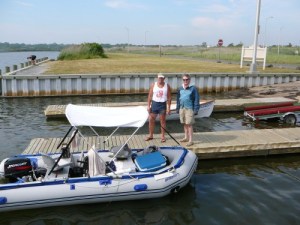
Ric and Me Ready to Roll

Ric and Me Ready to Roll

The Next 9 Trips

You might think that the trip just described above would steer me clear of any further adventures around the waterways of Long Island, but you would be wrong. It does seem that absence does make the heart grow fonder and perhaps some selective forgetfulness is also helpful. Whatever the reason, a couple of years later, Russ (yes, the same insurance salesman/surfer/waterman/fair weather kayaker dude) told me about another planned trip to go around Long Island. I was even more intrigued.

In this case, a guy named Rick Shalvoy, was planning to row around Long Island. Rick was Smith Point Lifeguard and he was rowing around Long Island to raise money for breast cancer research. That seemed like a good cause, but what sold me on the idea was the fact that Rick had already rowed the year before around Long Island and that fact that Rick was not trying to make speed an important criteria. No, the year before Rick took 7 days to row around Long Island and this time he might take 8 days. That seemed to take a lot of the stress out of the expedition.

Anyway, shortly after Russ mentioning this trip, I again volunteered to be the support boat. It seemed to me that I had acquired some experience from my previous trip and I would be in a position not to make the same mistakes. Not only that, the whole concept seemed much more practical. Rick would row, I would motor, providing Rick with supplies of water and some occasional food and Russ would accompany us for part of the time when we’re passing Moriches Inlet. In addition to my boat, there was to be another boat, a 32′ Boston Whaler accompanying us. And again I would be the small support boat running back and forth between the large support boat and Rick’s boat.

Since I ended up making this journey 9 separate times with Rick, I will not try to tell you the story of each and every trip. There were some very challenging and exciting moments in between long stretches of quiet plodding (Rick could row his boat around 5 mph on a good day with the wind at his back) and easy motoring. So I will try to give you some the highlights of these trips rather recount every trip.

The First Trip with Rick –

On this trip, Rick was starting out in Montauk. Since I was located in Port Jefferson Harbor and the run from Montauk Point to Orient Point to Port Jefferson was a fairly easy part of the journey and because Rick had two boats to support him on that portion of the run, I did not start until Rick got to Port Jefferson. So before Rick arrived I loaded my boat up with all sorts of stuff – sleeping bags, cases of water, beer, food, VHF radio, FM radio, cell phone (yes that time was upon us), changes of clothes, waterproof bags, flashlights, suntan lotion, CD player. Yes, it probably was true that I had more stuff than I needed, but I figured if you are at sea, you never know what you might run out of. Having all this stuff probably meant that I ready for just about anything Mother Nature could throw at me. It also meant that I had one pretty loaded up inflatable boat. On this trip I taking a 12′ 6″ inflatable transom boat with a 15 hp motor. I thought it was more than enough for this trip. I was wrong.

So on the appointed day I motored out of Port Jefferson Bay through the Port Jefferson inlet into Long Island Sound. I was to meet Rick at 12. Rick. It turned out Rick was running late and he showed up just about the time George Lindsay showed up. George was a friend of Rick’s, a teacher at Stony Brook School and a longtime rower. He came out rowing a 14′ rowing shell with a big sliding seat rowing frame. Rick came up moments later, followed by the 32′ Boston Whaler.

Almost immediately, we proceeded down the coast of the North Shore. Within half a mile we rounded Oldfield Point. In the bay before Oldfield Point the water was calm and tranquil, but as soon we rounded the point we were confronted with a stiff Southwest wind and whitecaps. I had a rain suit carefully packed away but it never occurred to me to put it on. It was a perfectly beautiful day, but when passed Oldfield Point the waves began to slap incessantly against us, drenching me with every wave. By the time I realized what was going on, about 3 minutes after we rounded the point, I was already soaking wet to the skin.

Rick was not having a problem with getting wet since he was rowing a specially designed 19′ Lifeguard boat. It had high sides and an open back. Almost no water came in and what did, immediately drained out the back. The wind and waves caused other problems for Rick because they were blowing hard and slapping against him. While Rick was rowing from the inlet to the point at 4 or 5 miles per hour, that slowed down to 2 or 3 mph when he hit the wind and waves on the other side of the point.

The problem was far greater for George Lindsey. He rowed magnificently from the Port Jefferson Inlet to Oldfield Point, oars in unison and going even faster than Rick because the sleek profile of his rowing scull. That advantage evaporated on the other side of Oldfield Point because the rowing scull figuration meant the oars in flat water rode gracefully just above the water, but when George came around the point, the 1′ to 2′ chop that he was greeted with meant his oars could not come back over water because the waves were hitting the oars. Almost immediately, George was in big trouble and soaking wet.

George and I had a little conference after it became clear that George was falling further and further behind Rick. I suggested that I tow George’s rowing scull. It turned out not to be as simple as that. Apparently the rowing frame was not secured to the scull so that meant, I had to put the rowing frame with its multiple sharp points in my inflatable boat. All this happened in the first 30 minutes of the trip. I could only imagine what else might happen over the next 7 or 8 days.

Anyway, we kept on going and Rick developed a technique that allowed him to make forward progress. Instead of rowing directly into the wind and waves, Rick rowed towards the shore and to the lee of the land – this is where the land acts as a buffer against the wind. In other words, Rick rowed until he was close enough to land so there was not much wind and then he rowed closely along the shore to the next point. This worked, but it proved to be very tedious and time-consuming. My boat was now really crowded with George Lindsey and his rowing rig, not the mention the rowing scull I had to keep an eye on behind me. In the meantime, every time we hit a wave, every 15 seconds or so, a wave of water would hit us, making us wetter with each wave. And that was hard to do since we were both soaking wet. It was about that time that I recognized that a 15 hp motor was insufficient for task at hand.

Rick’s situation was even more difficult because he had to row hard against the wind until he got to a protected area and then he would come up on another point and as soon he passed that point, he would be confronted by another great blast of wind and waves. There were times that I swear that Rick was actually going backward even though I could see him straining every muscle in his back and shoulders as he pulled on the oars. I should say that for me while it was just an hour or so into the trip, this already was the second day for Rick and he had already rowed 4 hours from Mattituck before arriving off Port Jefferson, so Rick was already one tired puppy.

But Rick was not a quitter and he knew he had to get from the North Shore on the Sound to the East River to the Hudson River to get to the ocean where the prevailing wind should be Southwest and pushing him in the right direction – east. Unfortunately, at the moment the wind was also from Southwest and pushing against us because at this time we were headed west.

Suffice it to say, it was a long hard struggle as we inched our way down the North Shore of Long Island Sound from one large point to the next. From Port Jefferson it was about 10 miles to Northport and Huntington harbors, then to Loyd’s Neck, Cold Spring Harbor, Oyster Bay and Glen Cove. It is hard to understand the North Shore of Long Island is a series of large points jutting out a mile or two into the water. This meant that every time we came around a point, we were hit in the face with a stiff wind and waves with whitecaps. Then as we worked our way past that point and toward another point, it would become calmer as we got closer to the land of the new point.

Even though it turned out only to be half day, it was a struggle for me. Along the way I did learn something about George Lindsey, who not only was a teacher at Stony Brook School, but also a sailing instructor for the school. It turned out that one of the reasons that he was interested in rowing along with Rick, was that the year before he and his son had also attempted go around Long Island. And while they had not attempted to go around the outside of the South Shore, they did go through the inland bays, rowing across Rockaway Bay, the Great South Bay and Shinnecock Bay and then passing through, like we did on our first trip through the Shinnecock Inlet to Peconic. George said the experience with son had been wonderful, although extremely difficult at times.

Anyway, the first day of the first trip with Rick was only about 6 hours and all of those 6 hours, every time we came around a point, we were confronted with a stiff 15 to 20 mph wind and drenching waves.  And while for that day there was not much for to do other than to shuttle bottles of water from the 32′ Boston Whaler to Rick’s 19′ lifeguard boat. Because the lifeguard boat was specially designed, sleeker and far faster than the traditional big bucket lifeguard boats you might have, Rick was able to ride against the stiff wind and over the 1′ to 2′ waves. Finally, when we arrived at Glen Cove Bay, we called it a day and the Boston Whaler towed Rick’s boat into the harbor for the night.

The ride into Glen Cove Bay convinced me of two things – just how large Long Island’s bays were and how ineffective 15 hp motor was towing a rowing scull and carrying me, a rowing frame and rower. That night I slept on board my little 12′ 6″ inflatable boat in a sleeping bag. The presence of multiple mosquitos and the steamy hot evening convinced me that, if I had a chance, on future evenings I would seek shelter at a nearby motel. And that is what I did on several of nights of this and future trips with Rick.

The rest of that trip went fairly seamlessly. George Lindsey decided maybe it was not such a good idea to bring his rowing frame scull along for the rest of the trip, waved goodbye and I was able to have more room in the boat go with a lighter load. The jaunt from Glen Cove to the city was miraculously easy with little winds and the tide just right as we entered Hell’s Gate and the East River. Because the current with us through the river, Rick was able to row exceptionally fast and we made it through the city, past the Statue of Liberty, under the Varrazano Bridge and out into the Atlantic in less than 6 hours.

Once in the ocean, the prevailing Southwest wind pushed us down the coast and everything went without incident. An impressive and new part of the trip was the fact that because Rick Shalvoy was lifeguard, other lifeguards along Long Island had gathered crowds to clap, cheer and watch as we passed by. Rick’s plan to row around Long Island and raise money for breast cancer research was quite well-known. Because it was being covered by Newsday and On Channel 12, the local Long Island station, our present progress was being followed daily. And while the cheers and applause were not for me, it was definitely a thrill to see the crowds on the beaches cheer Rick.

This first trip Rick passed uneventfully, even though it was long and tiring. I can only imagine from the point of view of sitting in a small inflatable boat bobbing up and down for hours at a time in the ocean or the sound what it might be like for Rick. You might think sitting on an inflatable boat is simple and easy, but if you are going up and down hitting waves or even stopped and drifting it could both be tiring and boring. There were long hours where I just waited for Rick to signal me to let me know when to bring water, Gatorade and energy bars. I cannot imagine what these same days were actually like for Rick where he physically rowed the same distances that I motored for 8 to 10 hours.

Rick was a lifeguard of the old school. When he discussed the subject of avoiding a sunburn, Rock told me the best solution to a sunburn was a good base. And Rick had a good base. In fact, his skin looked like brown leather. He did periodically apply sunscreen, but he refused to wear a shirt since he thought this got in the way of rowing. Rick did generally wear a large sun hat and I sure this helped save his face from getting a third degree burn. Nevertheless, watching Rick rowing with his back to the sun, one could imagine his skin blistering up. As far as I could tell, his skin never did blister up, but it did become more red and more leathery, day by day, as each trip progressed.

On the first trip a pattern of daily events emerged that was to be repeated on all 9 trips that I accompanied him. We would start out in the morning from some harbor where we had pulled in for the night. Rick would usually spend the night in a motor home that was provided for him to use (friends drove it from location to location). I and anybody else who were driving support boats would find some place to spend the night. That usually meant me taking a taxi from a dock somewhere to a hotel or motel somewhere on Long Island. And while sometimes, if there was no alternative, I would sleep on my little boat, more often I would spend the evening as good a hotel as I could find and have as nice a meal as I could find. The next morning I would take a cab back to whatever dock I was tied up to and we would start again.
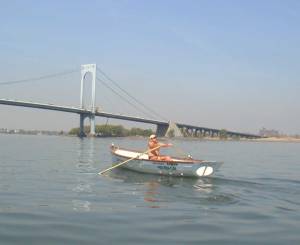
Rick approaching the city

Rick approaching the city

Each trip took 7 or 8 days to complete because Long Island is not only long (120 miles), it is also quite wide (45 miles in some places). So the trip around Long Island was an easy 300 miles and far more if you counted the running back and forth between different harbors. As I did this trip each year, each year I would find myself impressed by the many different and quite large waterways surrounding Long Island. The inlets on the south shore of Long Island were particularly impressive because they could have 8 or 10 mile an hour currents raging through them.

On the first several trips we had some large support boats to accompany us. It turned out that the combination of large support boat and inflatable sport boat to ferry supplies back and forth was both useful and practical. The large support boats were capable of motoring Rick and his boat back at the end of each day because they had large powerful motors. My little transom boat was quite perfect to deliver the drinks and food Rick needed. Because the sides of the larger boats were quite high it was not practical for Rick to either reach up to the larger boats or get into the larger boats. With my boat around I could hand him his drink and energy bars easily and at the same time Rick could get into my boat and stretch out when he was truly exhausted (usually in the late afternoon of each day).

If needed, I could tie up to his boat and he could get into my inflatable boat and stretch and take a short nap for 20 or 30 minutes. Strangely enough, even though his boat was larger, there was no place to comfortably stretch and take a nap. All of the trips we took had a kind of routine. Get up and meet at the last port of call. I would come from a local hotel or, in the cases where there were no motels available, directly from my boat. Rick would come from the trailer home that had been following him around. We would start out, usually me in my boat and Rick in a larger support boat with Rick’s rowing lifeboat in tow behind.

We would then motor out to the starting point of the last day and begin that day’s journey. I would motor back and forth between Rick’s boat and the support boat, ferrying Gatorade and other drinks and snack and energy bars. For my own sustenance, I stuck with bottled water, with and without bubbles, a few pre-made sandwiches, bottles of Ensure, and thereafter, what I called “squirrel food”. This was nuts and raisins and trail mix. I found this the easiest food to keep dry, bring along and keep me going.

Over the years that I was Rick’s support boat, he raised over one hundred thousand dollars for the cause of breast cancer research. On later trips Rick found it harder and harder to line up larger support boats and on many of those trips I was the only support boat. Very early on, I realized that my 12′ 6″ inflatable boat was not roomy enough for all the gear, gas and supplies I had to. Along with that realization came the understanding that 15 hp motor just did not cut it in many situations. So, very quickly I upgraded to a 14′ inflatable boat with a 30 hp engine.

The larger boat and the larger engine did make it possible to be Rick’s one and only support boat although neither of us preferred it that way. Unfortunately, it was not always possible to find someone to take 7 or 8 days off and run around Long Island. I can only say that I was always grateful to have larger boat along when that was practical.

Over the nine trips I made we had many interesting experiences. I can remember one day we started out from inside Jones Inlet, just me and Rick, with no support boat. The day was a fine one, with beautiful blue skies and only a few cirrus clouds. I could tell that there was a stiff wind, coming from the Southwest, but other than that nothing prepared us for the sight that greeted us when came around into Jones Inlet itself.
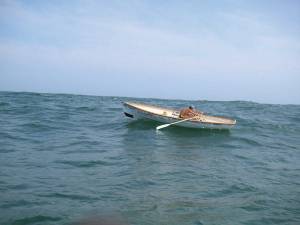
Rick in some waves

Rick in some waves

Jones Inlet is fairly wide and fairly deep, unlike Moriches Inlet. When we came around the corner and into Jones Inlet we saw something that I did not think was possible. There were sets of 6′ to 8′ waves rolling into the inlet and breaking….everywhere…across the full width of the inlet. In the several years I had done this trip before, I had never seen ocean waves breaking the inlet, not to mention, breaking across the total width of the inlet. It took me a few hours to figure how this was even possible. Later that day I concluded that the relatively low tide, combined with the strong outgoing tide, made it shallow enough to throw up the waves in the channel and have them break. Previous to this, it had been my theory that waves could only break either on the shore or on a sandbar where it was shallow enough to break. But, in this case, waves were breaking across the whole of the inlet and as far as I could see into the ocean.

We had to make a decision – basically – to go or not go. Well, Rick was a lifeguard with vast experience in and around the ocean. He wanted go through. I was not so sure because I knew I was towing a 19′ rowing boat and would have to motor through the surf with Rick’s boat on a towline behind me. I put on my life jacket, clipped the clips, zipped the zip, lengthened the towline to Rick’s boat to about 75 feet and we charged into the inlet. I soon figured out that I could wait for a wave to break and then gun the engine. This worked well except for one fact. Rick’s boat. I would wait for the appropriate moment and then gun the motor and we would race ahead until the moment the towline tightened and then my boat would slow abruptly and the prop would whine loudly as it cavitated in the froth of the oncoming wave. I would then have to wait for the prop to get some traction in the water and gun it again.

By repeating the above process again and again we were able to get through the channel and out into the ocean. It was then that I made my second discovery. As far as the eye could see there were waves breaking. Fortunately, the were not all breaking in a great line, but breaking in different locations. Again, this came as a direct contradiction to the many years I had spent swimming and surfing in the ocean. I always believed that waves always just broke on the shore or on a nearby sandbar and if one could get beyond the break and the sandbars, then it would be relatively calm. Wrong.

But that was not what I was finding on this day. As far as I could see out to sea, there were breaking waves. Simply put this meant that there was no escape from the breaking waves and these waves were big. The swells were coming nice and regular…all 8 to 10 footers. This called for a new plan. Rick and I had some conversation about what to do. Going back did not seem like much of an option, considering we had just spent the better part of hour getting out through the waves. So we pulled up Rick’s boat, he hopped in, not so easy in 8 to 10 foot waves rising and falling, while I watched out for breaking waves.

A mention of the differences of our two craft is probably worth mentioning. My 14′ inflatable sport boat with 30 hp engine could easily out maneuver most of the breakers because out in the ocean they were not breaking across the whole width of the ocean, but rather in spots two or three hundred feet apart. This meant that I could run to the side of the wave to a place it was not breaking or I could turn and run ahead of the wave until the break of the wave fizzled out or I could turn and charge directly into the wave if I thought I had enough time to go over it before it broke. It was a simple judgement call, but one that I was called on to make every four or five minutes for the rest of the day.

Rick’s situation was a little different. He could not outrun a wave, his max speed being 5 mph on flat water and this was not flat water. What he could do is turn into the wave and try to ride over it or turn with the wave and try to catch it. And again, each time, every few minutes, Rick would have to decide which way to go. Rick also had to make some forward progress, so in between breaking waves he had to row along the shore. Fortunately, there was a good stiff breeze from the Southwest and it was driving him in the right direction. So Rick tried to dodge waves and work his down the beach and that is what he did most of the day. Most fortunately, Rick never flipped his boat while catching wave or going directly into a breaking wave. If he did, it would have been game over because it would be very difficult for Rick and me to upright it.

Now comes one of the most embarrassing moments of that trip, and of all the trips I took with Rick, because this was to be the day that I lost Rick in the ocean. How do you lose someone in the ocean? That’s good question and it deserves an answer. As the day wore, the wind and the waves picked up even more. The Southwesterly breeze became a steady 20 mph and the swells picked up to 12′ to 14′. Strangely enough I was not concerned by this because I felt very safe in my boat and Rick was handling the wind and waves just fine. In fact, the wind was propelling him along at a really good pace.

When you are in ocean waves that are 12 to 14 feet high a strange phenomenon happens when two boats go alongside of each other. I could be 30 or 40 feet from Rick and we could be going alongside of each other and we could not be visible to each other. Why is that? Because if you are in the bottom of a swell and Rick was in the bottom of another swell, you are literally unable to see each because there is a 14′ wave between you. Think of it as a mountain in motion between the two of you.

I am not quite sure how it happened, but at some point I lost sight of Rick and I became convinced that he was behind me. I scanned the waves both the to the West of me (ahead) and to the East of me (behind) and all I saw was rising and falling waves, some breaking, some not. I scanned the waves for what seemed like 10 minutes and no Rick. So, I made a decision – Rick must be behind me, he couldn’t row as fast as I could motor and so I deduced he was behind me and I motored West. That turned to be a wrong move because Rick had already passed me and was having a fine time going East.

I motored back a half mile and then a whole mile and no Rick. I motored forward for what seemed like a mile and a half and still no Rick. Now I was beginning to panic. I could see the headlines in the next day’s Newsday – “Man in support loses man in life guard boat trying to raise money for breast cancer research. Coast Guard still searching.”

Well, I did not want to lose Rick. I called the next lifeguard station which turned out to be Smith Point. Rick was well-known to all the local lifeguard stations, so they immediately said that they would send some lifeguards on jetskis to help in the search and that is what they did. When a couple Smith Point’s finest showed in the rising and falling 12 and 14 foot waves, they said they would motor down the beach a while and see if they could find Rick and call the Coast Guard to send out a chopper. They left me with some pertinent words of advice – watch out for rogue waves.

For the next hour or so I kept an eye out for Rick and rogue waves and finally a chopper showed up circling me. I had no way communicating with them but I tried to make hand signals for them to search and off they went to the East. About 20 minutes later the chopper came back and started make circles over me and then head a little ways and then come, make a circle and then East again. I  realized that they were pointing me forward and so I cranked up my motor headed off at full speed. Two miles later I was happy to find Rick. Rick was kind of curious as to why I seemed to concerned. I explained the whole story. He looked at me incredulously and said there was nothing to worry about, he making great time. All is well that ends well.

On the third trip I went out with Rick, it happened we stopped one evening in South Street Port in the city on an early August day. As usual Rick had the motor home parked nearby on city streets and being totally wiped out, immediately headed there to crash. I, thinking that somewhat better accommodations might be available somewhere else, booked myself into a downtown Marriot Hotel. It happened my brother decided to meet up with me. So I checked into the Marriot, changed clothes and headed out to have dinner at a nearby Morton’s. My brother and I enjoyed a fine dinner of steaks, red wine and cognac.

After dinner, I decided to head see if I could find a place to get and extra change of clothes. Since we were quite close to the World Trade Center, I took a walk down into the city under the World Trade Center, found a store still open, got my extra change of clothes and picked up some croissants for the next day’s breakfast. I remember walking back to hotel through that underground city thinking how truly large it was. It was still busy even though it was around 10:30 at night.

The next day I motored out with Rick and thought nothing of my brief visit to the city. On lttile more than one month later, I happened to get up late and I turned on CNBC to get my morning dose of business news and there I saw a strange and horrifying sight. It was a large airplane crashing into the World Trade Center. Then, only a few minutes later, CNBC showed another large airliner crashing into the other World Trade Center building. And then CNBC showed the first World Trade Center with people still holding to the outside of building collapsing. Then the second World Trade Center building came down and, yes, the year was 2001.

And while I did not think of it at the time, I came to learn that the Marriot Hotel building that I stayed at and the building that Morton’s was in also came down. Because in the first days after the events of 2001, time seemed to stop and almost everything we had taken for granted came into question, I did not even remember I had been there one month before. It was only a few months later, after reality of it all had sunk in that I realized that I had been there just one month before it all came down. To this day, I remember walking around in the underground city under the World Trade Center, looking at the wide spaces there, the shops and restaurants, thinking there must be a lot of people coming through here during the day.
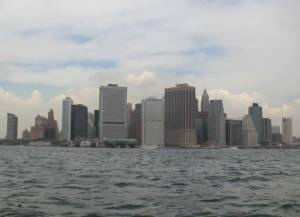
Manhattan without the World Trade Center

Manhattan without the World Trade Center

There have been a number of other episodes on these trips that I felt concerned about what might happen. One day we were approaching Montauk Point as the sun was getting low. Fortunately, we had just met up with a SeaTow captain who had agreed to escort around the point into Montauk Harbor. He had come up a few minutes before to report that the point was “Gnarly”. And he was right. The waves were quite high that day – 6′ to 8′. When we about a mile from the actual point of Montauk Point a thunderstorm started sending lightning bolts all around us and pelting us with wind and driving rain. At that point it was decided that we should call it night. Rick tied his boat up to the SeaTow boat, got in and we headed for the point. In minutes the sky became black and the sun disappeared. I found myself in high surf, with rain and lightning bolts pelting down, trying to follow the lights on the SeaTow boat. It was not easy since he was going as fast as he could and my motor could just barely keep up. We came around the point and just a few minutes later the thunderstorm mysteriously lifted and had a fairly tranquil trip into Montauk Harbor.

One day we were on Long Island Sound, somewhere past Mattituck Inlet, headed toward Mt. Sinai. It was perfectly calm flat day with almost no clouds. There was one cloud way in the distance that seemed to be almost in Connecticut. I took little notice of it for about 15 minutes and then when I looked up I noticed the cloud was now much closer. At that distance it looked like a fairly standard cumulus cloud, not dark or forbidding, just large. I did notice that it seemed to have a purpose and a direction, namely, our direction. I called over Rick and asked him to take a look. He stopped rowing, tuned around and promptly said it would pass us by.

Three minutes later I pulled over to Rick and told not to bother about turning around, just tie up and get in my boat. Rick was really quite irritated, but he turned around to check it out himself. He did not take much convincing. By this time the cloud was big and black and only about a half mile away. Rick got in my boat just as the first drops of rain were beginning to fall. The cloud no longer looked like a cloud. It looked like a black wall that was enveloping us. And that is exactly what it was.

By the time it was over us, it was like someone had blotted out the sun and replaced it with a black tempest. I had sun canopy supported by aluminum poles. I did have a lightning rod of sorts. It consisted to a piece of thick copper wire wrapped around one of the aluminum poles and going into the water. I do know if it was an effective lightning rod, I only know we were not electrocuted. The wind blew at 40 or 50 miles per hour and pushed and pulled my frail canopy to the left and right. Rick and I huddled on the floor my boat which was not easy since there was only about 35″ x 40″ space to sit on the floor. No matter. The rain and wind did their worst. The lightning bolts landed all around us and the sound of thunder almost made us deaf, but in 15 minutes it was all past. The tempest was temporary.

To this day I wonder what would have happened if that storm lasted an hour instead of 15 minutes. I also wonder what if it was an actual tornado instead of a kind of super squall. The whole experience made me feel very small and very lucky. I am guessing Rick felt the same.

On another day, we were approaching East Hampton, Rick turned a little green, said he was not feeling well. Two minutes later he said, “I think I will go in here.”

Here was a Amagansett Beach Life Guard Station. That left me in the Atlantic Ocean, halfway between Shinnecock Inlet and Montauk Point. I had to decide – Do I go for the inlet or do I go around Montauk Point and head into Montauk Harbor? It was a good 20 miles either way. Since I knew the next day Rick would want to leave from the same point he put in and Shinnecock Inlet was slightly closer, I headed back towards Hampton Bays. It is very depressing motoring back where you just came from. It was more depressing motoring back as the weather and the waves quickly got worse. And that is exactly what they did. The day had started calm and beautiful. When Rick abandoned me it was still pretty calm and tranquil, but as soon I started to head back, the waves and wind picked up and, of course, they picked up directly against me.

Sometimes, I would get to feeling that the ocean and the weather had a personal vendetta against me. I know that does not make logical sense, but when the waves go from 2 or 3 feet to 6 to 8 feet and the nice morning breeze morphs into 20 mile an hour wind against you, you can really believe old Mother Nature has it in for you. And that is exactly what it felt like that day. That feeling was further reinforced when I discovered that I was in a no-win speed situation. If I went full speed, I bounced from wave crest to wave crest and felt like I was trying to ride angry 3000 pound bull. If I went at half speed, I got drenched every 2 minutes as I hit each incoming wave. If went slow, I was reasonably dry and comfortable with the sure knowledge that I would never arrive before darkness set in.

In the end I settled on a kind 1/3 speed, fast enough not to get completely wet and still make steady progress. It was a long afternoon and by the time I pulled into the Shinnecock Inlet, it was a true whitewater river with 8′ waves breaking across the whole inlet. Fortunately, I had seen this phenomenon before and I knew what to do. I would wait for wave to break in front of me and then gun it over the broken wave slowing down just before I got to the next wave ahead of me. And then I’d repeat the process. It took about 10 minutes to get through the inlet that way, but it worked.

There were some general perceptions about these trips that emerged. One was how large, intricate and varied the waterways of Long Island were. The inlets on the ocean were completely different from the inlets on the Sound. On the ocean the inlets could be like whitewater rivers and the waves in front of the inlets could be far higher than inside the inlet. On the Sound, the inlets were calmer, easier to navigate. The only exception to that being Plum Gut as you went from Gardiner’s Bay into Long Island Sound. That could have 3′ to 4′ standing waves and a good 6 to 8 mile current.
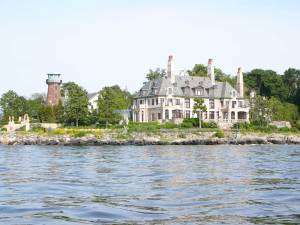
One of the cottages we passed

One of the cottages we passed

The other perception of going around Long Island was how large, intricate and varied were the houses and buildings that adorned the various coastal areas of Long Island. They could be huge estates or small cottages, tall buildings (in the case of Brooklyn, Coney Island, Rockaway and Long Beach), huge sandy beach parks (on both the South Shore and the North Shore). They could be forlorn and broken down buildings like the abandoned hospital in the middle of the East River where Typhoid Mary once stayed.

The biggest and most impressive were the huge houses and estates that ringed the coast of Long Island almost everywhere. As mentioned some were modest and perhaps almost affordable, but most were the possessions of billionaires, not millionaires. The biggest and best example of that being the Ira Rennert house, a 72,000 square foot palazzo that is plopped down on 63 acres of prime beachfront property In Sagaponack.

When I think of these Lilliputian trips around Long Island and think of my great, great, great-uncle’s trips literally around the world, I realize, of course, there is no comparison. My relative Andrew Shewan was literally risking his life and the lives of his crew on those trips. I think of him speeding across the Pacific at 18 to 20 mph, which is how fast the Clipper Ships sailed, generally alone in the world’s biggest ocean, with 18 or 20 men against the sea, seeing nothing and no one for days on end, fighting, struggling to get across the world, avoiding Malay pirates, typhoons, frigid weather, ice, torrid weather, heat, cold, in 40 or 50 foot waves, in gale winds or becalmed on a hot, unmoving sea, and everything in between, with no way to communicate with anybody, no cell phones, no telegraph nearby.
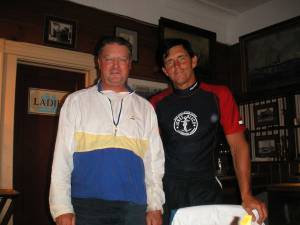
Rick and me after a well-deserved dinner at Claudio's in Greenport

Rick and me after a well-deserved dinner at Claudio’s in Greenport

Yes, my trips around Long Island were truly Lilliputian compared to his. That is not to say that there were no moments of concern, no causes for excitement, no adventures to be had, for truly there were and those trips taught me many things and I am forever grateful to have completed them.

The thing that I remember most about those trips was the end of each trip. I know I did not do the rowing that Rick did. When you think of the effort Rick Shalvoy put in to row the 300 miles or so around Long Island each time, 7 to 10 hours a day, 7 to 8 days a trip, it was truly incredible. I can tell you that just twisting a throttle, sitting on swivel seat on a small inflatable in the middle of the ocean or sound, for the same amount of time was totaling exhausting, so I can only guess how Rick felt. And strangely, even though I was exhausted by each trip, what I felt most of all was a true sense of accomplishment. I will always remember and cherish that feeling.


Posted in Uncategorized | 6 Comments

I Am Sorry About Thomas Jefferson

Our 3rd President

Our 3rd President

I worked with Thomas Jefferson. Not the gentleman whose portrait is shown above, not the 3rd President of the United States, the plantation owner, the slave owner, the founder of the University of Virginia. No, I worked with a black gentleman named Thomas Jefferson. We both drove cabs for Betty’s Taxi, owned by Betty Klemuk in Southampton.

You may ask why I was driving a cab in Southampton. The answer is that I had flunked out the University of Virginia, the same university founded by the gentleman shown above. The story is pretty simple. I had flunked out of college in two short years because I liked to drink beer, go to parties and have fun and I did not see much value in attending classes – this proved not to be a formula for academic success.

Because I had a pretty good education before I came to the University of Virginia, I was able to coast through my courses and actually maintain a C average in the first year. But by the second year, my lack of attendance at the five courses I was taking was noticed, as well as my poor performance on various tests and I was summarily flunked out.

This left me with a problem: what to do? At first I thought that I would be drafted and sent to Vietnam where I would have to worry about staying alive, but by a strange bit of luck, the military did not find me fit for service because I had a hernia. And so instead of going off to the paddy fields of Vietnam, I stayed in New York and tried to figure out what I was going to do. After flunking out of the University of Virginia and hitchhiking to California, I came back to the East Coast and determined to get back into the University of Virginia.

This led me to devise a plan on how to get back in and I decided to take a correspondence course in American History and work for Betty’s Taxi. Since driving a cab in Southampton entailed waiting for long periods of time until someone called for a ride, I determined I could study American History while waiting for jobs. I have to say that I was very upfront with Betty about what I wanted to do and to her credit, she was fine with me taking my correspondence course as long as I was always ready to drop my studies and pick up someone and take them wherever they wanted to go.

This brings me back to Thomas Jefferson, the black gentleman. Thomas was a tall and handsome man in his early 60s. He dressed very well, always wore a sport coat and pressed slacks and thought of himself as a ladies man, even if he not exactly at an eligible bachelor age. And his married status was another complicating factor of the bachelor profile.

There was another black man who worked with us at Betty’s Taxi and his name, if I remember, was Claude Haines. Claude was a much younger man, perhaps in late 20s or early 30s. Claude had been a quite the football player and track star back in the day and he also thought of himself as quite the ladies man. The only difference between Claude and Thomas was Claude looked like a ladies. Young, handsome, well-built, Claude thought highly of himself with pretty good reason. Claude was planning a comeback in the football business. He thought of his time at Betty’s Taxi as an interlude from what he called “his business”.

Claude and Thomas would from time to time discuss their many ladies and this, I admit, did distract me from my studies of American History. Frankly, you just couldn’t help but listen to their talk.

Claude would usually start out.

“I am going down to the hotel tonight and meet my sweet lady, Lorraine.” The hotel was not really a hotel. It was called the Hotel St. James and it was out on Route 27 between Watermill and Bridgehampton. This was a black music club that was often visited by white summer residents. The place was really quite cool. A lot of quite famous Motown acts played there. Mitch Ryder and the Detroit Wheels, Sam and Dave, Smokey Robinson and many other quite well-known groups played there and the joint was jumping. I can attest to that because I was one of the summer residents who went there.

“Loraine,” Thomas would chime in, “what happened to Loretta?”

“Oh, me and Loretta aint a thing no more. Now I am seeing Loraine. She’s my number one lady.”

“Hell, you ain’t even gotten out of the Ls. What’s wrong with you, you lazy or something.”

“Don’t talk to me like that. I had more ladies by the time I was 25 than you ever have.”

“Oh, Claude, you know I am just messing with you,” said Thomas with a broad, gentile smile, as he leaned back on a wooden back chair, he was very fond of leaning back on one the straight back chairs in the Betty’s Taxi office, “but you dead wrong about the number of ladies I had. I sleep with more in a week than you do in a year.”

“What you talking about. I had three ladies just this week.”

“You see, that’s what I am talking about. 3 ladies in week. Hell, you lucky to have three ladies in a year. You’re all bluster, Claude. That’s your problem. Why just this week, I was with Letishah, Sue Ellen and Francine and they was real, not to mention my main number woman, my sweet wife. You got to keep them home fires going.”

Thomas Jefferson usually got in the last word on whatever the subject was, but he did so in a quiet, dignified way.

Well, you can get the jist of their jive and one thing was sure – if I listened to them talk for long, my American History course would be toast. So, I would drop in and out of their conversation, trying to keep count the girls they had and, in the case of Claude, the touchdowns and track records he had and still accumulate some American History. It was not an easy task.

Occasionally, Claude and Thomas would change their subject to cars. On that subject, Claude and Thomas were unanimous. There were only two good cars – Cadillacs and Buicks. They were unanimous about the reason. Those two cars were the only two cars that had enough room for their “womens”.

Claude and Thomas were particular damning on the subject of Volkswagen bugs. At the time, Volkswagens were becoming quite popular in New York and in the Hamptons, but VWs were not making friends with Thomas and Claude. As usual, Thomas got the last word in on the subject.

“Them Volkswagen bugs, they ain’t working for me. Why if I had to bad to fit Claudette in the back seat and we was to get excited, what would I do? Why, there ain’t no room in that thing but for two flies and they’d have to be careful how they goes about their business”

Anyway, somewhere in between the conversations on girls, cars and my American History studies, Thomas told me that he was directly related to the other Thomas Jefferson. The gentleman whose portrait is at the top of this blog story and the gentleman who was the 3rd President of our country. At first, I found this hard to believe, but Thomas explained to me how this could have happened.

“You see, in them days, they had something called ‘nighttime integration’ and that’s how Thomas Jefferson came to be my great, great, great, great-grandfather.”

And although it sounded pretty implausible, the more I looked at Thomas Jefferson’s face, the guy I was driving cars with, the more I realized he looked a lot like Thomas Jefferson, the 3rd President of the United States. In fact, my Thomas Jefferson was the ebony version of the Thomas Jefferson.

Well, I did not think of this much until about 10 years ago when it was reported that the Thomas Jefferson had a slave lady, Sally Hemmings, who was his mistress. There seemed to be some disputes about the truth of this, but that was presumably settled a few years ago when a direct descendent of Sally Hemmings wrote a book on her relative’s relationship with Thomas Jefferson, the 3rd President of the United States. And presumably the matter was finally put to bed, so to speak, when the DNA of this lady was tested and it was found that she was directly related to the Thomas Jefferson.

And when this came to light, several articles were written that because of the fact that the Thomas Jefferson had slaves and because he slept with one or more of his slaves and because he had children from that activity, Thomas Jefferson should not be revered as the third President of United States and it would be a good idea if his name was removed from various buildings, including some buildings at the University of Virginia.

Well, as mentioned, I went to the University of Virginia and, as not yet mentioned, after I finished my American History course and drove cabs with the other Thomas Jefferson, I went back to the University of Virginia and I actually ended up graduating from the University of Virginia. This gave me a special appreciation of the University of Virginia.

So when I saw it suggested that we should try to remove Thomas Jefferson’s name from some buildings at The University, I have to say that it seemed like an extreme measure to me. Thomas Jefferson not only founded the University, he designed many of the buildings and, if you have ever been there, I think you will have admit that it is a mighty pretty place. In fact, it is perhaps, the most beautiful university in America. So taking Thomas Jefferson’s name off of some of the building does seem like a pretty extreme solution, even if he did sleep with Sally Hemmengs.

Recently, it has been reported that Woodrow Wilson was a segregationist and a bigot and there were suggestions that his name be removed from Princeton University, where Woodrow Wilson was the President of Princeton University. I am sure that it was truly the case that the Woodrow Wilson was a segregationist and a bigot and I also think being a segregationist is a very bad thing. But, again, one has to realize that Woodrow Wilson was a President of the United States and a President of Princeton University. I am not saying that we should forgive him for being a segregationist and a bigot. I am not even saying that we should think highly of him because he was a president of Princeton and a president of the United States.

In addition to being President of the United States, Woodrow Wilson was also the man who said we should go into World War I because it would be “the war to end all wars”. Of course, that didn’t work out too well and I might agree he was not the brightest star in the firmament. I would also say that he did not improve himself too much with his conduct and follow though with the Treaty of Versailles.

All of that of course is just history. So, if you ask me, both of those Presidents were not too perfect, but they did do things and they are a part of history. Thomas Jefferson, for example, made something called “The Louisiana Purchase”. That is, he bought from Napoleon, another candidate for having his name taken off of buildings, two-thirds of what is presently the United States. So, if like you anything west of the Mississippi in the present United States, you really have to thank Thomas Jefferson.

This brings me back to the other Thomas Jefferson, the guy I drove cabs with. A few years ago I was at a party and who should I see but Betty Klemuk. There she was, no longer a taxi business owner, but now catering company owner appropriately dressed in a handsome and neat serving frock. Betty was a short but well-built lady and I can attest to the well-built part because when Thomas and Claude and I used to pick up the U.S. Steel executives at the now defunct Grumman airport in Riverhead and take them to play golf in Southampton, one of the U.S. Steel executives, on they way back to the airport, after they had played golf, had lunch and obviously quite few a drinks, would try to look down Betty’s blouse when she rode with the executives in the back. Betty was always very firm, keep your cotton-picking hands off, but she did not mind if the little feller had a look-see. I could tell all this because I was driving and I could see Betty and the U.S. Steel guys in the back seat through my rear view mirror.

Anyway, I was surprised to find Betty was now in the catering business. Apparently, Betty thought there was not too much difference between delivering people to specific places from delivering food to people at specific places. So Betty had found herself a prime position in the Hamptons’ catering trade and it seemed from my conversation with her that times was good. She was catering some of hottest parties in the land and business was booming.

For a while, Betty and I talked about old times, even though I was one of the guests she was catering on – a situation that might have surprised her more than me. What happened with the old taxi business, I asked her. She sold it apparently for a pretty penny. What happened with Claude? He’s selling derivatives in Hampton Bays, making a fortune. What happened with Thomas Jefferson. Didn’t you hear about that? No, I said. He got into an argument at a bar and killed a guy with a knife. He’s in the pen.

I looked at Betty in amazement. Not Thomas Jefferson, he was too nice a guy. Well, you didn’t know it, Betty said, but Thomas, he had a mean side. It did not come out often, but when it did, watch out.

Why did he knife the guy, I asked. It was an argument about woman. It seems Thomas was sleeping with another man’s wife. I could not help but be amazed. Thomas really did have lady friends and that apparently was his undoing. Go figure.

Well, this got me thinking about the two Thomas Jeffersons, Woodrow Wilson and some of my relatives. Now, as I have written in this blog a story on Sidney Cecile Cunningham Hoge, my grandmother. She was the matriarch of our family, a wonderful strong woman and a terrible bigot. And I am really sorry she was a bigot, but I figure she grew up on a plantation in Louisiana and she was kind of influenced by the people she grew up with. That is not to excuse her from being a bigot, but rather to explain her a bit.

And this got me thinking about everyone I have ever known, and the fact that all the people I have known and especially myself, seemed to have had some kind of flaws or made some kind of mistakes. And trust me I am sorry about that too.

In the end it seems to me that all people make some mistakes. Sometimes they say things they should not say, sometimes they do things they should not do, sometimes they do not say things that they should say and sometimes they do not do things they should do. So, it seems to me we are all damned if we do and all damned if we don’t.

“To err is human.” – I believe William Shakespeare said that and I can only say it seems true to me.

Anyway, I would like to get back the title of this blog and say again, I am sorry about both Mr. Jeffersons, the black guy who would ended up stabbing someone to death and the other Mr. Jefferson, the slave owner, the founder of the University of Virginia that I went to and the 3rd President of the United States.

But, as they say, that’s history.

One last point, in case you have not guessed what my college major was, here is the answer: philosophy.

Posted in Uncategorized | Leave a comment

Princess Olga Asks Me To Write This Blog

Olga_Ivanovna_Obolensky

Olga in her younger days

By Cecil Hoge

That is not exactly true. Olga never heard of the word “blog”, but she did ask me to write about my family. Olga, whose full name was Princess Olga Ivanovna Obolensky had read some of my articles in Dan’s Papers. This was sometime in the early 70’s. Apparently, my articles were enough to convince her that I should write about my family. Here is what Olga actually said.

“You should write about your family like Masha’s great-grandfather.”

Masha was Masha Tolstoy and Masha’s great-grandfather was Leo Tolstoy. I had met Masha at a Russian Blini, which is a kind of pre-lent festival celebrated with a kind of Russian pancakes and a whole lot of vodka. I remember heading out one evening with Masha and some of her friends to some Greek place in the city to dance and drink Ouzo like Zorba the Greek. Masha was a wonderful, fun-loving girl, but writing like her great-grandfather, well, that was a stretch.

I should probably tell you how I came to how I came to know Olga, have Russian relatives and, in the process, meet Masha Tolstoy. My aunt, Barbara Hoge, married Ivan Obolensky, who was also a Russian Prince, if you can be a Russian Prince after The Russian Revolution. Ivan was the son of Olga. When Ivan and Barbara came to be married, I came to meet and be related to Russian princes, princesses, dukes and duchesses.

One of the houses the Obolensky's lost

One of the houses the Obolenskys lost

In the 1950s and 1960s New York City was a kind of center of displaced Russian aristocrats. Since the Russian revolution, they had lost the houses, the factories and the villages they had owned, not to mention control of their government. First, the Russian aristocrats (those that survived and left Russia) migrated to England and Europe, but by the 50’s and 60’s, many had moved on to America.

So when my aunt married my new uncle, a whole bunch of Russians came into my life.

This was because my father’s family was quite close and anyone coming into the family met everyone else in the family. So for Christmas, for Thanksgiving and for summers out in the Hamptons, all my family would gather together, Russians included. And this led, inevitably, to meeting Olga and Vladdy and Masha and Ivan and Alex and Dimitri and many other Russians, some of whom were relatives and some of whom were just friends.

About 50 years later, I decided that Olga was right. I should write about my family. I feel she would approve of this blog, even if it is not “War and Peace”.

This brings me to Olga’s story which, by turns, is interesting, tragic and extraordinary. Olga grew up in the court of the Czar. She was in her twenties when World War I and the Russian Revolution began. What that time felt like, what it was like to live in Russia as a princess, what it felt like to live in Russia as a common person or as a serf, what Russia itself was like in days of Rasputin, in the days of Czar Nicholas and his wife, Alexandra, in the days before the Revolution, all that is lost to time and hard to imagine. We can read about it, but understanding and feeling it is a different matter.

Here is her story, as much as I know of it. Olga was born in 1891 and married young, at age 19. The man she was married was Petrik Obolensky, her second cousin. In the years before the Revolution they were happy and had 2 sons, Ivan and Alex.

Olga with Ivan before he walked out of Russia

Olga with Ivan before he walked out of Russia

The times were full of change. World War I and soon the Russian Revolution was upon her.

After she came to the United States in 1948. Olga wrote her memoir. While this book has yet to be published, I will quote a few things from the first three chapters of her book which have been published. Here is what Olga said about the onset of the Russian Revolution and the upper class youth she grew up with:

“In the years preceding the October Revolution, the upper class youth had no interest in politics leaving it to their parents, uncles and aunts – considering politics an occupation of the ‘old folks’.

I remember it well from my childhood. After long dinners, with plentiful, exquisite food, the older generation, whose members for the most part occupied important official government positions, would either retire to the library or remain in the dining-room for coffee and liqueurs. There, ensconced in large, soft armchairs, they would spend hours arguing about current political events with great excitement.

The elders never talked to young people about politics: most probably assuming their lack of interest, they considered it unnecessary. Thus, the high-society youth must have been the social group the least prepared to face the Revolution. When it broke out, my husband and I were puzzled by the events and had no conception whatsoever of its potential repercussions.”

But Olga did have some understanding of what was happening:

“At the end of October 1917, the situation in the country became highly threatening. We had the feeling that we were sitting atop a volcano.”

As the days went by the Russian Revolution first took a moderate turn and became the Kerensky Government and then took a more violent turn and became the Bolshevik Revolution. At that point things got a lot worse, at least for the aristocracy. Czar Nicholas and his wife, Alexandra and their children were imprisoned and then killed by the Bolsheviks. Other aristocrats were gathered up and either killed or put in jail.

Here is another excerpt from the opening chapters of Olga’s book:

“Suddenly I was seized with an instinctive feeling of fear. The huge crowd which had by now surrounded our house was easily capable of smashing everything in its path–the iron shutters, the doors, the windows–and then breaking into the house. Already the people outside were standing next to our entrance. What would happen next?

Taking no account of what was happening at that moment, I hurried to my bedroom, where I quickly took off my diamond earrings, the rings on my fingers, and all the other valuable jewelry that I usually wore. ‘It will be better that way,’ I thought. Next I put on the simple black coat which I wore when working as a nurse (sister) at the hospital and covered my head with a mohair Orenburg kerchief. Then, slipping my jewels into the pockets, I hurried back to the hall. The crowd outside was still standing silently waiting.”

It did not take long for the police to find Olga and her husband, Petrik. They were thrown in prison by the Cheka, the secret police, in 1920. Because men and women were put in separate prisons, Olga went to a women’s prison and Petrik went to a men’s prison.

Olga’s mother, Alexandra, and two sons, Ivan and Alex, were not arrested and they stayed in St. Petersburg while Olga and her husband were incarcerated in separate prisons.

Olga lived in prison for a total of 8 months. At first, she was placed in a solitary confinement cell in a “death row” section where many of her fellow prisoners were systematically taken out and shot. Everyday she was told that the next day she would be shot. But the next day for her to be shot never did come and she never was killed.

What happened is for the first two months she lived in 3′ wide by 6′ long cell. The conditions are almost impossible to imagine. Three sides of her cell was constructed of rough wooden boards, the 4th side was stone. There was no window, no ventilation, and almost no air to breath. On the ceiling of her cell was a bright electric light that was un-reachable and on 24 hours a day. Her bed, if you can call it the that, was some fabric from sacks and some straw. Food consisted of some stale bread and hot water that came once a day. There were insects of all sizes which would crawl all over her whenever she lay down. The walls and floors of her cell was covered with alive and with squashed insects.

Almost every night she was taken out of her cell and mercilessly interrogated by the Cheka, the secret police who had arrested her. Often, she was not returned to her cell until just before dawn. And each day, she was told she would be shot the next day. For all of this time, Olga had to live in the same clothes she had been arrested in. These became more torn and tattered and sweat-stained as each day passed.

As hard as this is to comprehend, it must have been harder for Olga to comprehend. Remember, she grew in the court of Czar. She was used too elaborate jewelry, beautiful clothes, fine foods. She was brought up on large estates, she was entertained on large elegant yachts. Her life before the Revolution must been one of incomprehensible luxury. So the transition from princess to prisoner, from palaces to prison, must have been even more incomprehensible and more horrible for her.

Olga stayed in solitary confinement in her 3′ by 6′ cell for over 2 months and everyday must have been a living hell. Her only opportunity to get out of that cell and breath some fresh air was when she taken nightly back and forth to the Cheka, to be questioned and shouted at and tortured mentally and physically for hours. Then one day after two months, for reasons she was never to learn, she was sent from her 3′ by 6′ cell to the Women’s General cell. By that time, Olga was exhausted, delirious, temporarily deaf and almost dead from her treatment in solitary confinement.

Olga stayed in the Women’s General Cell for another prison for 6 months. There conditions were better with food and water two times a day. Conditions were still terrible. Each day she was eating stale bread, sickening soups, living with rats and insects in the women’s section of the prison, with no heat and only straw and sackcloth to sleep on. She still had no clothes other than the clothes she came with.

When you think about it, this must have been a strange and horrifying change of life. When she and her husband were arrested, Olga’s life took another terrible turn. Not only was her husband sent to another prison, but she was also separated from her mother and children. Quite simply, nothing would have prepared her for World War I, the Russian Revolution, the fall of Czar and his government, the loss of all their family’s land and property and her time in prison.

As mentioned, Olga did sense that some terrible change was coming when she started hearing the commotion outside of her house and the louds shouts of revolutionaries protesting in the streets, but the situation became grave in too short a time to understand truly what was going on. Apparently, the butler came to their breakfast table with their newspapers and informed Olga that most of the servants had left the house. Olga had only a short time to sew some jewels into her dress and leave. Apparently, this happened to many people of her class. There simply was no time to understand that their way of life had disappeared.

A strange side story which occurred before The Revolution is that some of Olga’s fellow aristocrats organized the murder of Rasputin in 1916. For those of you who do not know who he was, Rasputin was a Russian priest who exercised extraordinary, almost mystical control over Czar Nicholas’s wife because only he (Rasputin) was able to help Nicholas and Alexandra’s son Alexis with the disease he suffered from. This was Hemophilia, a blood disorder that results in bleeding or death if bumped or bruised.

Rasputin might have been a priest, but he was no man of God. A drunkard and a womanizer and a man of strange spiritual powers, Rasputin spent his time corrupting princesses and staying drunk. These episodes were known to the public and this scandal was thought so bad that it would bring down Czar Nicholas’s government. Many of Czar Nicholas’s friends and relatives were urging him to get rid of Rasputin, but the Czar would not because he and his wife believed that Rasputin was the only man in Russia who could heal their son, Alexis, or at least, keep him from dying. And in truth there were several documented instances of Rasputin coming to the side of Alexis when he appeared to be dying from an episode of Hemophilia and there are documented instances of Czar Nicholas’s son recovering at least temporarily from this strange disease. It was said that Rasputin had a strange Godlike power to reverse the bleeding.

It is strange to think that a single man could change and influence history, but it was surely true that Rasputin was one of the causes of the Russian Revolution. To be sure there were many causes of the Russian Revolution – poverty, famine, injustice, a government unable or unwilling to rectify these failings, but the issue of Rasputin and his relationship to the Czar and, in particular, to the Czar’s wife was an enormous problem. It was rumored in the streets that Rasputin had put Alexandra under a spell. It did not help matters that Alexandra was German and did not speak Russian very well.

I cite this story because even if Olga was only in her 20s at the time, she must have known something terrible was going on and something was very wrong as early as 1916.

Just being in prison must have been terrible enough, but to be told every day that the next day you would be executed and to live on stale scraps with insects crawling all over your body and your cell must have been an experience in horror that is untranslatable and impossible for us to understand.

Then one night, in the middle of the night, Olga was released from the Women’s General Cell without explanation. Shortly afterwards, she made her way to Petersburg and was reunited with her mother and her two children where they were able to enjoy a simple Christmas together.

But there were still changes and hardships to come. Almost immediately, the Cheka began again to harass Olga and her family.

It was at this time that she determined to smuggle her two children, Ivan and Alex, aged 7 and 5, with the aid of a former footman. Ivan, and Alex and the footman literally walked through forests overland north through Russia and then through Finland. There, they were finally able to take a boat from Finland to France.

Olga was not to see her two sons for over 20 years.

Olga herself stayed in Russia, moved to the city of Kalinin and changed her name to Olga Zvezdino in an effort to avoid government scrutiny and reprisal. She lived Kalinin for many years through the depression years until the beginning of World War II. In this period, Olga lived a drab, Soviet style life, with no money, working as a nurse in the local hospital. Eventually, Olga became the head nurse in her hospital. Again, the contrast of her early life with her later life in Russia must have been hard for her to bear.

In 1941 Kalinin began to get bombed by the Germans and the city descended into chaos, creating more misery for Olga. In late 1941, the Germans invaded the city of Kalinin and because Olga spoke German, she worked as a health medical inspector for a few months. Olga then decided to leave Kalinin and literally walked with group of German soldiers and Russian refugees to Germany, almost dying in the process. Towards the end of this exhausting walk, she collapsed in the snow and was left behind by the group because they could not carry or wait for the weak. It was a compassionate German soldier who found her in the snow and actually carried her to the German border.

Telling this story almost makes Olga’s life up to this point seem surreal, but her subsequent life was also full of many changes.

Olga finally got to Berlin in 1943 where she began her life yet again. Here she was to find a distant relative who able to help restart her life again. This relative helped locate her son Alex and got her permission to go to France and meet up with him in 1943, after 22 years of not seeing him. At that time she still did not connect with her son Ivan and her mother Alexandra.

When Olga returned to Berlin, the situation there started to go downhill. The bombing of Berlin became daily and Olga had to hide out in churches and hardened buildings to avoid being killed. Day after day, the bombing escalated and the situation became more and more desperate. In spite that, Olga lived through and survived the bombing of Berlin in 1944 and 1945.

In an incredible coincidence, Olga happened to be living just a few blocks away from my future step-mother. This meant that two of my future relatives lived in and through the bombing of Berlin in 1944 and 1945. So, my future stepmother and my future great aunt lived in Berlin all through the carpet bombing and fire bombing of that city.

Just before the end of the war, Olga moved to Hamburg and finally reunited with her son Ivan after 24 years. After the war, Olga and Ivan went to France and there she was reunited again with other son, Alex, in Paris. Unfortunately, by this time, Olga’s mother had died. In Paris, once again, Olga began yet another new life, this time with her two sons and other Russian refugees.

Olga lived in France and then went to Hamburg, Germany with her two sons up until 1948. What the post World War II period was like in Hamburg for her and two her sons and the many refugee Russian aristocrats huddled in different parts of Europe is hard to know. So much had changed. I think you could say they found a new life and Olga found it better than living in a prison or living in the Soviet Union after the Russian Revolution. I am sure that even though some sort of normalcy had been restored, life was still difficult and anything but secure.

In 1948 Olga and her sons came to New York on an over-crowded boat in rough seas. The journey took 11 days. The post World War II world was rebuilding itself and Olga and her sons came here to seek new opportunities and find a new life.

How my uncle to be came to meet my father’s sister is still something of a mystery for me. I do know my aunt Barbara was active in organizing many charity balls and life and society was also reorganizing itself here after the earth-shaking events of 2 world wars, The Russian Revolution and the terrible depression of the 1930s.

As I understand it, Olga, Ivan and Alec found a new life in New York, meeting with other Russian aristocrats. Ivan, at the time, began living in Southampton with Angier Biddle Duke in what was known as the Duke Box – this was a group of very eligible bachelors living in Angier Biddle Duke’s house. What I know for sure is that Barbara and Ivan met and came to be married and Ivan ended up being the sole representative in America of Taittinger Champagne for Kobrand Industries.

Kobrand Industries distributed Beefeater Gin, Taittinger Champagne and a lot of other alcoholic beverages. The company itself was owned by Claude Taittinger. It turned out Claude thought his brands would be better sold if a Russian Prince represented his line. And that is what happened. Olga ended up living in an an apartment on 98th street between Madison and Fifth Avenue. This was quite convenient because my grandmother had an apartment on 97th street between Madison and Fifth and my uncle Hamilton Hoge lived with his wife and children at 1150 Fifth which was on the corner of 96th Street, just across from Central Park. Adding to the convenience of it all was the fact Barbara and Ivan moved into an apartment on 94th and Madison. So, I ended up having about 20 relatives in a 6 block area. My father and myself (when I was in town) lived in various apartments from 60s to the 70s to 104th street.

This all meant that we all got together as a family quite often. That was the beginning of meeting and greeting many Russian aristocrats who would come by Barbara’s apartment and drink and smoke and tell stories of the 2 wars, of the Russian Revolution and of times in between and of the time before when they lived in palaces and estates and on yachts and had more money than God and were served on hand and foot.

Of course, many things had changed. Most of these Russian aristocrats were now poor. A few were fabulously successful. Serge Obolensky was one of the successful ones. He came to visit often on holidays. He seemed to have led a charmed life, having left before the Russian Revolution started and having gone to England to live among other aristocrats. Serge had an exotic and exciting career as a Colonel during World War II – he was reputed to be the oldest man to parachute into France. He went on to marry Alice Astor after the war, come to the States, dance with Jacqueline Kennedy and be a man about town just about everywhere you could be a man about town.

Vladdy, Ivan and Serge entering the Southampton Bathing Corporation

Vladdy, Ivan and Serge entering the Southampton Bathing Corporation

Serge would come over to the 94th and Madison apartment where he would come by and have one or two drinks and sometimes dinner. When he came in, he would give my aunt Barbara a hug and say, “Hello, Dahling.” After an hour or so and a pre-requisite martini, he would look up and say, “Dahling, I must be going.”

And out he would go. That is my memory of him.

We did see a lot of other relatives and other refugee aristocrats – the building on 94th street was full of Russian and French refugees and they were fun crew to be sure. They took a little getting used to, trying to understand what they were talking about. This was not helped by the fact that half the time they were talking in Russian or French or German. But even if you did not understand everything they were saying, you could get the jist of most of what they were talking about. And what came through loud and clear was that they were a very exotic group of people with many eclectic views, some very intellectual, some very flamboyant, some prejudiced and one-sided, and all fascinating.

Olga was an extremely dignified lady who had this lilting voice with a sonorous Russian accent. In older age, she had these great sunken eyes that watched people like a hawk and then on occasion, if she was feeling gay, those big, dark eyes would sparkle.

Occasionally, Olga would talk to me about my mother (my mother died when I was quite young).

“Your mother never came into room,” Olga would make a grand flourish with her arm which would gradually rise as she spoke. She always seemed to be wearing an elegant black dress. She was a grand European lady, but she was also all business, but not in the sense that she liked commerce. Far from it, but at the root of her personality, Olga was both very serious and very grand.

And then after a pause demanding quiet, she would go on, “Your mother would make an entrance. Yes, when your mother came into the room, everyone would know she had arrived. They would turn and look.”

Olga was very impressed with the way my mother carried herself and Olga never would mention that my mother drank too much or say anything negative about my mother. In her mind, my mother was a lady. Instead, Olga focused on my mother’s entrance into a room. For Olga, making entrance was very important. It was in her mind a kind of lost art no longer known to people in America.

I saw Olga on and off over many years, at family events, in New York, in Southampton. She was always a grand and noble lady to me.

I understand that she could have her harder moments when she was quite stern with people. For many years she lived in New York with Vladdy Obolensky. Vladdy was Serge’s brother and a kind of polar opposite to Serge. He was a warm and friendly human being who liked his drinks. As an evening wore on his voice would get progressively louder and he would began to tell war stories about General Eisenhower and General Omar Bradley – Vladdy had met them both during the war and he would get wound up, excited about telling his story and almost be shouting. At those times Olga would quietly move in and grab his arm, look sternly, but quietly, and you would see her hand gradually press into Vladdy’s arm.

“Vladdy, I think it is time for us to go,” she would say. And Vladdy would suddenly become quiet and begin nodding.

“Yes,” he would say, now quiet and strangely calm, “We must be going.”

And they would go and walk back from 94th street to 98th. Sometimes, if it was late and dark, I or Ivan or one of Barbara’s daughters would walk back with them, just to make sure they arrived safely. Olga would walk with Vladdy, guiding him as she went, an old woman in black with a black overcoat with a dark fur collar, her back now a little hunched with time, Vladdy a little unsteady on his feet, but now accepting of the fact that he was headed home and the party was over.

I know Olga could also be stern with her two granddaughters, Lizi and Vari Obolensky. They were twins and the daughters of Ivan and Barbara.

When the period of the 60s and the 70s came about and many of the younger generation were experimenting with drugs, Olga had a little heart to heart talk with her granddaughters.

I am not sure exactly what advice and admonitions she gave to her granddaughters. I imagine it went something like this:

“So, children,” she might have said in her heavy Russian accent, no doubt wearing a black dress, “You are trying these drugs. I know about these things, children. Do not try to fool me. I was not born yesterday. What you are doing has been done before. It is nothing new. Leave it, it will do you no good.”

Whatever she actually said, I do not know, but I do know it surprised Vari and Lizi and made a deep impression on them.

I had the honor to attend Olga’s funeral. I remember it quite well. I was a little hung over and I remember standing in a line of relatives before her coffin. It was at the Russian Church a few blocks from Barbara and Ivan’s apartment. There was an Orthodox Russian priest, looking very stern and sinister with a great long gray beard, there were Russian princes and princesses of various ages and various demeanors, some old and worn and haggard, some young and vibrant, some of the younger generation who had grown up in America. There were other Russian people there, some men and women who had known Olga and family, perhaps in Russia and perhaps in America.

I remember I had a hard time standing still in that line by her coffin, but you could sense, a great lady had passed and stand you must. It seemed that ceremony went on forever, but eventually it ended and a bunch of Russians came back to Barbara and Ivan’s apartment, as people do after a funeral, to gather and speak some words of condolence and have some drinks, some food and remember the grand lady who had passed.

Russian funerals do not end with just a single ceremony. The process of morning takes two weeks. The next day Olga’s coffin was taken upstate to a remote area where a lot of Russian aristocrats are buried. There they had another funeral ceremony for Olga. I am not sure why there and I am not sure why they have the additional ceremony. Maybe they prefer to be buried where it is colder. Maybe, they think one ceremony is just not enough. I remember going up to this town and visiting another Russian church, one that was smaller and more authentic, one that seemed like something out of Dr. Zhivago. There was a blizzard outside and it gave me the feeling that I was no longer in America. I felt that I was now in Russia. I did not stay for the two weeks that Barbara and Ivan stayed there. I left that day, but I left with the feeling that Olga was now back in Russia.

Author’s note – As mentioned, Olga has written a book on her life which has been translated into English, but has not yet been printed. 

This is a picture of Olga a few years before her death. She is in second row sitting between my aunt Barbara and my uncle Ivan – my aunt Helene sits happily below, enjoying an afternoon cigarette. I am guessing Olga is watching a tennis match at the Meadow Club in Southampton. Perhaps, Olga is smiling, looking the camera, thinking of her long and strange life, beginning as a princess in the court of Czar, enduring the Russian Revolution, becoming a prisoner in 6 foot by 10 foot cell, later released to become a hospital worker in drab city in Soviet Russia, a refugee who walked from Russia to Germany, a survivor of the Berlin bombing at the end of World War II, a grandmother of twins, a migrant to the United States and, in this picture, sitting with her long lost son watching tennis players on the green tennis lawns of the Meadow Club. Life is strange.
Posted in Uncategorized | Leave a comment

A Fog Moves Into Berlin And I Gain A Stepmother

arithma-addiator-f-120dpi[1]


By Cecil Hoge

In 1954 my father started advertising a product called Addiator. This was a small German adding and subtracting device that was operated with a stylus. When you wanted to add, you stuck the stylus into a slot in one of the top rows with a number that had a red or black tab and if it was black you pulled down, if it was red you pulled the stylus up and around. When you wanted to subtract you stuck the stylus into slot in one of the bottom rows with a number that had a red or black tab and pulled the stylus down if it was black and up and around if it was red. It was an early calculator before electronics and it worked quite well. It was not high-tech but it was the only game in town if you wanted a small device that added and subtracted and fit in your pocket.

I am not quite sure how it happened, but my father got the rights to advertise this product by mail order. This was not a new kind of endeavor for my father. He had an advertising agency at 699 Madison Avenue in New York City called Huber Hoge & Sons Advertising that he started with his brothers shortly after World War II. That agency at first just did advertising for outside clients, but over time it came to advertise its own mail order products that it had the sole rights to.

At the time of advertising the Addiator, my father was also advertising and selling RX15 fertilizer (for lawns and gardens), a number of William Wise How to Books (including a TV repair book), an art painting instruction kit, dress forms for ladies to make dresses, paint brushes to paint walls and tables, Jackson and Perkins roses, Doubleday Books and Arthur Murray Dance lessons. His advertising agency varied from 50 to 100 people, and had 2 or 3 floors of the 699 building, depending on the success or lack thereof of different mail order or advertising promotions.

In short, my father advertised everything and anything that could be sold by mail order. Along the way, my father came to advertise Addiator. At first this product was not very successful, but the first ad results were close enough for my father to keep trying. After several rewrites of a page ad, my father came up with the headline, “World’s Smallest Adding Machine” – see the ad below. That headline proved to be very successful and my father was soon selling far more Addiators than he had a stock of. By 1956, he had already sold over 15,000 units of this little pocket adding machine and found himself with orders, but no stock.

This is the ad that worked

This is the ad that worked

Having a backlog of orders without inventory of a product could be a harrowing thing. Imagine thousands of envelopes filled with orders and checks for $3.98 plus $.50 for shipping. In those days, if you did get more orders than you had inventory, you had 2 choices: refuse the orders and send back the checks or go rushing around to somehow get the inventory made fast enough so you could fill orders.

My father had some experience with this kind of situation and sending back orders with checks in them was not in his vocabulary, but getting stuff produced pronto was. There was a complicating factor. The pocket adding machines were imported from and made in Germany. So my father did the next most logical thing that was natural to him. He got on a plane and flew to Berlin.

There was another complicating factor and that was that the owner of the pocket adding machine company did not speak any English and my father did not speak any German. No problem, my father hired a translator from the German Chamber of Commerce and went to the offices of the pocket adding machine factory shortly after arriving at Templehof Airport, in Berlin. The factory was called quite logically Addiator Rechen Machinen Fabrik.

Portrait of the future Edelfried E. Hoge with their house in the background

Portrait of the future Edelfried E. Hoge with their house in the background

The lady my father hired as a translator was named Edelfried von Kalkreuth. “Edelfried” means noble peace in German. At the time Edelfried was 32. My father’s plan for this trip was to arrive with a Diner’s Card and some spare cash and a few days of clothes and check into a good hotel of the time and conduct his business in 3 or 4 days. That was the plan. It turned out that Mother Nature had other plans for my father.

It took some time for my father to explain to Edelfried what he was trying to do. It must have sounded quite strange to her, whose previous experience was mostly translating for traditional businessmen and women and for diplomats coming from the States. No matter, Edelfried soldiered on and did her best.

One of the hardest concepts for Edelfried to get, other than my father’s excited and rapid fire conversation on his business and the world as he saw it, was the idea that my father had started selling some German product in the U.S. and had run out of stock.

“Warum” – why – was Edelfried’s question. Running out of stock in business was simply something that no self-respecting German businessman would do. No, a German businessman made a plan to sell 5,000 of something, ordered the 5,000 of something, waited for the 5,000 to come in and then made plans to sell it. And long before that 5,000 ran out the German businessman would place another order for more goods, if he thought he could sell more goods. So, the whole thing sounded kind of strange to Edelfried.

But that was not all that sounded kind of strange and crazy. Coming to Germany without much cash and some strange plastic card also seemed very weird. She was very surprised to find that restaurants and hotels in Germany actually accepted this strange piece of plastic. Most of all, my father’s explanation of how he sold the pocket adding machines was particularly weird. My father explained that he ran advertisements in newspapers and magazines and people read those newspapers and magazines and then people wrote out checks or put in actual cash in envelopes and sent their orders to him.

“Verruckt” – a word that means crazy, was all that Edelfried could think. No one in Germany would do such a crazy thing. Yet, here was this tall, excited American telling her that was exactly what he did. Worst than that, when Edelfried heard that my father had started advertising with only few hundred pocket adding machines in stock, had run ads, sold out in days, flown in thousands more and had sold over 15,000 Addiators in less than a year. That really sounded “verruckt”.

I am sure the first day must have been a crazy rush from the airport to the hotel to the German Chamber of Commerce to pick up Edelfried to the Additator factory and offices. I am sure all this rushing around and exciting business conversation must have been exciting. Edelfried was particularly amazed that the German Addiator businessman not only believed every word my father was saying, but was actually anxious to help him get immediately more Addiators. At the end of the first day my father must have been very tired and Edelfried must have thought she had a crazy, but exciting American for a client.

I would guess that my father and Edelfried extended the day to have dinner with the German factory owner and his wife, Herr and Frau Schaffhirt. You could be sure that my father, after a 14 to 16 hour flight to Germany (these were the days of prop planes to Europe), only a few hours sleep on the plane, hasty trips to the hotel, the German Chamber of Commerce, the offices and factory of Addiator and a quick dinner, no doubt with heavy German food and some beers, was one very tired guy.

The next day with 7 or 8 hours sleep, my father must have seemed to Edelfried to be a little less strange and a little less crazy. And by the next day, perhaps, she had become a little more adept at understanding my father’s rapid fire conversation. My father was the kind of guy who could infect people with enthusiasm and no doubt, by the second day, some of his exciting enthusiasm was beginning to infect Edelfried.

So on the second day, my father met Edelfried and Herr and Frau Schaffhirt at the Addiator offices and you can be sure there was lots of exciting conversation about flying goods from Germany to the United States in a great rush.

“Wie viel?” – “how many?” Herr Schaffhirts would have asked.

“10,000” my father would have said. Edelfried would have translated and the number would have immediately seemed strange and impossible to both Edelfried and Herr Schaffhirt and Frau Schaffhirt. So they probably would have repeated the number in both German and English a few times and you could be sure Herr Schaffhirt would question it because my father had only gotten the last 10,000 three weeks ago and now, somehow, he seemed to be completely out stock. Das war ganz verruckt. That was completely crazy. 10,000 was a big number in 1958 and you could be sure Herr Schaffhirt questioned it again and again. At the time he was only selling about 60,000 Addiators per year in Germany after 10 years of trying to sell them.

No doubt Herr and Frau Schaffhirt would confer on how it would be possible to produce such a quantity in such a short time. Sure they had some stock, but to produce 10,000 in a week when their yearly production was 60,000 units must have seemed really strange and in some ways terrifying to the Schaffhirts.

So I imagine it took some time in both German and English to get across the idea and think of how to produce 10,000 units in a very short time. Then another question would come up. What is the plan for the future? In Germany, everyone had a plan for the future so Edelfried and the Schaffhirts would have asked my father, what do you plan to do for the next year.

“I will take 5,000 a week thereafter for four weeks and then 10,000 a week after that and then we will see what happens.”

This statement probably would have been another blow to my father’s credibility. Suddenly, everything sounded totally crazy again. And no doubt, Herr Schaffhirt, Frau Schaffhirt and Edelfried would have interrogated my father multiple times more to determine if he had somehow ingested some hidden drugs during the conversation.

In the end my father won out, as he almost always did, by simply repeating again and again and again the numbers he wanted to buy each week for the next ten weeks. No doubt my father would then bring out a long list of advertisements he planned to schedule and run, all written out in my father’s almost illegible writing on long yellow pad sheets with a whole bunch of other yellow pads sheets covered in more illegible writing, going over estimates of sales, week by week, ad by ad, for the next twenty weeks.

“Unmoglich” – “Impossible”, Herr Schaffhirt would have said and perhaps, the Schaffhirts and Edelfried would have gone out into another room to discuss whether this man was a lunatic and whether what they heard was really what he meant. But as time and conversation passed, no doubt certain facts would be remembered and recounted. Two years before my father had started with the purchase of just 300 units and then had sold over the course of a year, 5,000 units. Four weeks ago my father ordered and paid for 10,000 more Addiators. The goods had been sent by airplane even though the Schaffhirts thought this was insanely crazy. Now my father was in their offices saying he had no more inventory and that he desperately needed more.

Not only that, now this strange, tall American with the fast and excitable English was saying he wanted  5,000 a week thereafter for the next 4 weeks after that and 10,000 a week for the next 4 weeks after that. No doubt there was much use of the German words verruckt and unmoglich.

The day must have passed quickly and my father was probably coming to the realization that this business trip was going a little slower than planned. I am guessing that my father made a hurried call to the hotel to extend his stay and Edelfried also made a hurried call to the German Chamber of Commerce to tell them she was going to be occupied for a couple of more days with this lunatic American.

So no doubt, Herr Schaffhirt invited both my father and Edelfried to go out to dinner with him and Frau Schaffhirt. He needed an interpreter to explain what this crazy American was trying to tell him. And probably on the second night, the restaurant of choice was moving up in the world and Herr Schaffhirt was feeling pretty good about the new order for 10,000 which he was thinking now, just maybe, he would be able to make in the next two weeks. So I am guessing my father’s and Edelfried’s eating experiences were getting pretty convivial as the days passed and maybe by this time, just maybe, my father might have noticed that young German lady doing the translation was quite pretty.

I will take this moment to interject that my father at this time was fully divorced from my mother, so he was so to speak, a free man in Berlin. I would also guess that my father was beginning to have some vague understanding of the city he was in. No doubt these impressions were aided with some beers at lunch and some more beers and some wine at dinner. My father was not a drinker, but if business trip called for him to have a few drinks with his business associates, you can bet that was what he did. And from later personal experience with Herr and Frau Schaffhirt, I can tell you they liked their beer and wine. So, no doubt, Herr Schaffhirt would have been pressing drinks on my father until late in the evening.

And no doubt, as conversations with my father continued, they would have drifted into conversations about Berlin, about the experiences of World War II, about why the Germans were on the wrong side of right (my father was also quite a forthright speaker, so he would have minced no words), about the state of the economy, about life in the city, about life in America, about his hopes and dreams. Because that was the kind guy my father was, he could talk a lot about business, but in seconds he could segway into conversations about the world, about history, about hopes and dreams.

All of this I am sure charmed and amazed Edelfried and the Schaffhirts. Sure, they would have thought he was truly crazy, but they would have recognized him as crazy intelligent and they would have loved him for that.

So, by the third day, they all would be quite friendly and quite charmed by father and no doubt Edelfried was feeling a strange attraction to this tall and weird American. By that time it was probably dawning all of them that this trip was coming to its natural conclusion. The Schaffhirts had worked hard figuring out how to produce the crazy schedule that my father had outlined and while they doubted they could meet the numbers that my father had outlined, they figured that they could come close, by producing maybe half the numbers, week by week. My father, being a realist at the heart of the matter, would have agreed to the somewhat less aggressive schedule.

So, by the end of the third day, they would have had another fine German meal that could not be beat and they would have taken my father back to the hotel with the simple plan to pick him up and take him to the airport in the morning. Edelfried would be picked up by Herr Schaffhirt and then transported to my father’s hotel and they would drive my father to the Templehof Airport and say goodbye to him. And by that time, Edelfried would have imagined that as interesting and strange as this tall American was (he was 6′ 4″, so people almost always had the sensation of looking up to him), this was probably the last time she would ever see him.

But as I mentioned Mother Nature had other plans for my father and Edelfried.

Here is what happened. The next day Herr Schaffhirt and Edelfried showed up at the hotel to take my father to Templehof Airport. They probably should have guessed there might be some problem with the flight because it was incredibly foggy on the way to the airport. When they got to the airport, they accompanied my father to the PanAm flight desk to be sure his flight was on time. Perhaps, not surprisingly, they were told that not only was the flight delayed, it was cancelled because the airplane that was to take my father back to America had not been able to land. The people at the PanAm desk suggested he call the next morning to be sure the next day’s flight would be leaving on time.

So my father, Edelfried and Herr Schaffhirt went back to the hotel and my father checked back in again. No doubt my father adjusted to the situation quickly and went back to reviewing his needs for inventory and how to get more Addiators. And when they ran out of business to talk about no doubt they had some more nice German meals and maybe checked out some of the local sights in Berlin.

The next day Herr Schaffhirt checked in with my father to find out that my father’s flight had again been cancelled. In the meantime, my father began to take his fate into his own hands and so he called Edelfried and suggested that she take him around Berlin to see some more sights. Well, something must have happened between my father and Edelfried.

But that was not all that was happening. Mother Nature was again getting into the act in order to prove she can influence the fate of people and businesses. The fog, which had been pretty heavy to begin with, got even heavier and covered Berlin for the next five days and for those five days, nothing flew in and nothing flew out of Berlin. This had the unintended consequence of keeping my father and Edelfried together for five days and in that short space of time, my father fell in love with Edelfried and Edelfred fell in love with my father.

My father and Fritzi doing some modeling work for our inflatable kayak business in the 1970s

My father and Fritzi doing some modeling work for our inflatable kayak business in the 1970s

So when my father returned to America five days later, he came to me and told me he planned to marry Edelfried and that he wanted me to fly back with him to Berlin in two weeks and meet my new step mother and my new German family and that is what I did.

When I got to Berlin in 1956, I entered a strange, new world. Europe. I could hardly believe that I was there. And I must say I had a blast. Even the flight over was a gas. We took one of the very first jet planes run by Pan Am, the Boeing 707. At the time the plane had only been in service for three weeks and it’s big claim to fame was the fact that the flight to Berlin now took only 9 hours, instead of the normal 14 to 16 hours. And because it was one of the first jets to fly on regular airline basis to Europe, you can be assured that the flight was also super comfortable and stewardesses could not wait on you enough.This was before planes moved seats as close together as possible and at that time seating and service was elaborate and super comfortable.

Once in Berlin, I got to meet my new German family. It turned out that Edelfried (now nick-named Fritzi) came from a very old long line of counts, countesses and generals. Like everything and everybody else in Germany the world changed with the advent of the two world wars. Before World War I, the Von Kalkreuth family owned large estates and houses and family homes. After the World War I, many of the family properties were lost. Fritzi’s father decided to move the family to Tanganyika and start a new life on a coffee plantation in the early 1930s. Edelfried and her family grew up in Tanganyika. That endeavor was prospering when World War II began. Almost immediately, the family had to move back to Germany because war was raging in Africa.

Back in Germany things went from bad to worse. Most of the male members of the von Kalkreuth family became soldiers, went to the Western or Eastern front and ending up getting killed. The female members of the family stayed in Berlin. One of the lucky things for the family was that Fritzi’s father, Gottfried, was already too old to be inducted in the army when the war broke out. So Gottfried, his wife, Edelgard, Edelfried, Ketty (Fritzi’s sister) and Jacky (Fritzi’s brother) were all lucky enough to survive the war.

When I arrived the whole family was living in a large, but not very comfortable apartment in Berlin in the area Victoria-Luise-Platz. The arrival of my father and myself into Berlin was something of a surprise for the family. We had much to learn about each other. Remember, my father had only met Edelfried a few weeks before and had proposed to her only 7 days after he had met her. Talk about love at first sight. It did take longer than just one glance, but things proceeded pretty fast. So when I got to Berlin, we were as new to them as they were as new to us.

This comes to the point of explaining how old I was, how naive I was and how little I knew about Germany. Now it happens that my father always read history books and as a kind of natural course, I also read some history books. And as soon as I learned that I was coming to Germany, I began to read stories and history books about World War II. I was 14 years old at the time and 100% American and very surprised to learn about the truly awful history of the war. My father being far older (46 at the time) had read many books about the war and had also lived through the two wars, so all the history that had passed in that terrible period must have been especially real to him.

For me the history was all new. Even though I was born in the first year of America coming into World War II, many things seemed incomprehensible. The fact that the Germans had tried to exterminate millions of Jews was one of the big and horrifying questions that I had. How could this have happened? How could anybody living in Germany at the time have allowed it to happen? How could anyone follow Hitler? Being just 14, drinking Coca Cola, being an American kid and not knowing much, I repeatedly asked my new family these questions.

The answers my new family gave were also kind of hard to understand. They were living in Berlin, they did not know the terrible things that were happening to Jews, they did not realize the extent of it. And on the subject of Hitler they were even more vague and hard to understand. Hitler had brought order to their country after World War I. In the beginning he was very reasonable. Only as World War II began did they begin to realize he was truly crazy and, by that time, it was simply too late.

A very interesting and unique person was Edelfried’s brother, Ernst von Kalkreuth (aka Jackie). He was almost as young as me and he was an artistic and bohemian type who guided me through German history, took me around the city and tried to make me understand how this terrible calamity had befallen Germany. You must understand in 1958 World War II was still a fresh memory and a terrible stigma in minds of many Germans at that time. The people in Germany were defeated and the whole horror of what Germany had done had been exposed to the German people. And by that time, the German people really had a true sense that not only were they on the losing side, but also that their elders had been on the wrong side and had done terrible things.

Another thing about Berlin at that time was that the city was still rebuilding. Literally, every third or fourth building was simply an empty space of rubble where a building had been. And yet, Berlin at the time, was brand new because all of the existing buildings before World War II had either been fully or partially destroyed and there were only new buildings to replace them. So at the time I visited Berlin, 20 to 30 percent of the city was still gone and the remainder was brand new.

My new family lived in a drafty, high ceiling apartment in Berlin, one of the few buildings that had survived the onslaught of the war. I do not remember much about the apartment, but I do remember that it had a living room, a small square dining leading off other  bedrooms and bathrooms. Living in the apartment were Fritzi’ father and mother, Fritzi, Ketty and Jackie. Since Fritzi, Ketty and Jackie all had jobs, their collective incomes must have gone a long way to pay for the apartment. I would imagine that Fritzi parents also had some small income from the government.

As I mentioned, Edelfried’s Prussian family had lost everything. Estates, apartments, plantations, all of it was obliterated by World War I and by World War II. The von Kalkreuths could trace their family heritage back 800 years and in truth it was a long line of impressive and austere looking Prussian generals and their aristocratic looking wives. How did I know it? They had the paintings prove it. In that apartment were these paintings of various generals and ladies of the family going back an easy 300 years. And when you looked at the paintings their ancestors and the living faces of the present generation, you could see the actual real resemblances.

Edelfried’s father, Gottfried, was the man who bore the clearest resemblance of the portrait paintings. Not only did he have the same sharp facial features of his ancestors, he also sported a dueling scar, something that was very important to acquire if you were a member of an aristocratic Prussian family. And Fritzi’s father indeed had the requisite scar and it was clearly visible and a good 2″ long. Other than the scar, her father’s personality was the exact opposite of what you might expect. He was a short, thin old guy who was always jumping up and down, full of good cheer and, as far as I could tell, full of German jokes. And, he was bouncing, laughing and smiling, asking me questions in German that I did not understand, patting me on the back and then asking more questions in German that I did not understand and then patting me again on the back when I said something in English that he did not understand. Of course, my new step-mother was there to translate all the goings on, back and forth.

Fritzi’s mother, Edelgard, was also a very cheerful and happy person, not grim like the portraits of their family. Frankly, if you just looked at the portraits of their family, you would think the family had given up talking to one another for about 300 years. But that definitely was not the case, they were all chattering along like crazy. This was the first time for me to be immersed in a room where a foreign language was being spoken at the same time as you were trying to speak your own language. It gave me a real case of insecurity because I could not speak their language and I could not understand what they were saying. No matter, I survived the experience and soon learned that my new family were just like other people and after that I just stumbled along and had a great time.

On that trip, I remember we stayed at the Hilton Hotel. At 14 years of age, this was big excitement for me. I had my own room and at the time, the Hilton was the newest and most expensive hotel in Berlin. As a gift upon my arrival, Herr Schaffhirt, who picked us up at the airport, gave me a small 35mm camera. This was the first time I ever had a camera of my own other than a Brownie and I remember being excited to learn how it worked. I looked inside to see the shutter and the lens and the rollers that accepted the film. It was all very mysterious and magical to me.

I remember coming back up to my room after dinner and taking pictures from the window in my hotel room. Below, I could see the lights of Berlin with cars driving on the streets. I would take pictures by propping my camera up on the windowsill and depress the camera shutter button and wait for it to click. It would not be until I returned to the U.S. and developed the film that I found out that instead of capturing the lights frozen in motion, I had capturing the lights of cars moving through the streets as white erratic zigzag streaks. So what I ended up with was pictures of streets lights which were blurry blobs and pictures of car lights which were blurry zigzag lines over the streets. I still loved the pictures even though they were blurry.

Jackie's Messerschmidt took all over

Jackie’s Messerschmidt took us all over

I took that little camera everywhere I went in Berlin and I ended up going a lot of places, thanks to Jackie. As I said, Jackie was the bohemian artist of the family and all the other members of the family were worried about him. At the time, he had something called a Messerschmidt car. This really was not a car. It looked more like a torpedo on 3 wheels because that is exactly what is was. It had two seats – one in the front for the driver and one in the back for the passenger. Normally, the back seat was reserved for one of Jackie’s many girlfriends, but since I was a new member of the family, Jackie took me under his wing and decided to show me the sights of Berlin.

So we zipped around in Jackie’s little torpedo car seeing the sights of Berlin. We stopped in cafes where Jackie sipped beers and I sipped Coca Colas. We went to what seemed like every museum in Berlin and we stopped by the broken down church which still stands in Berlin, still broken down, as a reminder of World War II. Jackie and I had many discussions about World War II. Me, being the brash American kid, could not help asking questions on why people followed Hitler, why they let Hitler lead a campaign to murder Jews, why they followed Hitler into a war they were doomed to lose.

Of course, Jackie was the bohemian of the family so he was happy to admit that Hitler was wrong and Germany was wrong. Sometimes, we would be in these outside cafes, Jackie and his friends, male and female, drinking beers, me soaking up Coca Colas. And those discussion would become pretty heated. But, almost universally the younger generation were ashamed and depressed by what happened during the war. They all usually agreed that Hitler should never have happened, that the war should never have happened and that the extermination of the Jews should never have happened. It was a terrible, crazy time, their parents were caught up in the politics of the day and their parents believed they had to support their country right or wrong. They also made a great point to say that the general population did not realize what was really going on with the Jews. Of course, they were being taken away, but they did not know that those being taken away were being systematically murdered.

Jackie’s own personal history is interesting to recount here. He had been in something called the Reich Arbeit Dienst – Imperial Labor Service. He was just 16 years old. By that time, everybody in Germany knew the war was about to end and that Germany had lost. Bombs were falling everyday on Berlin and stories of daily defeats were becoming known by the German population. Weeks before the end of the war, Jackie was sent to the Western front. It seems that even then Jackie was a bohemian. So the first thing Jackie did as they were being taken to the front, was run away. And the second thing he did was even smarter, he headed for the American front. For three weeks, Jackie wandered through the war-torn fronts of Europe, trying to make his way to the American front. It must have been a terrifying and horrible time for him. He starved most of the time, twisted his ankle and eventually limped, starving, to the American lines. There he was made a prisoner and fed. Within 3 weeks, the war was over.

Since Jackie was then in another part of Germany and there were no cell phones or even regular telephones at the time, he had no way to contact his mother and father, Edelfried or Ketty, to tell them he was all right. They assumed that Jackie had been killed at the front, like many other members of the Hitler youth. It was not for another 8 weeks that Jackie was able to make his way back to Berlin that he was able to inform his parents in the best way possible, in person, that he had indeed survived the war.

It would seem that the worrying about Jackie did not stop because even when he enrolled in art school, his family thought that art school was a frivolous kind of education. It would never pay. And they did not like the bohemian friends he hung out with who had taken a fancy to American jazz, German beer and even Frank Sinatra. All of that would come to no good, his parents thought.

Well, it turned out that they had no reason to worry. Eventually, Jackie came to America, married a fine German girl, had two kids, got a job as an illustrator and designer and did quite well for himself, thank you very much. Among other things Jackie went on to design the packaging for many well-known American consumer products, including among other things, the can for Coca Cola. After his wife died and after many years in the United States, he moved back to Europe. He now lives in France, where he developed a fondness for tennis, and is in his late 80s as of the writing of this blog story (2015).

Anyway, back to my new step-mother and my first adventures in Europe, we did many things in the short two weeks we were there, including going back and forth through Checkpoint Charley and listening to a Bach organ concert in East Berlin to going again back and forth through Checkpoint Charley in Jackie’s Messerschmidt car torpedo to visit a Soviet museum see a Soviet film on how Olga (not my great-aunt, but some worker lady) had invented a new wrench to improve factory production in some Russian town somewhere in Russia. This museum was right on Stalin Alley, which was a row of very impressive buildings in East Berlin.

I remember coming out of the film and walking around the museum where I came to learn that Ivanovich someone had invented the automobile and Igor somebody else had invented electricity and a whole lot of other Russian guys had invented or designed just about everything useful in the modern world. Who knew? I also remember coming out of the museum afterwards and walking around the corner to the other side of Stalin Alley. There, stretching out before me was a truly strange sight. A vast sea of rubble and rocks was spread out for a mile or two.

In the distance I could see a large metal fence with barbed wire and on that fence was a big sign in German. Beyond the fence and sign was an even stranger sight. The new buildings of West Berlin jutting up in the sky in the distance. I must remind you that the year was 1958. It was still several years before the Berlin Wall would be erected and many years afterwards that the same Berlin Wall would be torn down. But even before the Berlin Wall, it occurred to me that people in East Berlin could not long ignore what was going on in West Berlin. In the distance beyond the fence and the sign, the buildings of West Berlin stood impressive and new, a sharp dividing wall itself between the East and West. From that vantage point, I could see the brand new Hilton Hotel, the tallest and the newest building jutting up into the sky, a pronouncement of Western prowess unto itself.

The strangest part of all this was that the sign in front of this sea of rubble and rock. It was pronouncing to the East Germans what a great future they could look forward to. And beyond the sign you could see visual proof of a great future, the only problem being that the great future was on the other side of the fence. The Berlin Wall was erected in 1961 and was to be taken down only in 1989. So much for the history of the last century.

To sum up, I came to Berlin in 1958 to meet a whole new family and to visit Europe. Although I did not know it, this was to be the first of many visits to Europe. In that trip I came to meet and understand something about my family. It was both a strange and a great experience.

One last point, the Addiator became a great mail order success for my father. At one point in 1959 he got up to selling 50,000 Addiators a week, a really incredible number for the time and even at just $3.98 a pop, it added up to some real dollars, maybe not the billions we hear today, but certainly millions of dollars per year. In time, my father sold several million units of the Addiator and, oh yeah, he was married happily ever after.

Posted in Uncategorized | Leave a comment

Our Family Secret


Yes, this was one of the houses we rented. Now it is a museum.

Yes, this was one of the houses we rented.
Now it is a museum.

By Cecil Hoge

Under normal circumstances my family would never be able to rent a house for the summer in Southampton, but my family had a secret. Because they were one related family they were able to rent one house, even though, in truth, they were really four separate families. So, starting in the 1960s and continuing through the 1980s, my family rented one large house each summer.

As mentioned above, the collective family ensemble was composed of four separate families, my father, his wife and myself, my father’s sister, her husband, their two daughters and my father’s brothers and their respective families. Last of all, our family was capped off, fulfilled and driven by the presence of the family matriarch, my grandmother.

All told our basic collective family consisted of 18 people. This necessitated a large house with a sufficient bedrooms to house all these people. When making a selection of a house for the summer, we also had to consider the number bedrooms needed for relatives and guests who would most certainly show up.

There was also the collective financial status of our family to consider, since in some years we felt more flush than others. The word “flush” is probably not appropriate here since our family’s collective financial health ranged from poor to bad to middling decent. In any case, one way or another, the four families managed, usually at the last minute, to raise the necessary capital to rent a house for the summer.

In those days, using the word capital to refer to the money needed for the rent might also be a misnomer. The first house we began to rent on regular basis was The Hill Street House and it cost a whopping $2500 for summer. This meant that the individual contribution of each family was $625. The Hill Street House is still readily visible about a mile from the Indian Reservation on the left side of Hill Street as you approach Southampton. It has today, as it had then, a white concrete wall in front. You may call it our starter rental house and, as such, it was tight fit for our four families, even though it’ run on structure had 11 bedrooms, if I remember correctly.

Reading this today, you may think that $625 per family is exceeding cheap by today’s standards and you would be right, but I want to remind you that in addition to paying rent there were other vital expenses to consider. Membership in both the Meadow Club and The Southampton Bathing Corporation was considered an absolute must. Clothes for attending cocktail parties, balls, lessons for younger family members for tennis, sailing, swimming, tennis and perhaps golf, also had to be considered. There was listing of our respective family’s telephone numbers in the Southampton Blue Book and the subsequent cost involved. There was gas and/or train fare from New York City to Southampton and back. Last, but not least, their were the bare minimum of entertainment costs, which included invites over for dinner and barbecues and at least, one reciprocal cocktail party for the season.

Then, as today, these things cost money and they had to be considered in the overall investment for the season. And while none of these things were enormously expensive in themselves, taken together all these things constituted a relatively large “nut”, especially considering my family’s not so great financial abilities. No matter, whatever the monies involved, my family, through boom and bust, during inflation, deflation, recession, stagnation, somehow found a way meet these expenses, although sometimes the more prosperous members had to temporarily support the less prosperous members.

You may wonder how could an extended family of 18 people get along. My short answer is with lots of cocktails. My long answer is a little more complicated. My grandmother, being the dominate Louisiana Belle she was, was always a driving force behind my family’s social aspirations. She was absolutely insistent that club memberships, listing in the Blue Book and The Social Register, be maintained at all costs. They had precedence over everything except death and hospitalization. If you think taxes should also be on this list, some of my family members would disagree.

The pattern of our family life over the course of these summers took on a rhythm of its own. On Friday evenings the men of the house would arrive by car or train. The wives and their children would gather to greet the returning men. Cocktails would be served and young and old would sit down to discuss disparate events…the week’s toil in the city, the heavy traffic coming out, the dramatic events out in the Hamptons during the week, the difficulties shopping, national or local news, national or local gossip, the weather, any and all of this might be subject of Friday evening’s conversation. It was always animated and that usually called for a second round of cocktails.

The men of the house, now properly relaxed and greeted, would prepare with their wives for the evening activities, which could include a visit to a real cocktail party or going out to dinner to one of many local restaurants. John Duck’s, Ridgely’s, McCarthy’s Bowden Square, among others, would be considered. This is not say that the younger members were not without their own sets of plans. Adult automobiles may have been borrowed, friends were called. There were movies to go to, dances to attend, friends’ houses to visit. Young and old, in short, had plans for the evening. Certainly, in the early years, there were also some members of the house who had to stay home under the care and guidance of a local baby sitter, but the majority of the household was out for the evening.

Saturday also acquired its own pattern, though it may not have been easy for an outsider to perceive. Young or old might, depending on the previous evening’s activities, arise late. Usually, someone would emerge around 8 or 9am and start making breakfast for themselves. Other members of the household would gradually come in and also fend for themselves. My grandmother, one of the earlier risers, would usually sail in around 8:30 and make a substantial breakfast for herself and any other youngsters who happened to be abroad.

My uncle Hamilton was one of the most regular and dependable of the breakfast crowd. He would generally be down by 10 and set himself up at the end of the dining room table. His breakfast was always the same: The New York Times, a glass of orange juice, a pack of Camels, several cups of coffee, a bowl of cereal and a pint of heavy cream. My uncle was plagued with a throat condition which impaired his ability to swallow. There was considerable debate as to whether this problem with his esophagus was a pre-cursor to cancer and whether my uncle’s lifelong smoking habit might be responsible. I don’t think he spent too much time worrying about this.

My uncle’s solution to this problem was to eat extremely slowly.

So, if you came down to breakfast, invariably you would find my uncle seated at the head of the table, reading The New York Times, sipping his coffee, pulling on one of his Camel cigarettes, content from all the worries of the world, occasionally adding heavy cream to his coffee or his cereal. People would be sitting down having their own breakfast. They would leave, others would come, have their own breakfasts and duly leave. Through it all, my uncle would happily peruse his newspaper and nibble at his breakfast. Generally, he finished sometime before noon, just in time to head to the Beach Club for swim and a late lunch.

The family’s Saturday was usually devoted to the Beach Club or the Meadow Club, with activities alternating between swimming, lunch, tennis and cocktails. In late afternoon or early evening, they would reconvene for cocktails. After that, as on Fridays, it was all family members for themselves. Sometimes this many meant they all gathered for cocktails or dinner, but more often than not, it meant that we all scattered to the four winds, each to find their own destiny.

On Sunday, the men would again prepare to go back to the city, sometimes waiting until quite late for the traffic to subside or until the last train was about to leave. The house would assume a quieter demeanor, with only the wives and younger generation there to hold the fort. For those of us who did not have work the weekdays were a glorious time spent swimming and chatting and playing tennis and watching movies and visiting friends houses. For my grandmother, my step mother and my various aunts this was also a period of comparative quiet in which they could chat among themselves, catch up on household duties and prepare for the next weekend.

This was the way spent our summers for over 20 years. Over time, we came to rent many different houses. We lived for a couple of summers in a place we called The Monster. It was an enormous house about a half a mile from the Beach Club (aka The Southampton Bathing Corporation). Fortunately, it had fallen on something like hard times and we were able to obtain it for a steal. It was so large that it didn’t seem to need to be cleaned. The dirt just got lost in the enormity of it all. We stayed a summer in early 1960s in the original Halsey House. This is the same house that is on South Main Street and is now a museum. It was and still is, I suppose, the oldest standing house in New York State. All I remember was the really huge fireplace that doubled as a stove with hanging pots.

We stayed in numerous houses on First Neck Lane and Great Plains Road. These houses were considerably larger and nicer than our original Hill Street House. By this time, my family’s financial condition had passed from poor to bad to a little bit better to not too bad. Through it all, my family somehow found the money to pay for the rent and expenses of living in the Hamptons. The early 1970s found us almost prosperous.

As the family fortunes rose or declined, so did the size of the houses we rented. Good times found us in extremely comfortable quarters, with houses located near the Beach Club and the Meadow Club, less prosperous times found us in smaller, less well-appointed houses further away from the two all important clubs.

But whatever the house and whatever our collective financial condition, summers found us in Southampton and whatever the difficulties of four families living in peace, we generally had a collective blast. This experience, which brought the different families together, actually created closer family ties and made us through it all, happier than we would have otherwise have been.

There was a constant ebb and flow of relatives and friends and house guests coming and going that provided ceaseless activities to whatever house we stayed at. Outsiders, who would come over for dinner or drinks, could only wonder from a distance how it worked. To them it was a kind of mysterious miracle. And truthfully, I am not sure that any of us knew why it did work. Perhaps, it had to do with the centralizing effect of my grandmother, although I suspect some of the wives found her a challenge and in some cases, a true pain.

Whatever the reason, for over twenty years, our family did gather this way, spending their summers in relative harmony, learning quirks and foibles of every family member. And because this was in a time when their was a lot of controversy about the direction the country, with numerous periods of financial upheaval, with doubt about the progress of the Vietnam War, with doubts about the future of the country after the Vietnam War, with the advent of drug use throughout the country, there were many excited and impassioned discussions about the meaning of these events between in the families. I cannot say we all agreed and were of one mind. Far from it, we all had strong opinions and profound disagreements about all these subjects, but through it all we had fun and remained a family.

Posted in Uncategorized | Leave a comment

The Zirinsky House


A painting of the Zirinsky House, courtesy of Bill Zirinsky and family

A painting of the Zirinsky House, courtesy of Bill Zirinsky and family

by Cecil Hoge

Of all the houses in Southampton that my family rented over the years, the nicest one was the Zirinsky House. It was situated at 353 First Neck Lane behind a high green hedge on a 2 acre plot. Not only did it have 14 spacious bedrooms, a large dining room, a huge living room, a good-sized kitchen, a huge rambling porch that wrapped around the whole front of the house, a giant lawn, it also had a gardener’s cottage in the back where the younger members of the family could retire to their own amusements. This house is still there presumably, although it is hard to tell because the high hedge is now twice as high and twice as thick. It is no longer owned by the Zirinsky family. I understand that the cottage in the back has been replaced by a tennis court.

We stayed in the Zirinsky House for 3 years during the early 1970s. This was a particularly exuberant period in our family’s life. Everyone in the family was reasonably prosperous (a condition that was not always the case). I should explain that my family was composed of three bothers and a sister, all of whom were married and had kids of their own. Add to that my Russian great aunt, my Russian great uncle and my grandmother and you come up with a basic family unit of up to 20 people. The reason for so many family members in one house can be summarized by one word – economics. Simply put, without sharing the expenses, we could never had rented such a house.

At this time, the younger members of the family were no longer so young. I, myself, had just graduated from college and was coming up from Virginia to enjoy the many benefits of the Hamptons with several of my college buddies. My male cousins were all of drinking age and feeling their proverbial oats. My female cousins were also quite grown up and creating quite a stir of their own with their long hair, long legs and micro mini skirts. All my college buddies were extremely eager to visit.

The adults were also feeling their oats, the family’s finances seemingly running on all cylinders. My aunt Sarah, was at that time the social director the Modern Museum of Art, giving her not only a great job, but also great social connections. My father’s business was chugging along quite healthily. My other uncles were also blessed during those years with better than average incomes. One was a Sales Manager for Taittinger Champagne and Beefeater Gin, meaning, if a party was to be given, we certainly knew where we could get some good booze.

All the above facts, aligning like so many stars, led the family to one grand conclusion: it was time to have a reciprocal cocktail party. It takes a certain divine understanding to know just when to give a reciprocal cocktail party. Timing is all important. You don’t want to give it too soon (in which case will not have maximized your cocktail party attendance) and you don’t want too late (in which case you will have worn out your welcome and will face declining cocktail party invitations).

If I might say so myself, our timing was impeccable. Once motivated to the task at hand, each family set to work to enlist all the assets available. Each family made up lists of friends. These lists were then compiled by aunt Sarah, who added celebrities from her Museum of Modern Art star party list. Each family called in favors from catering services, grocery stores, florists. My Russian uncle provided a large portion of the drinks, including significant quantities of Taittinger Champagne. Some of my younger female cousins persuaded some local band members to provide music. In short, every family resource was utilized and all stops were pulled out.

The result was really quite extraordinary. The guest list included Henry Ford, Andy Warhol, Gina Lollabrigida, Norman Mailer, Truman Capote and about 700 other prominent Southamptonites. Not all these people showed up, but well over 500 did. First Neck Lane was almost completely blocked off by the cars lining each side of the road. Fortunately, one of my aunts had thought to enlist the help of 2 of Southampton’s finest off duty police officers to park cars and to make sure no guest ran into one of the many nearby hedges.

I knew we really had a good thing going after I had a half hour conversation with the FBI agent who had captured Patricia Hearst (I believed he later married Ms. Hearst, who was in the process of recovering from her kidnapping and brief criminal career). Immediately after discussing the ups and downs of Ms. Hearst’s emotional life with her FBI beau, I turned around and found myself deep in conversation with George Plimpton, whose book, The Paper Lion, I had only recently read. Mr. Plimpton, who is quite a tall man, was extremely kind to me, giving me great encouragement as I tried to explain my literary ambitions. I don’t remember him inviting me to submit anything to The Paris Review, but he very kind to me for 20 minutes.

This party was a great success. Wealthier Southampton friends, who had known me for years, suddenly became convinced that my father had come into millions. The same reaction was enjoyed by all members of the family for this was to be considered one of the parties of that summer.

And although that party was a highlight of that particular summer, it was by no means the only highlight of staying in the The Zirinsky House. The house was large enough for almost everybody to have house guests. Myself, my parents, my aunt and uncles, their assorted children, all had various house guests over the three summers we stayed there. Some were kind of odd and surprising. One morning I got up and came down to find my uncle having breakfast with Roger Daltrey, one the founding members of the rock group, The Who.

It was kind of odd. There was my uncle with his pack of Camel cigarettes, a cup of coffee, his New York Times, a bowl of cereal and a pint of heavy cream. Seated next to him at this big dining room table, looking a little out of place, was Roger Daltrey. It seems my cousin Cynthia had brought him by, introduced Roger to her father without mentioning that he was rather famous and had left him seated at the dining room table while she went off to change.

I should mention that my uncle, an ex-marine and a rather conservative gentleman, was rather dubious of anyone with long hair, which Roger Daltrey had in spades at the time.

My uncle began by probing Roger on his opinion of the Vietnam War. Roger was smart enough to say he was not into politics. Then, my uncle, after taking a pull on his Camel cigarette, adding some heavy cream to his coffee and cereal, asked Roger point blank what Roger did.

Again Roger took the high road of vagueness. He was trying his hand at music, he explained.

“Did it pay well?” asked my uncle.

“Not bad,” Roger said just as Cynthia came down, her long blond hair coming down almost to her waist, looking tanned and fit, in a form fitting lavender knit shirt and a white micro mini skirt.

“We’re outta of here, dad,” she said as she and Roger whisked out of the dining room.

When later I explained who Roger Daltrey was and that he was probably richer than most people in Southampton, my uncle made the following comment:

“Nice young man, needs a haircut.” and he then went back to his breakfast of champions – cigarettes, cream, cereal and coffee.

The fact that the Zirinsky House had a cottage in the back was an added benefit that allowed the younger generation to partake in the panaceas of the time – namely, beer, funny little cigarettes and munchies. Each Friday and Saturday evening, the younger members would gather in back by the cottage, have some refreshments and then go back the big house and laugh and giggle while the adults had cocktails. The parents could not quite understand what made their kids so amused, but everybody had a good time in spite of some confusion.

You could say that those three summers were the high moment of our 20 years of renting summer houses in Southampton. In truth, the Zirinsky House turned out to be one of the last houses we rented together as an extended family. The reasons became fairly simple. Just a few years later, owners of the houses on Dune Road, First Neck Lane, Great Plains Road, South Main Street found out that they could rent their properties at tens of thousands or hundreds of thousands of dollars per month. Quite simply, the new reality of summer rentals made our four family summer rental system no longer viable.

Still, I think back to that period and I remember the many years our family enjoyed those many summer days in the Zirinsky house and in other summer houses we rented as a one giant family. I remember the summer evenings having cocktails on the porch, throwing Frisbees around yard, playing croquet or badminton on the expansive green lawn, sneaking away to the cottage in the back. I remember as if it were yesterday the smiles and laughter of my many relatives, many of whom are now dead. I cannot help but think, in spite of the odd inconsistencies, it was a remarkable and truly wonderful time for my family.

Posted in Uncategorized | 4 Comments

Grandma Causes a Ruckus

Grandma with my mother and aunt

Ann B. Shewan – my Grandma with my mother and aunt

Grandpa with Mom

Grandpa with Mom

by Cecil Hoge

I never realized that my grandmother, Ann B. Shewan, caused the Town of Southampton so much trouble. I doubt she ever felt sorry for the trouble she caused. She had a tendency to cause trouble for people. I guess you could say she was a beautiful, but difficult woman.

My knowledge of her doings comes from some old family newspaper clippings and some brief reminiscences of my mother and my aunt. We will never know what really happened to her pearls and her other jewelry.

That summer my grandfather, Edwin Shewan, rented a large house on Great Plains Road called “Strathmore”. This house is still there situated behind a tall green hedge with a long blue stone driveway leading up to a large white house with imposing white pillars. My grandfather, his wife and their two young daughters must have been very happy there. At the time Southampton was known as “The Queen of Long Island’s Watering Holes”. The year was 1925 and Long Island must have been a beautiful place to live.

How my grandfather and his family got to Southampton from their Fifth Avenue Townhouse in New York I am not sure, perhaps, in a large automobile or on the Long Island Railroad.

Stolenjewelrysmall

I found this newspaper clipping telling the story the missing pearls and jewels.

They came early that summer of 1925 and began enjoying the benefits of what was then called “a summer cottage”. Just when The Meadow Club and the Southampton Bathing Corporation opened their doors I am not sure. Nor do I know if my grandfather and his family were members. My grandfather’s family were from what I called the “pirate” side of my family, meaning that they were far richer and somewhat less respectable than my father’s family. On my grandfather’s side I come from a long line of sea captains and the further you go back the more likely it was my direct descendants were actual pirates. This heredity might have played into the events that were to transpose in the Summer of 1925.

My grandmother, who was reputed to be one of the most beautiful women of her day, reported to the police that her prized pearls, valued at $32,000 and a jewel bag of other jewels worth $15,000 was missing from their house on Great Plains Road. The police duly came and searched the large summer home and questioned repeatedly the 5 employees about the missing ring.

I remember hearing from my mother that grandfather would disappear into his private study to have a scotch whiskey during the investigation. This was the period of Prohibition and it was not strictly legal to have a drink in front of a police officer. Anyway, my grandfather was apparently convinced that the pearls had simply been misplaced by his wife. This was an opinion that he offered to his wife, apparently to her everlasting fury. Grandmother was convinced that something more sinister was afoot (like the theft of the pearls and the jewelry by a servant) and insisted that the police redouble their search.

At the time, the police department consisted of two people, a single police officer and a gentleman who filled in “big investigations”. That other gentleman’s primary job was mayor of Southampton.

The search proceeded and all the occupants of “Strathmore” were intensely questioned. This brought a new theory. One of the maids speculated that the $32,000 pearls might have been “accidentally” thrown out in waste paper basket. That of course did not account for the missing bag of jewels.

My grandfather, according to my mother, was a leading proponent of the “waste paper basket” theory. After voicing his opinions to the two officers, he disappeared into his study, fixed himself another scotch and later came out to say with great conviction, “Yes, that must be it.”

Grandmother, being the beautiful and dignified lady that she was, had change of heart and said, “Well, maybe, a foolish maid had thrown the pearl into the waste paper basket.”

Not wanting to be too hard on the girl involved, my grandmother gave her the benefit doubt by saying that whoever it was probably did not realize that the pearls were wrapped up inside an opened envelope that my grandmother had left somewhere in the 16 bedroom cottage.

This led the police officer and the mayor of Southampton to conclude that most probably the pearls had been thrown into a waste basket. Both my grandmother and my grandfather, after some heated discussions, concluded that this must be correct and my grandfather went off to his study to mix himself another scotch.

There was one basic problem with this theory and that was this – all the waste baskets and the trash cans and the garbage pails had just been emptied that afternoon into a model T pick-up truck and taken off to the town dump.

That knowledge led my grandmother to a new conclusion. A search of the town dump must be organized, she said.

“Yes,” said grandfather, warming to the new task at hand, “A search must be organized.”

The police officer and the mayor, naively hoping that the unified theory of accidental loss would bring the matter to a calm conclusion, quickly exclaimed that a search of the town dump would be quite impossible. The dump, they explained, was over 5 acres in size and the garbage might have been dumped anywhere. And then there was the cost involved and the fact that Southampton had no employees to conduct such a search. The police officer and the mayor wrapped up their argument with stating that such a search would be impossible these impossible circumstances.

I am guessing that this was the first time the two Southampton officials had ever talked to my grandparents. What was impossible to my grandmother was the official’s argument that a search would be impossible.

At this point my grandfather exerted his considerable power.

“Cost be damned, I will pay for it. We will organize a search tomorrow.”

I am told my grandmother gave my grandfather a big loving hug.

So, despite the protestations of the local authorities, my grandfather hired 15 men to search the town dump the next day. This caused quite a stir in the town. The local paper felt compelled to cover this story and reported on the very thorough search that was conducted. This story proved so intriguing that the New York Times and other papers picked it up. My grandparents were residents of New York City, so it was not surprising that the story had legs. Anyway both the Southampton paper and New York Times dutifully reported on the search as it continued over the next three weeks.

This story was also covered by The Brooklyn Eagle and that was understandable because my grandfather had a very shipyard located in Brooklyn employing over 2,000 people. It was natural therefore that the Brooklyn Eagle cover a story about the Shewans.

Alas, after three weeks and several thousand dollars expended by my grandfather, no pearls or jewelry bag showed up.

What did show up was a ransom note signed by “The Hustlings Gang”. The ransom note, written in a vaguely familiar hand, stated that my mother and her two children would be kidnapped and there would be “dirty work” done by the Hustling Gang. The note went on to say the Hustling Gang were quite capable of killing my grandmother, my mother and her sister. The note concluded that unless $500 was paid on some appointed evening they surely would die.

The author claimed that he needed the money to buy a new car. The note said that my grandfather was to meet the leader of Hustling Gang on Dune Road five days later at midnight in a car bearing the license plate 2N-1177. A final P.S. said if my grandfather showed the note to the authorities, the family would be in mortal jeopardy.

As mentioned above, the note had a vaguely familiar look. Once again, the combined forces of the Southampton Police Department were called in. I am quite sure that they were much happier having to investigate a real kidnapping note rather than a missing jewelry case.

This new investigation led to my grandfather hiring two Pinkerton guards to watch my grandmother and her children. The one Southampton Police officer and the mayor of Southampton then conducted an interview of all the hired help at Strathmore.

After a few days, it became apparent that my grandfather’s chauffeur’s handwriting strongly resembled the handwriting on the kidnapping note. Within a few hours an arrest was made and the poor chauffeur was taken off to jail. Within due course the man confessed to his crime, was prosecuted in court and was sentenced to many years in jail.

The two Pinkerton Security Guards were kept on as permanent employees. My grandfather had been shaken by this event and wanted to be sure that nothing like this would happen again. Actually, I have another theory about that. I think my grandfather had some doubts about his wife’s faithfulness. I found some other newspaper clippings about my grandmother staying in Deauville, France for the 1928 summer season while business matters called my grandfather back to the States.

“The rumors are quite unfounded,” my grandfather told the New York Times, “we are very happy. And by the way, the rumors about my wife palling around with Princess Vlora are pure exaggeration. Why she hardly knows the lady. And I am not the Shewan who had his yacht, The Patricia, sequestered by custom officials off of Sag Harbor, who found 1188 bottles of whiskey on board. That was my brother, James Shewan.”

I happen to know my grandfather was not coming forth with the whole truth, since he indeed was the Shewan who happened to captaining the good ship Edwina (not The Patricia) when it ran afoul of Customs Authorities. As to who Princess Vlora was I have no idea.

What I also know is that in 1929 the New York Times reported on a nasty divorce in which my grandmother was to receive $18,000. per annum from my grandfather. The high cost of leaving was considerably lower then. I am sure that many of today’s billionaires would be very jealous.

In any case, it seems that my grandmother was quite a high strung lady and a grand looker, as you probably can tell by the picture above and the picture at the beginning of this article. The French newspapers reported that she was the most beautiful woman in Deauville for summer season of 1928. In 1929 various newspapers, including the New York Times, reported that my grandfather had found his wife in arms of a soon to be doomed stock broker. Apparently, my grandfather’s two Pinkerton guards had led the way.

Champagnelady

Here is another newspaper clipping I found regarding the antics of my grandmother. It seems she was just too hot to handle.

Other articles went on to associate my grandmother with a man named Billy Rich – I am not making this stuff up. I still have the old newspaper clippings. There were also were several reports of my grandmother drinking Champagne with her Swedish masseuse who apparently was a childhood friend – see the above newspaper clipping from the The Daily News in 1931. The masseuse was reported as saying he always enjoyed having a bottle of Champagne with my grandmother, although he frowned on my grandmother’s habit of putting ice in her Champagne glass.

I don’t know what happened with my grandmother. After her divorce, I gathered she kind of fell out of our family history. I do not remember my aunt or my mother ever telling me much about her. The Roaring Twenties and the worldwide depression that followed it must have been a topsy/turvy period and a very difficult time to find your moral compass or your lifelong destiny.

I like to think my grandmother ran off to Europe and remarried and, after the second or third marriage, found true love, became quite wealthy or not. Maybe she took up an interest in religion or the arts or became a lover of cats. I hope and trust, as the years past and her beauty faded, she became a wiser person content with who she was, whether that that was rich or poor.

I am sorry that I never got to know my grandmother and I am sorry for all the trouble she must have caused the good town of Southampton and other folks. She must have been quite the babe. I would have loved to have sipped Champagne with her and hear her full story.

Posted in Uncategorized | 1 Comment

A Family Friend Starts A Garden

Herbby Cecil Hoge

In the late 1970s, a family friend decided to take up gardening. At the time he was living in a sprawling farmhouse on 10 acres of prime potato growing land. This property was set on one of the back, back roads north of The Highway behind Watermill. This farmhouse was surrounded by potato farms of all sizes. I remember visiting this friend a few weekends in the winter and riding snow mobiles around the property and listening to loud music and drinking beer in the evening. It was the kind of place that you could host a party of 1500 people, bring in several loud bands and 200 cases of beer and no one would ever know.

I guess that is what gave this person the idea to take up gardening. There was lots of land to plant any kind of vegetable or plant one might choose. Ten acres of land is quite a spread and almost anything would grow because the land was very fertile. In fact I have often thought that this land might be ideal for planting a vineyard. This thought was born out a decade or two later when large vineyards were indeed planted and subsequently flourished just a few miles away.

No matter, this friend, whose shall remain nameless for reasons that will become obvious, had other ideas. It seems he had big plans which he relayed to no one. We found out about those plans when the local newspaper broke the story.

“Watermill man arrested for growing marijuana on potato farm.” This was alarming enough until one read a little further.

“The arrested suspect stated the marijuana was for medicinal purposes only,” said one of the newspaper accounts. The newspaper went on to state that this acquaintance told police that he was suffering from chronic back pain and that he found relief only by smoking pot.

The newspaper stated that this seemed like a stretch since the police had found 178 pot plants on the property, each 3 to 5 feet in height. That seemed like quite a lot of pot for personal medicinal purposes and the newspaper just didn’t buy explanation the 178 pot plants were for medicinal purposes only.

Here I have to intervene on the part of my friend. It is absolutely true that he had long suffered from chronic back pain. I know this because some years later he decided to have a back operation to get rid of his pain. As to the question as to whether he smoked pot to relieve his pain, I do not recall that he spoke to me about this. I do know that he smoked pot and he had back pain. This seems like pretty strong causal evidence that he was indeed telling the truth.

I can also say that this friend tended towards extremes.

“If it is worth doing,” he always said, “it is worth over doing.”

Now, I am not trying defend his point of view, but I am trying to give you a window into his mind. My friend had a natural tendency to overdo things. Even today, if you go out to dinner with him and he asks if you would like to share a nice bottle of wine, say no, because if you say yes, he will promptly order a $1200 bottle of wine. You may ask how many places serve a $1200 bottle of wine – well, that question might not be pertinent in The Hamptons, but no matter, $1200 is a lot for a bottle wine.

However, if you are going out with my friend, trust me, the restaurant will have a $1200 bottle of wine. And probably many other bottles of wine costing considerably more. This is because my friend does not go to restaurants that do not offer $1200 bottles of wine. And if you do have one bottle of $1200 wine, he is going to order another. Again, I am not trying to defend his actions, but rather give you an idea of his point of view.

Back to the 178 pot plants, I asked my friend about this. Why would he grow 178 marijuana plants? My friend immediately corrected me. This was a gross exaggeration, he said, the cops had miscounted, there were only 159 plants. On the other hand, he felt the cops had significantly understated the size of his plants, which he said were an easy 4 to 6 feet.

I asked my friend if all these plants were to relieve his back pain and he said that he had not expected so many plants to come up. Apparently, a friend had given him a large bag of seeds and he thought it was a shame not to plant all the seeds – waste not, want not was another of my friend’s mottoes.

Of course, the real surprise was that almost all the plants had actually come up. What was his secret of having so many plants come up? He told me that he really not done anything special. One day in late May, he began throwing the seeds on the ground and pressing down on them with his boot. After 3 beers, he went back into the house. That was it. Oh, yeah, he remembered one other detail, it rained that evening.

About two weeks later, little marijuana plants began to emerge. About month later he began pruning some of the plants to test for the quality of the product. It was pretty good, he thought. That summer he kept testing the quality of the product and, theoretically, easing his back pain.

My friend never told me about this until after the fact of his arrest. I do remember he was pretty cheerful that summer. He had a tall thin girl friend with blond hair and come to think of it, she seemed pretty cheerful. The two of them would come over to our house, giggle a lot and then suddenly ask what was in the refrigerator. It seemed that they both had a bad case of the munchies.

My friend told me that he was just getting ready to harvest his crop when the cops showed up. It certainly was a bummer day for my friend. He figured he would have enough marijuana to keep his back pain at bay for the next hundred years. And then all his plans came to naught.

My friend never found who alerted the cops. Maybe it was his blond girlfriend. He had just exchanged her for a brunette – if you can’t love the one you are with, love the one you want, my friend said.

I am not quite sure how my friend explained his 178 or 159 pot plants to the court – I think he claimed that he thought he had the legal right to grow marijuana for medical purposes. Apparently, the judge, while not very impressed with the legal defense, felt my friend had no intentions to be a criminal and gave him a minimal sentence. My friend must have had a good lawyer.

Today, my friend is a pillar of his community. He married a beautiful wife and raised several smart and beautiful kids. He has a special fondness for his mother and has made sure she was well supported in her old age. In fact, in almost every respect, he is a very respectable guy. He does still have a penchant for a $1200 bottle of wine every once in a while, but not more than twice a week. Fortunately, through hard work and somewhat limited wine consumption, he has been able support that habit.

I keep telling him that he should consider less expensive wine. His response is that if he needs to improve the condition of his heart, he has to be sure that the quality of the medicine is above average.

Some things never change.

Posted in Uncategorized | Leave a comment