My Hospital Visit

This is where I went!

This is where I went!

By Cecil Hoge

A day after returning from a recent trip to Asia, I fainted in the bathroom and managed to smash my right leg in a couple of places. My wife, who was concerned to see me fall and lose consciousness for a minute or so, insisted that she call the doctor. It was my guess that my fainting was a simple case exhaustion after a 9 day trip to Asia and a cold that I had caught, but my wife thought it was best to be prudent.

From there things went downhill fast. She called my doctor who was not available and ended up speaking to his assistant. The assistant said I should go straight to the Emergency Room and get checked for a stroke or a heart attack. Well, I didn’t think I had either, but my wife is a determined woman who believes in the edict Doctor Knows Best. I don’t, but I also know arguing with my wife over such things is a losing game. Hence, in a very short time, I found myself on the way to the emergency room.

On arriving at the ER , the admitting nurse, a sandy-haired and somewhat balding young man, asked about 3 questions and then called a “code orange” situation. That means that I may have had a stroke. I did not think this was necessary, but it certainly made me feel well-attended.

Immediately, I was whisked into the ER holding room to have blood tests, blood pressure, X-rays and, shortly thereafter, a Cat Scan taken. The attention, though not requested, was quite impressive. Nurses rushed around bringing water, taking vials of blood, hooking me up to an IV and presenting me with a turkey sandwich and a nice plastic receptacle to pee in. Multiple doctors and nurses came in to ask my name and birth. I proudly recited both with lightning speed. I knew their intentions were good and it was their job to ask the same questions time after time. And, true to their profession, they asked my name and birth date about 25 times.

It was only after about an hour of various tests and 10 vials of blood being taken that they announced that I would be admitted to the hospital for observation. I tried to argue that this was unjustified. My arguments were listened to respectfully and then denied. They said a Dr. Roth had determined that I should stay the night for observation. According to a nice young doctor lady named, Dr. Cooper, Dr. Roth was an excellent neurologist and also a very nice lady.

The fun did not stop there. They went on to say that I also needed an MRI of my brain and an Echo Cardiogram of my heart. I could see this was going to be a very exciting day. Personally, I would have preferred to stand up, walk out and leave, but several new doctors arrived to tell me what an imprudent thing that would be. At this point, I was comfortably enscounced on a hospital bed and my wife, who had back and knee issues plaguing her, decided to go home for a short break. After about an hour of munching on my turkey sandwich and drinking some water, some guy showed up and rolled my hospital bed to the MRI room.

There I got onto the MRI Table, put on earplugs and a MRI helmet to cover my brain. Soon I found myself inside the glorious machine which made an incredible racket. I tried to imagine that I was listening to some new, atonal guitarist like Slash or Motörhead, although if it was Slash or Motörhead, I am pretty sure they also wore earplugs. Anyway, after 28 minutes of banging, knocking, screeching, grinding, beeps, bells, dongs at the highest possible decibels, I emerged from the tin can, had the earplugs and helmet removed and was told by a trim Korean lady that the agony was over.

Almost immediately, I was whisked out of the MRI room on my roller bed and told the next stop was the Echo Cardiogram room. A young lady came and then rolled me off. It turned out to be a busy day in the Echo Cardiogram Room, so I was rolled off something called the Nuclear Room. There, in a corner behind a curtain, the nice young lady smeared some goo on my chest and took something that looked like a pestle for pummeling garlic, but was not, since it was metal and had an electric wire sticking out of it. Then she pushed the metal pestle against my chest and began to pummel me for the next 20 minutes while looking at a computer screen. She was kind enough after the procedure was finished to say that she saw nothing bad that she could tell. Of course, she said dutifully, the pictures from the Echo Cardiogram would have to be reviewed by a cardiologist.

After that the real excitement began. I was wheeled to my new home…room 314. There I found a gentleman named Orlando in the next bed with his daughter sitting by his side. A curtain separated out two beds and my bed was next to the window while Orlando’s bed was nearest to the door. For a while things went pretty well. I didn’t hear or see Orlando even though he was in the room with me only a few feet away. His daughter seemed to be pretty jovial, asking her father to think of the medicine a nurse was trying to administer as vodka. That seemed work well as long as his daughter was around. However, things went south once she left.

The first thing I noticed was that Orlando had some kind of bowel problem. This became evident as a succession of nurses came to change his clothes and wash him up two or three times. From the smell of it, I judged the bowel problem to be of the solid variety. And I could tell by the offhand comments of the nurses that they were, as is perfectly understandable, getting fed up with the mess up and clean up routine of Orlando.

Pretty soon a special ringer nurse was brought in. At first I thought he might be a relative, but I finally realized he was a late night nurse brought to help out with the more difficult cases. Pretty soon Benny (that was his name) was doing his very best to take care of Orlando. In doing so, Benny noticed I was watching Fox News about the election. While Fox News is not my favored media, I, being just back from Asia, was eager to catch up on all opinions of each station, so I was moving back and forth between Fox and CNN, soaking up their diametrically opposed opinions. I have to say, horrifying or not, the Presidential Election of 2016 is really interesting.

Anyway, Benny, in between trying to calm down Orlando, started to ask me questions about the election. Who did I think would get elected, Benny asked. I said I was afraid that Trump was going to win. How could he win, asked Benny, Trump hates everybody.

Well, I agreed that Trump did seem to hate everybody, but I still said that I felt that he might really win. For a while Benny and I had a nice conversation on the state of the world and for while, things the room were pretty quiet.

Around 7 pm and while Orlando was still relatively well-behaved, the good Dr. Roth, the lady neurologist, showed up to say that she had looked at my Cat Scan and my brain MRI and had found nothing out of the ordinary. She went on to say that she really no idea why the nurse called it a code orange situation because she could see no evidence from the tests results she had seen of a stroke or of brain damage. That was good news to me and we had nice little conversation about what happened, how I fell, what parts of my knee that I bruised and how it is good to check if you have had a stroke. After about 20 minutes of this nice conversation, she drifted out the room on her to other patients, who no doubt had more pressing needs.

A little after the nice lady Dr. Roth left, Orlando decided to up his game, just as Benny and I the beginning to get into a further conversation on politics. Not only was Orlando asking Benny for more cleanings and more changes of clothing, he was beginning to tell Benny that he had not checked into the hospital and it was all a big mistake. I could see that Benny was having a tough time dealing with his new problem child.

But Orlando, who turned out to be very obstreperous 92 year old man, was not content to leave it at that. You would not think that a 92 year old man could be that difficult, but Orlando was not to be underestimated. Pretty soon Orlando was trying bribe Benny to take him to a hotel and claiming he had been kidnapped. Benny bravely tried to reason with Orlando that it was his own family who had put him in the hospital.

But Orlando was not buying that for a minute and pretty soon he calling out loud for the police to come and rescue him. This went on for a good two hours with other nurses coming in and frantically and Benny and the other nurses trying to reason with Orlando. All efforts failed and Orlando kept up cries of “Help” and “Police”. Again, you would be surprised at the strength and persistence of Orlando.

Now, since Orlando was a 92 year old guy, his voice and physical strength was not as great as a 40 year old man. That said it was enough to keep 3 females nurses and Benny frantic with trying to reason with him and trying to restrain him and trying to keep up with his mess ups and clean ups. Finally, in consideration of the fact that I was an innocent victim who just happened to be in the same room, the nurses had a little pow wow and decided to move me to the only empty room on the floor, room 304. I was very grateful because the cries and antics of Orlando were beginning to wear me down.

As I was being wheeled out, I wished Benny good luck.

Benny was not optimistic.

“Oh, no, I am going to die tonight,” he said as I was being I wheeled out of the room.

I found out, just as I was leaving, that Benny was working overtime, so it was probable that Benny had not much sleep.

I left Orlando and Benny to their pain and was rolled off to the relative quiet of room #304. Here, I kind of struck gold because I was the only human in the room. Considering the fact that this was a very busy night in Mather Hospital, another fact that I learned as I was being wheeled away, I was really lucky to have a room of my own.

This is the wall in my room. If you look closely you can see my recorded blood pressure and heartbeat taken at 8:30pm

This is the wall in my new room. If you look closely you can see my recorded blood pressure and heartbeat taken at 8:30pm, after my TV got working again.

Shortly after getting to room #304, the nice nurse who had rolled me over, came to check in on me. I am guessing she was in her late 50s and, after asking her a few questions, I found out she had been working in Mather Hospital for about 20 years. She was concerned to see if I was now comfortable and she checked on how the various hookups to the portable monitor I was wearing, took my blood pressure, pulse and temperature, all of which were normal. She was concerned to see if the TV in my room was working – it was not – and she promised to call the TV company to make sure they got it working.

I complained about the IV that was still in my arm, even if it was no longer connected to anything. My nice nurse said they could take that out because you never if they might have to administer some medication. I didn’t like the idea of having a catheter sticking in my arm, but there seemed to be no way around having it.

The nice nurse went out of her way to apologize for the behavior of Orlando, saying that it must have been stressful listening to Orlando protest his situation. I said that I thought it was probably far more stressful for the nurses, her, Benny and the other two nurses, having to deal with cleaning and changing and restraining and trying to control Orlando.

Sometimes the patients get that way, especially, the elderly. she said. And then she said something exceedingly strange which made me have some sudden and genuine sympathy for Orlando.

“You know in Florida they don’t give colonoscopies to patients over 75. I don’t know why they give prescribe a colonoscopy for patients over 90. You know, he had a bowel prep. So his bowel problem was caused by the bowel prep that he was given. That’s why he had to be changed so many times.”

It was then that I realized that it was kind strange to order a colonoscopy for a 92 year old man. I mean, what was the point? If the test was negative, what would they say? You can go home. If the test was positive, what would they say? You got colon cancer and maybe you will die. If you are already 92, you probably know you do not have many years to live. So, again, I could not help but wonder why Orlando was having a colonoscopy. I can hope there is some logical reason for that.

Anyway, I was grateful to the nurse for being kind enough to come back and check in on me and give me this somewhat strange information on the plight of Orlando.

I mentioned before that my new room was relatively quiet and that is true. By that I mean, I did not have to listen to the croaking cries of Orlando as he endeavored to get released from the hospital. So in that sense, the room was much quieter. However, after a few minutes in my room, I began to really notice all the other sounds and the spectrum of different noises was truly impressive. There bells and beeps and humming sounds coming from both the various machines in my room and the machines just outside my room and just down the hall.

It seems that in a modern day U.S. Hospital all the patients are hooked up to some kind of machine. Now I was relatively free, being only hooked up to a monitor that kept track of my heartbeat, my CO2 content and my blood pressure. And my monitor was relatively quiet. It only beeped and binged a little bit. In my room, was another monitor that seemed to be a general monitor somehow connected to all the other patient rooms. And if a patient pushed the little button to call a nurse, it would start beeping. And if nurse didn’t come, it would start beeping louder and more frantically and if the nurse did not come for a longer time, the decibel level would increase with each minute.

It was then that I realized that my room was really not as a room meant for patients, but rather it was designed as a nurses station. However, on nights where all the rooms on the the hospital floor were fully occupied, this nurses station was occasionally used as a patient’s room. Hence, my good luck in having my own room.

All this probably meant that this particular room might have been somewhat noisier than the other rooms with patients in them. I say somewhat noisier because in truth all the rooms were inherently noisy, mostly because the many patient were all hooked up to different machines that beeped and whistled and hummed and droned and moaned and whined and made noises that the most brilliant digital musician could only dream about.

Now, by this time it was about one o’clock in the morning, and because evening had set in, there were very few sounds of nurses and doctors on the floor. This made the noises from the various medical machines and equipment really loud and really dominant. And while I was trying to go sleep, I tried think think of what that really like. I came up with the idea that trying to sleep in that hospital room was like trying sleep on the inside of a pinball machine while a pinball game was being played.

So imagine, if you can, a man on a hospital bed inside of a pinball machine with the pinball bouncing off of different parts of the pinball field and a very active and enthusiastic pinballer pushing buttons frantically trying to knock the pinball around my bed while the pinball bounced off of different stations, making maximum decibel bell sounds with bings, and dongs and sirens going off. In short, it was impossible to sleep.

This was not improved by the fact that a nurse showed up at 2am and 6am to take my vitals and several more vials of blood. I suppose this what a modern hospital in the U.S. is. I could not help but wonder to whose benefit all this was? Was it to the benefit of the electrical company powering all these beeping and binging and ringing and buzzing machines while happily charging for the needed electricity, or to the benefit of the makers of all these wonderful high tech monitoring machines keeping track of all the vitals of all the patients, or to the benefit of the nurses and doctors who occasionally looked at the data continuously streaming out these machines, or to the benefit the patients whose vitals were being monitored while they trying to get some sleep among all this clamor.

I did not go around floor and ask each patient if they were able to sleep, so I do not know for a fact who got sleep and who did not. I can only say that I think you would have to be in deep coma to get some rest on that hospital floor.

As you might understand, by the time the morning rolled around and sunlight began to flood into my beeping and binging room, I had long made up my mind to get the hell out of there at the earliest opportunity. So when the nurse brought in the tray with the long dead pears in little cup of goo juice, the Raisin Bran cereal with warm skim milk and the decaf tea which tasted like warm oak leaves, I announced to the nurse that I wanted to her to call my doctors and tell them I wanted to get released as soon as possible.

At first the nurse said it was up to the doctors to decide when I would be released and that they might decide they needed a few more days to observe my condition. But I was ready for nurse because I had used my sleepless night to good purpose. I had gone to the trouble of reading through the nice booklet they provided on patient rights and I immediately pointed out that points #11 and #13 permitted me to refuse all hospital services and to be advised by the doctors of all the reasons that was a bad idea and to then leave the hospital. So, I told the nurse, unless the doctors can give me some actual and valid reason not release me, I was determined to be released that very morning.

Now, this may make you think that I was just as much a trouble-maker as the 92 year old Orlando that I mentioned earlier, but no, I was far more diplomatic. I said I really would like my doctors to sign off on this, to say that it was perfectly all right to leave because after all, after taking a bunch of tests, they found nothing wrong.

Anyway, this approach got the attention of my nurse and while she was very much saying doctors know best, she was still sympathetic to my wish to get released. So she went off to consult one of the doctors who was now coming onto the floor to make her rounds. Soon, a nice young Indian or Pakistani lady Doctor (I preferred not guess which country since the two countries seem to hate each other) came in to try to persuade me that this was unwise. First, she tried to persuade me that I had stroke.

No, I said, I have already had a nice visit the night before with the good doctor Roth. She said my Cat Scan and my brain MRI were both normal and showed no evidence of a stroke.

“Hummh,” said the lady doctor, “Well, we are worried you might have had a heart attack.”

“Why?”, I asked, “Did my EKG or Echo Cardiogram show evidence of a heart attack?”

“Well, the EKG was normal, but I did not know you had an EchoCardiagram. I will have to check that out.”

I told the young lady doctor, who I am sure was trying to be a professional and as responsible as possible, that I was pretty sure my EchoCardiogram would be normal if my EKG was. After all, I had no history of heart problems, I get checked every year for heart or other problems, I don’t take medications, I exercise regularly, I have normal blood pressure, heartbeat and temperature. I then went on to say, if the doctors can tell me one good reason to stay in hospital longer or take other tests, I would listen to that, but if all the tests they had so far were normal, after a Cat Scan, a brain MRI, an EKG, EchoCardiogram and God knows how many tests on the 12 vials of blood I had already given, I am going call this fishing expedition at an end and insist upon leaving the hospital.

The good lady doctor was not happy by this, especially when I asked to get the doctor to review all this in the next two hours. She went off shaking her head in dismay. She had, by the way, beautiful black hair and I was only able to guess that she was either Indian or Pakistani and, as mentioned previously, one has to be careful about suggesting either these nationalities since they hate each other with a passion. And of course, she could be some other nationality. Whatever, she seemed to be a fine young doctor lady, who was a little too prudent for my taste, but no doubt well-intentioned.

As luck would have it, the needed doctors to approve my release did show up around 11am and they did come by. They were headed up by the good Dr. Ahktar. Now with a name like that you think he looked like a terrorist from the Middle East. Not this Dr. Ahktar, he looked more like Princeton graduate. Under his white cloak, he wore snappy collegiate sweater vest, spoke the most fluent American and seemed to have a sandy complexion and sandy hair to go along with his All-American look.

He seemed like a truly nice guy, although he did reiterate that they would love check me out a little more. In any case, he did admit it was true that all the tests they conducted were completely normal and there was no real reason to keep me in hospital any longer. In the end, he signed a release and extracted a promise from me to see my regular doctor within four days.

With great relief, I left the hospital, went home to recoup from the beeps and buzzing and ringing and dinging and binging that seemed to inhabit my head for several more days. How anybody can actually rest and recover in a hospital is beyond my understanding. I can only hope that there is good scientific reason for all the machines and all the noises in a hospital.

In the allotted four days, I did schedule an appointment with my regular doctor, Dr. James Kelly. He kindly saw me, asked what happened. When I told him it was his assistant who recommended me to go to the hospital.

“That’s the best thing you could,” he said, “If you come to our office and for some reason do have a stroke, it will probably be too late to help you. You did the right thing.”

Dr. Kelly then took my temperature, my pulse, my blood pressure, listened my heart, looked in my ears and in my mouth.

“Everything looks normal,” he said.

I asked Dr. Kelly to tell me what the blood tests the hospital conducted told him. I had brought along the hospital report that they gave me when I was released.

“Let’s go through that,” said Dr. Kelly, taking a look at the paperwork that I gave him.

He then went through the 25 or so test results listed on the paper. After stating each test, he ended with two words:

“All normal.” The only thing that was not quite normal was cholesterol level.

“This really isn’t pertinent to these these tests, but your cholesterol level is really good – 117 over 56.”

I was glad to hear all of this. I then told Dr. Kelly that I thought my passing out and hitting my knee on the bathroom floor was probably the result of being tired from my trip to Asia, having a cold and taking Contac.

No doubt, that was what it was, said Dr. Kelly. He then went on to volunteer this:

“You know, years ago, when I went to church as a kid, every Sunday, someone would faint in the church. And what did they do? The priest would give whoever fainted some water, tell them to sit down in a pew for 20 minutes and then send them home. That was it. It was a different time.”

That reminded me that I had fainted in church on two separate when I around 14.

“It’s all the lawyers.” Dr. Kelly volunteered, “That’s why the doctors give you all these tests. If there were no lawyers or they just put a cap on liability insurance, they would give you half the tests and you have been out of the hospital in less than two hours.”

This led to a different track. I had come to my own conclusion that giving me all these tests must be pretty expensive. I was thinking $10,000 or $15,000 for the day I was in the hospital and the various tests I was given.

I asked Dr. Kelly what he thought the cost for my visit might be. He did not hesitate to answer.

“$25,000 to $30,000,” he said, “And you know, it goes on all day long, every day, people coming to the ER, getting all sorts of tests done, most them just because the doctors know if they do not prescribe the tests, they will be sued by the lawyers. The system is broken and I don’t see it getting fixed.”

I left the good doctor Kelly on that note. I must say this experience, both the visit to the hospital and my talk with Doctor Kelly set me to thinking.

As far as I can tell Obamacare or whatever system we put in place of it, just does not have a chance to ever be reasonable in cost. Nor is it likely to ever offer patients the best possible service. Our system almost seems setup to subvert that from happening.

I can say without question that I think it was important to check out what happened to me. It is no stretch of imagination to think that I might have had stroke or even a heart attack, especially for a man of my present age (74). So clearly it is important to check out some health event and see if it is serious. And certainly doing this without questioning and as fast as possible, is also equally important.

That said, the system a patient is confronted with today is clearly vastly expensive and vastly over-protective. There must be, there should be, a better and less expensive way to quickly and quietly determine if someone is having a stroke or a heart attack without the fear of thousands of lawyers suing for and against what happens or what did not happen. It is truly a broken system.

One can only hope a better way is found forward in the future.


Posted in Uncategorized | 2 Comments

Hoge’s Horehound Honey

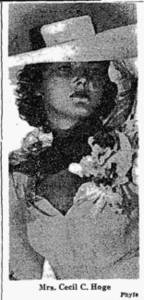
This is a Healthy Looking Customer of my Great, Great Grandfather

This is a Healthy Looking Customer of my Great, Great Grandfather

By Cecil Hoge

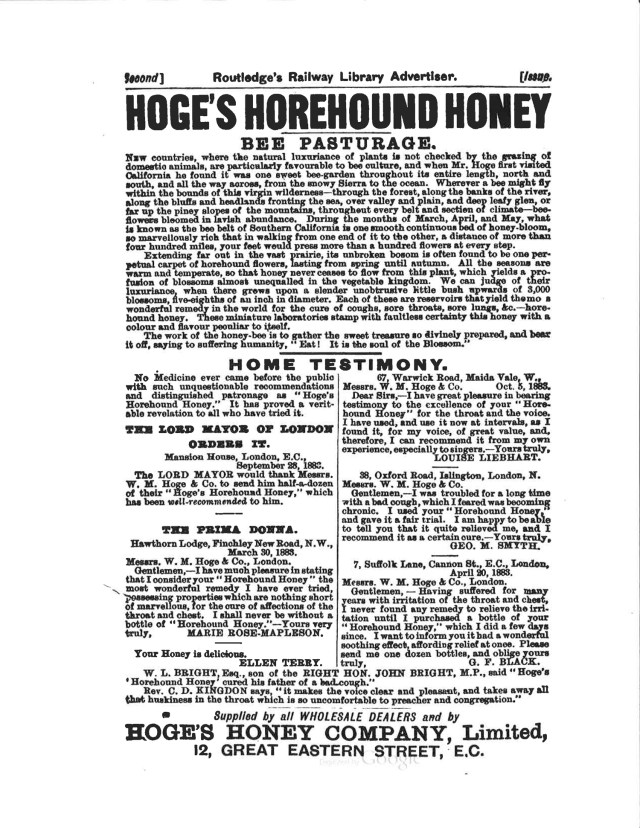
My father told me that his great grandfather, one William Hoge, sold honey in England. I never paid much attention to this story until one day my wife came across some information about that business. She found it on the internet. It seems that nothing ever dies, it just goes to the internet. There she found reproductions of some old ads from my great, great grandfather’s business that he ran in the late 1800s.

It turns out that he must have been a great marketing expert of the time because here it is almost 150 years later and somehow reproductions of his advertising efforts are on the internet. In looking at the poster shown above and the ad shown below, a couple of things are evident. He seems to have believed deeply in his product. He talks about his horehound honey in the most glowing terms.

This is an early testimonial ad of my great, great grandfather from the late 1800s

This is an early ad of my great, great grandfather with testimonials from the late 1800s

In the beginning of the advertisement above, my great, great grandfather talks about the “Bee Pasturage.” I gather that he got his honey from California, which at the time must have been an ideal place to harvest certain kinds of of honey. He starts in his advertisement by explaining what a wonderful location California is for bee cultivation:

“New countries, where the natural luxuriance of plants is not checked by the grazing of domestic animals, are particularly favorable to bee culture, and when Hoge first visited California, he found it one sweet bee-garden throughout its entire length, north and south, and all across from the snowy Sierra to the ocean.”

Today if you visited those same areas, I am pretty sure you will find things have changed, that the entire length of California is no longer “one sweet bee-garden”. But I guess when my great, great grandfather first visited California it truly was.

Listen to my great, great grandfather’s description of what must have been the pure and pristine wilderness of California at the time –

“Wherever a bee might fly within the bounds of the virgin wilderness – throughout the forest, along the banks of the river, along the bluffs and headlands fronting the sea, over valley and plain, and deep leafy glen, or far up the piney slopes of the mountains, throughout every belt and section of climate – bee-flowers bloomed in lavish abundance.”

I can only wish it were so today. I will grant there are some areas of California that probably still fit this description.

My great, great grandfather goes on to wax even more poetic –

“During the months of March, April and May, what is known as the bee belt of Southern California is one smooth continuous bed of honey-bloom, so marvelously rich that walking from one end to the other, a distance of more than four hundred miles, your feet press more than one hundred flowers at every step.”

Here again, I think William Hoge might be surprised by the same stretch of territory today. I would think he would have to walk over many highways and streets and parking lots to get to any places where he crushed one hundred flowers with every step. But one hundred and fifty years ago, it must have been something like that, before the discovery of oil, before Hollywood, before vast housing constructions, before super malls, before high rise buildings, before vast warehouses and factories feeding and servicing the needs of more than twenty million people presently residing in California.

But my great, great grandfather’s description of California bee country in the 1870s does not stop there –

“Extending far out in the vast prairie, its unbroken bosom is often found to be one perpetual carpet of horehound flowers, lasting from spring until autumn. All the seasons are warm and temperate, so that honey never ceases to flow from this plant, which yields a profusion of blossoms almost unequalled in the vegetable kingdom. We can judge of their luxuriance, when there grows upon a slender unobtrusive little bush upwards of 3000 blossoms five-eights of an inch in diameter. Each of these are reservoirs that yield them of a wonderful remedy in the world for the cure of coughs, sore throats, sore lungs, & c. – horehound honey. These miniature laboratories stamp with faultless certainty this honey with a color and flavor peculiar to itself.”

William Hoge then ends his love poem to his honey with the following:

“The work of the honey-bee is to gather the sweet treasure so divinely prepared, and bear it off, saying to suffering humanity, “Eat! It is the soul of the Blossom.”

I have written many an advertisement in my time, but I am amazed by the beauty and majesty of my great, great grandfather’s advertising copy.

This is a copy of another ad by my great, great grandfather in the November, 1884 issue of Harper's Magazine

This is a copy of another ad by my great, great grandfather in the November, 1884 issue of Harper’s Magazine

Not only do the old poster reproductions for Hoge’s Horehound Honey, like the one at the beginning of this article and just above, show healthy people endorsing his products, his testimonial ads would go on, after romancing the benefits of bee culture, to talk about the health benefits that his horehound honey brings to opera singers, actors, statesmen, clergymen and everyday people. Citing the health benefits his product brings, these testimonials must have been powerful persuasion for those days. Here a few examples:

The ad relates that the Lord Mayor of London had purchased 6 jars of Hoge’s Horehound Honey, which had been “well-recommended to him.”

But that is only the beginning of many praises from customers. A Prima Donna of the Day, one Marie Rose-Mapleson, is quoted as saying, in the stilted lingo of the day:

“Gentlemen, I have much pleasure in stating that I consider your “Horehound Honey” the most wonderful remedy I have ever tried, possessing properties which are nothing short of marvelous, for the cure of affections of the throat and chest. I shall never be without a bottle of Horehound Honey.”

Now that is a testimonial. I am not quite sure what affections of the throat and chest are, but whatever the are, they seemed to go away with some of my great, great grandfather’s honey. And if you look closely at the first picture above, you will see that the smiling lady  (whose name is E. Darren) has written in her own handwriting that considers Hoge’s Horehound Honey to be an excellent cure for hoarseness.

Then there is the testimony of one Louise Liebert who states,

“Dear Sirs, I have the great pleasure in bearing testimony to the excellence of your “Horehound Honey” for the throat and the voice. I have used, and use it now at intervals, as I found it, for my voice, of great value, and therefore, I can recommend it from my own experience, especially to singers.”

But the the good grades just keep coming in. A Geo. M. Smith states,

“I was troubled for a long time with a bad cough, which I feared was becoming chronic. I used your “Horehound Honey” and gave it a fair trial. I am happy to be able to tell you that it quite relieved me, and I recommend it as a certain cure.”

Then there is the further words of one G.F. Black,

“Having suffered for many years with irritation of the throat and chest, I never found any remedy to relieve the irritation until I purchased a bottle of your “Horehound Honey,” which I did a few days since. I want to inform you it had a wonderful soothing effect, affording relief at once. Please send me one dozen bottles and oblige yours truly.”

Now I come from a long family line of advertising men. My grandfather, Huber Hoge, had his own advertising company, called Huber Hoge Advertising, founded in 1919 in New York City. My father continued this tradition and had his own advertising agency called Huber Hoge and Sons Advertising at 699 Madison Avenue late forties and early fifties. And my brother and I still continue to produce advertising in many different forms…print ads, videos, banner ads, Google Adwords, catalogs, etc. all of that said, it seems my great, great grandfather was ahead of us all already in the marketing world of the 1880s.

My father was a man who knew the value of marketing. In his time, he sold an amazing array of products, from ladies dress forms to fishing lures, to dance lessons, to pocket adding machines, to live roses you could plant in your garden. To promote fishing lures, he developed a tank with water in it. It had a little motor on top that dragged a fishing lure around in a circle. That showed the swimming action of the lure. That worked so well he increased the number of displays to 3 tanks with water and 3 little motors dragging around 3 little fishing lures, each showing the swimming action of each fishing lure. That worked so well, that he developed a display with 10 tanks with water and 10 motors dragging around 10 fishing lures.

And that worked really well for some time. He sold over 3,000 of these huge displays – it took up over 10′ of space in fishing or department store and it sold hundred of thousands of lures. Well, everything has its rise and fall and that was also true of my father’s 10 Tank Display. It seemed it had one little flaw – two, if you count the people tending to the upkeep of the displays. The one flaw was that the water tended to become green over time and the lures tended to disappear as algae formed in the tank. Flaw number two was the humans in each store who looked on complacently while the great marketing display, first sold thousands of lures and then gradually turned cloudy and green, until at last all that could be seen was dark green water and ominous looking blob running around in an endless circle. Ah, the best dream of mice and men fail on the smallest details.

DYNAMITE - Handle As Though - That did the trick!

DYNAMITE in LARGE TYPE – Handle As Though in tiny type  – That did the trick!

Speaking of the best laid plans of mice and men, my great, great grandfather apparently had some issue with the Long Shore men of London unloading his Horehound Honey from California. Apparently, the gentlemen at the port were manhandling his honeycombs. As usual, my great, great grandfather came up with an unusual solution. He had his honeycombs packed in wooden boxes, which looked just like the boxes containing dynamite and he marked his boxes in big letters with the word “DYNAMITE”. In small, almost unreadable type below the word “DYNAMITE” he added the words: “Handle as Though”. That apparently solved his damage problem and thereafter his honeycombs arrived from the virgin forests of California in absolutely pristine condition. It takes an unusual solution to solve a usual problem.

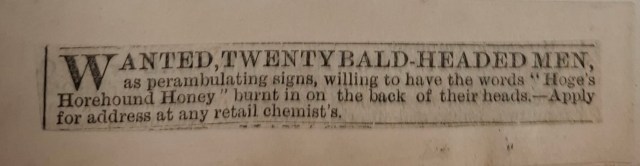
Recently, a reader of this article, Gary Tavender, sent this picture of an ad my Great Grandfather ran. It seems getting 20 bald-headed guys to market his honey was not that easy.

Speaking of unusual solutions, my father told me about a unique marketing system my great, great grandfather developed in the 1880s. It seemed his poster and testimonial ads were not quite delivering the growth and sales he had hoped so he developed a brilliant new marketing plan. That was to hire 20 ball headed guys. Each of these guys had one letter painted on their head. So guy number one had an H. Guy number two had an O. Guy number three had a G. And Guy number four had an E. Guy number five had an ‘. Guy number 6 had an S. This meant the first six guys spelt the name HOGE’S. And the other fourteen guys had fourteen other letters painted on their heads and when all 20 bald headed guys put their heads together and leaned forward, they spelt HOGE’S HOREHOUND  HONEY.

That still does not tell you what William Hoge did with the 20 guys with 20 letters painted on their bald heads. So here is how my great, great grandfather’s marketing program worked. It seemed in London in the 1880s many of the major theaters were located relatively close to each other. So my great, great grandfather made a deal with several of the local theaters and sent these 20 bald-headed guys around to each of these theaters. The 20 guys would arrive just before the theater curtain was going up, march up on stage, stand is a designated line-up, and then, while the orchestra played some tulmultuous introductory music and announcer said the following:

“Ladies and gentlemen, may we present you for consideration HOGE’S HOREHOUND HONEY”

At that moment the 20 bald-headed guys would lean their heads forwards an expose the 20 letters painted on their heads.

HOGE’S HOREHOUND HONEY – It must been quite a sight and I would guess it drew a few oohs and aahs.

After the 20 guys did their performance art at one theater, they would walk down the block and go into the next theater and repeat the performance. I do not know how many theaters they did this in, but I gather it was several each night.

I have no statistics on my great, great grandfather’s honey sales resulting from his bald-headed marketing program. I gather for a while his honey enjoyed great fortune and fame and then, like many things, eventually got taken over and merged into a larger food marketing company. I am thinking that the endless fields of bee blossoms once covering California from the north to south from the sea to the mountains have now been mostly over-run by shopping malls, parking lots, city centers, factories, thruways, housing developments, oil rigs and water parks.

I am sure there are still places in California, rural and pristine, where it is true that a man cannot walk a step without crushing a hundred bee flowers, but I am guessing they are pretty rare. I also know if it is true that there is a special heaven for great marketers of the past, my great, great grandfather is there reclining on a lounge chair with a cool tall drink and the buzzing of bees and blooming fragrant flowers are all around him.

All of this makes me want to get a bottle of Hoge’s Horehound Honey. If anybody knows where I can find one, please let me know.

Posted in Uncategorized | 5 Comments

On The Deceptive Beauty of our Waterways

BeautifulWaterway

View of Stony Brook Harbor

By Cecil Hoge

The waterways within 10 miles of my house are supremely beautiful. Above you will see a picture of the back bay of Stony Brook Harbor. That waterway is very scenic, with intricate marsh pathways wending off in different directions. Because it is shallow, tidal and heavily reeded with hardy saltwater grasses sticking out of the water, it is not suited for big motorboats dragging towables or knee boarders or water skiers. It is therefore ideal for kayaks and standup paddleboards, especially if you wish to paddle over quiet, scenic waterways without having to hear the sound of outboard motors or negotiate the wake of big motorboats.

If you drive around Dyke Road to get to my house in Strong’s Neck and you happen to look to the right out at the bay as you go by, you will probably also be struck by the great beauty of that little bay, especially if you look at a section that appears to have no houses. In the summer, with the surrounding deciduous trees fully foliated in luscious green, the shimmering summer light sparkling off of tiny waves and gentle summer breeze flitting across the surface of the blue/green water, it can be a sight to behold. A wonderful aspect of the deciduous trees and foliage surrounding the bay is that the surrounding houses, which are so visible and prominent in winter when there are no leaves and no green foliage, almost disappear and blend in with the green trees and foliage.

With Summer Foliage One Would Almost Think Your Are In A Remote Wilderness

With Summer Foliage One Would Almost Think You Are In A Remote Wilderness

If, however, you drive on the same Dyke Road to my house and you look out over the same bay and the tide happens to be low (it empties completely twice a day for four hours at a time), you may notice something else that you may wonder at. And that will be a green cover to the mud bottom of the bay. This too is scenic in its own way and no doubt many an onlooker is equally at ease with that visage. This is green algae growing on the bottom of the bay.

View from my house at low tide

View from my house at low tide – the green algae extends to the other side of the bay

And if,  you paddle or row on a daily basis as I do, you will note that the appearance of the water changes daily and that is often quite different than the view from afar. I happen to live on a small cove that is at the end of Little Bay. As such, it is the last place that the tide and water arrive. Because of this, much of what is laying on the surface of the bay is picked and pushed into my tiny cove. This view, up close, can be unsettling. Often one sees a kind of oily brown scum covering the surface of the water with brown, suspicious glutinous spots and large green blobs of algae.

And when I go paddling, I often find the arc of my paddle or oars being slowed by globs of algae. This was not always the case. When I first start paddling or rowing on my little bay, I did not see algae or hit algae with my paddle or oar. Thirty years ago the waters were clear of algae and while not crystal clear, they were usually clean enough to see the bottom of the bay, even when the 7 to 9 foot tide was fully in.

Another difference that I have noticed over the last 30 years is the steady decline in the number of fish, crabs and minnows that I see each time I go for a paddle or a row. Years ago, the bay I am on was teeming with fish, crabs and minnows. In the spring, male horseshoe crabs would appear, mate with female horseshoe crabs and then die, as is their fate, after mating. This often meant that the bay had floating corpses of horseshoe crabs. And almost always when you went in shallow areas of our bay, you would see living horseshoe crabs working their way over the bottom.

Striped bass would also come into our bay in May and June and sometimes you would see them jumping and splashing everywhere in the bay. In the summer, if you were paddling you would see blue shell crabs swimming in front and behind you. In the late summer, the bay would become crowded with snappers (baby bluefish), jumping and splashing everywhere in the bay. Today none of that happens, although I will admit to seeing a few horseshoe crabs every now and then.

In my cove, in the spring and summer, turtles come in and you can see their heads sticking just above the water. You can hear them plopping their bodies off of the dock or a log into the water when I arrive. And in truth, I have to admit the turtles do show up and they have been present even this summer. By the way, in honor of these turtles, I have named my house Turtle Cove. So not all is in decline.

This summer (2016), I have noticed something new that I do not remember ever seeing. And that is dark reddish brown areas of water as I paddle along. These areas can be quite 75 by 100 feet and they seem to be in my bay, Little Bay, and in Setauket Bay. The areas of reddish brown water appear as you paddle along, with the water turning from a murky dark blue to a reddish dark brown. It is as if you have just paddled across a different waterway where the color of the water is strikingly different. I don’t know what causes this, but I am pretty sure it is not natural. These areas seem to be in different parts of the two bays, so as you paddle along, you find yourself paddling in water that turns from muddy blue to muddy, dark reddish brown. Whatever it is, I do not think it is a sign of healthy bay water.

If you read some of the histories of Long Island, you will find references to flocks of birds flying overhead and darkening the sky for 20 and 30 minutes at a time, to the extent it almost becomes pitch black outside on a sunny day. We still are blessed with many birds…swans, Canada geese, great white herons, great blue herons, egrets, kingfish, loons, ducks and cormorants line the four bays of Port Jefferson Harbor and if they are not there in their previous numbers, they are still there in all parts of the bay. And no doubt they would not be present if there were not some fish and some vegetation to feed on.

There was a local historian named Kate Strong who was alive when we first moved to Strong’s Neck and she wrote from 1937 to 1976 a series of stories about Long Island called Tales of Old Long Island. I read some of those tales and I remember one story where the local residents were complaining about the terrible swimming conditions in Setauket Bay. Apparently, Setauket Bay and the other bays forming Port Jefferson Harbor were infested with lobsters. Not only were these creatures a severe danger to the toes and fingers of local residents, but apparently these creatures served no useful purpose other than being chopped up and used as fish bait. Apparently, the habit of cooking lobsters and considering them to be a delicacy was to take place in the future.

Today our bays are no longer infested with useless lobsters. Each of the last ten years has brought more vegetation, more algae and more murkiness to my little cove and to the interconnected bays of Port Jefferson Harbor. And in each of the last years, I have seen less fish, less crabs and no lobsters. Part of this may be due to a simple fact of declining visibility. Today the waters of our bays are far murkier than they once were. Often when paddling or rowing it is impossible to see my paddle or oar blade even when it just 5″ or 10″ below the surface of the water.

Look closely and you may see my oar just below the surface of the water - It is almost a good day.

Look closely and you may see my oar just below the surface of the water – It is almost a good day.

The waters that lead up to my house were never truly clear and pristine as long as I have lived here. The complex of bays that form Port Jefferson Harbor consists of Conscience Bay, Port Jefferson Bay, Setauket Bay and Little Bay, the bay that my house is situated on. These bays have always been dirtier than the waters in Long Island Sound, just outside the harbor and its connected bays. Over 30 years ago, it was reported that Stony Brook University was dumping raw sewage directly into Port Jefferson Bay and no doubt this fact has continually compromised the quality of the water.

It is my understanding that this sewage is now treated and that treated sewage, not raw sewage, is being pumped into Port Jefferson Harbor. Perhaps, this is creating the reddish brown areas that I am came across recently. It is also my understanding that Stony Brook University had planned to run the treated sewage pipe out into Long Island Sound so sewage, treated or untreated, was being dumped directly into Long Island Sound and not being dumped directly into Port Jefferson Harbor. As far as I know, this has not been done and treated sewage from Stony Brook University is still being pumped daily into Port Jefferson Harbor.

Further complicating the water quality situation of the Port Jefferson waterways is the presence of an oil burning electrical plant in Port Jefferson Harbor. This electrical plant is a large source of air-borne pollution, emitting thousands of tons of soot and chemicals each year into the air according to an article in a local newspaper that appeared some years ago. No doubt some of the soot, the gases and the chemical particles coming from the plant fall back down onto the houses and into the waterways surrounding the Port Jefferson/Setauket area. So, it is fair to say, that I have always known that our waterways were tainted and comprised for at least the last 30 years.

That said, the water quality of our bays has gotten progressively worse despite persistent reports in the local press that it would soon get far better. About 10 years ago, widespread algae has begun to appear. First in little and far between clumps and later in denser and heavier clumps all throughout the 4 bays that comprise Port Jefferson Harbor. As mentioned, this most conspicuously evident at low tide in my bay when you can clearly see green algae growth covering most of the bay. In the spring and early summer, algae gathers in big clumps and floats on the surface of bay. As the summer continues and the various Mastercrafts and other high power ski boats make their rounds around Little Bay, the dense clumps of algae tend to get chopped up into smaller pieces and are dispersed throughout the four bays. Each spring, despite being chopped into little bits by large boats used to tow water skiers, tubers and kneeboarders, the clumps of algae seem to get bigger and denser and spread farther throughout the bays.

I do not know if algae is as great a problem in Stony Brook and Mt. Sinai harbors. Certainly, I can see evidence of algae in these bays at low tide times. These two harbors are just a few miles east and west of Port Jefferson Harbor. My belief is that Stony Brook and Mt. Sinai waterways are basically cleaner and healthier waterways. This is probably because there are fewer houses surrounding those waterways, because they do not have treated sewage being dumped into them and because they have less pollution from the National Grid electrical plant in Port Jefferson. All of that said, all the waterways surrounding Long Island Sound, whether on Long Island or in Connecticut, suffer from various forms of pollution and the two culprits that I just pointed out are by no means a complete list of all the problems inflicting damage on the water quality of my local bays.

When the press writes about the problem of pollution of Long Island waterways, they like to blame one or two causes, although generally they do not usually mention the two causes I just mentioned above. A very popular culprit to blame these days is nitrates coming from our cesspools. I have no doubt this is also one of the contributing causes of pollution in our waterways. Recently, I read an article in a local paper citing the apparent fact there are some 432,000 cesspools in Suffolk County alone. The paper was suggesting that all the cesspools need to be rebuilt so nitrates do not seep into the ground. And I have no doubt rebuilding and replacing all the cesspools in Suffolk County if properly outfitted with devices to eliminate nitrates would help reduce nitrates. The paper said this could be done for a cost of about $8,500,000,000.

Apparently, some of our local legislators are very enthusiast about this solution and I have no doubt why. Eight and half billion dollars is a pretty good contract for somebody and I am guessing it might allow a buck or two to come back to some people who might be influential in  requiring that all cesspools in Suffolk County to be rebuilt and replaced. And while I have no doubt this would prove to be some very good business for some people, I am guessing that it will not solve the total problem of pollution in our waterways. For one thing, replacing all the cesspools in Suffolk County would not reduce the pollution from Stony Brook University dumping treated sewage into Port Jefferson Harbor or from soot and chemicals falling from the sky from the Port Jefferson Electrical plant.

And even if you solved all three of these problems, there are other causes also contributing to the pollution of our waterways. I will cite a few other factors contributing to the problem of pollution…fertilizer and insecticides from homes and farms, gas and oils from automobiles driving down our roads, oil and gas seeping from gas stations and oil storage facilities into the ground water, various forms of pollution seeping into our ground water from our local factories and local businesses. It is not necessary to name names, whether it be bus companies parking buses, some of which drip oil and gas onto the parking lot, whether it be certain chemical companies producing some by products that somehow get into the groundwater, the fact is that eventually any and all chemicals that get dumped onto or fall onto the ground flow into our ponds, our lakes, our rivers, our bays and, eventually, into our ocean.

In short, I think a good case could made that there are dozens, if not hundreds of sources of pollution affecting our waterways. And in truth, this is only a natural effect of putting several million people on an island and letting them go about their business in all the ways that people go about there business.

This the Melville Mill Pond in Setauket - once upon a time is was clear of algae. In the last two years it has become quite literally clogged with algae.

This the Melville Mill Pond in Setauket – once upon a time it was clear of algae. In the last two years it has become quite literally clogged with algae. Shall we change the name to Green Pond?

I would like to cite another local example of what is happening to our waterways. Above you will see what used to be called the Melville Mill Pond. As you can see, it is now completely covered with a bright green algae. In a way, it is still beautiful. The DayGlo green color of the algae blends nicely with the green foliage and the blue sky, so you might even argue that it is still beautiful and scenic.

What I think is kind of strange is that this is a park that people come to walk around and take pictures of each other posing by this pond. In the summer, when many weddings take place, you will see wedding parties, brides and grooms, posing by this little pond, now brightly colored with an almost luminous DayGlo green color. I wonder what they think? Do they think this is what a pond is supposed look like? Do they remember seeing this pond when it was not covered with bright green algae? Surely some of the older people must remember what it originally looked like when swans and ducks and herons went there, when local fisherman used to try their luck fishing for trout and other freshwater fish that used to be in the pond.

I would guess that whatever fish there used to be there are now gone and this little waterway now officially close to dead.

If you go to the website for the Frank Melville Memorial Park, there will mention of the fact that the pond is dying and choked with algae. According to the website, a group of experts has been appointed and they are studying the problem. In the meantime, there is an opportunity to become a friend of the park on Facebook. Well, I hope the experts come to a conclusion soon because I think time is not our their side. I would modestly suggest that a simple, but drastic solution to this problem, would to get some people in a few small boats and literally rake off the algae once or twice a year. I am no expert, but I guessing this drastic solution would alleviate the problem while the experts debate on the best long-term solution to the problem.

I cite these examples of my bay and the local pond because it is clear to me that our waterways are in deep trouble. At the same time, it is also clear to me that not many people are concerned about this problem – I cite the fact of people walking around Melville Pond Park as an example of that. Surely some of the people know what they are looking at.

And I suppose there are many good reasons why this is not a priority in all our lives. Most of us have enough difficulty in just in surviving…getting by day by day, meeting our bills, trying to get the kids into good schools, trying to pay our mortgages and taxes. And while I may point out these problems with our waterways, I cannot in truth say that I am doing anything myself to resolve them. And there is one last point, which is the point I made at the beginning of this article, when we drive around the North Shore in summer, everything is green and scenic, and even ponds clogged with algae look kind of beautiful in there own way.

The reason I bring up this issue is that while it is obviously a local problem here on Long Island, I believe it is also a problem all across this country. Recently, I returned from Orlando, Florida. This year, Florida suffered from some severe algae and outbreaks of red and brown tides n both the east and west coast of Florida. Coming into Orlando by air, one can see the green algae covering lakes and ponds in and around Orlando. This is clearly visible by air. In speaking to some fishermen who were recently fishing on the Gulf Coast side of Florida, they described the red tide that was plaguing that coast as a thick, poisonous goo that covered the bay waters and made fishing nearly impossible. Moreover, it was emitting a toxic gas that actually stung the eyes and made it hard to breath.

It really does not matter what part of the country you go to, whether it be an inland pond or lake, a white water river, a large reservoir, many parts of the country, our waterways suffer to a greater or lesser degree reduced water quality and increased forms of pollution. In many cases, this has had a dramatic effect on the fish stocks in the affected waterways. I mention this because fish is a staple food in the human diet. We are likely to miss it, if it is no longer available.

So the big question comes is what do we do about this situation? Do we ignore it or do we wait for someone to solve this problem or do we allow some politician to require the replacement of all our cesspools, even though that will solve only one part of the real problem?

I would like to mention that while I can visibly see the deterioration of our waterways and while I can point to many visible and tangible evidences of the decline of our waterways, I do not believe this situation is unsolvable or hopeless. There are, in fact, many instances where we have turned around fish declines and reduced greatly the pollution facing some waterways. I would like mention a few notable cases. In the Northeast, where ten years ago the striped bass population had declined severely, by instituting a cap on the number of fish that can be harvested per angler and enacting rules against dumping into the oceans and Long Island Sound, the striped bass population has come back in a big way and the fishery is far healthier than it has been in the last 30 years.

In another rather curious example of how waterways and fisheries can come back, in Lake Erie and Ontario where the waters had suffered from chemicals been dumped into these lakes, where algae had become common and where there was great concern that zebra clams would get into the waterways and clog up the harbors and halt the workings of dams and electrical plants, the zebra clams did succeed in getting the waterways and did expand and become endemic throughout both lakes. What was the result: strangely those two lakes became far cleaner and the fish populations, which had been in severe decline, came back and began to flourish once again. Why? Because it turns out that zebra clams filter water faster than almost any kind of shellfish and where their populations explode, their ability to clean the water also explodes. And today, the fishing is better in those two lakes than it has been in the last forty years and the lakes are far cleaner. Go figure.

In the Delaware River, where that river had been the dumping ground of various chemical and industrial factories built up along the river, new environmental rules greatly reduced the number and quantity of chemicals dumped into that river and today many parts of Deleware River are far cleaner than they have been in over 50 years. In fact, trout fishing, which had been almost eliminated in parts of the Delaware, is today also better than it has been in 50 years in many areas.

The lesson in citing these examples is that waterways can get better, just as they can get worse, fisheries can get better, just as they can collapse, new species can alter and improve the health of a waterway, just as some species or life forms, such as algae, can destroy a waterway.

My belief is, if we are to make real progress about this problem, we will have to delevop dozens and possibly hundreds of solutions to it, not just one or two. I do not think there is one silver bullet that will solve all the problems facing our waterways, but I do think a wide variety of different approaches and solutions can, when taken together, greatly improve these problems. I would also like to say that whatever the solutions they will have to be applied on a local bay by bay, river by river, pond by pond, waterway by waterway basis. Why? Because each waterway is different and each waterway may have to be addressed differently to solve their specific problems.

I would like to suggest some partial solutions to the waterways of Port Jefferson Harbor. Certainly, I think we will need to restrict and reduce the amount of chemicals being dumped into those waterways. In a number of cases, this has already been done, with rules    requiring 4-stroke motors and rules outlawing and banning certain chemicals. I am guessing that more has to be done in a variety of ways. New types of chemicals for washing clothes, for cleaning floors, for fertilizing gardens and farms, for killing insects have to be developed that are less toxic and less harmful to the environment.

And yes, better cesspools have to developed that reduce the seepage of all the chemicals we put into waters, whether from our homes, our factories or from our farms. I doubt it is practical or possible to mandate the replacement of all our cesspools, but it is probably practical to mandate that new cesspools have new controls on them and as old cesspools have to be replaced, to replace them with more efficient cesspools that better contain all waste materials we put into them.

I think towns surrounding the bays of Port Jefferson, should take an active role in re-introducing oysters and clams and other shellfish that can clean our waterways. The fact that clams and oysters and other shellfish naturally filter and cleanse our waters should be artificially stimulated, meaning we need active programs that plant and tend to the introduction and cultivation of shellfish in our waterways. I would like to cite the fact that at one time the Great South Bay provided 75% of all the clams served in restaurants in America. I would like to cite the fact that during the 1800s and the early 1900s there were over 10,000 oyster bars in New York City alone. Simply reintroducing the shellfish that were in our bays and waterways could go a long way to cleaning up our waterways.

Unfortunately, I believe it probably goes beyond just planting oyster and clam seed beds. Those oysters and clams will have to be tended to and active aquaculture farms will need to be set up. This probably means setting aside in our waterways areas where this is actively done and setting up a system to tend and monitor the development of shellfish.

I would like to suggest a controversial concept which I think could help the specific waterways of Port Jefferson. At the present time, these waterways have only one inlet to Long Island Sound, I think if one or two additional inlets were created it would allow the waterways of Port Jefferson Harbor to better clean themselves. I am sure that there will be homeowners who will be concerned that these same inlets could let in more water during hurricanes and storms. Probably so, but I believe in the long run it would be healthier for our waterways of Port Jefferson to have two or three inlets, rather than just one.

Sometimes, this kind of solution is provided by Mother Nature herself. On the South Shore of Long Island, a new inlet was opened up a few years ago, courtesy of Hurricane Sandy. In the case of Port Jefferson Harbor, I think it would take a really large and violent hurricane. I would prefer a man made solution.

I would like to suggest another controversial idea that could better clean the four bays that comprise Port Jefferson Harbor. At present, Strong’s Neck is a peninsula of land sticking out between Little Bay and Conscience Bay. If a water passageway was cut through from Little Bay to Conscience Bay and a small bridge was built to allow homeowners to get to their homes on Strong’s Neck, I believe the both Little Bay and Conscience Bay could better clean themselves and all the waterways of Port Jefferson Harbor would be cleaner and healthier.

I also think think selective dredging could help our waterways to better better clean themselves and better allow clams, oysters, crabs and fish to thrive in our waterways. Dredging, of course, is a dirty word and no doubt the process of dredging poses potential harm to the waterways it is being done in. An important concern is where the dredged material is being dumped. At this moment, the State of New York is threatening to sue the State for Connecticutt because Connecticutt wants to dredge its harbors and rivers and dump the dredged material into Long Island Sound for the next 30 years. It is believed, probably correctly, that if dredged materials were dumped into Long Island Sound for the next 30 years, it would do great harm to Long Island Sound.

I do not know what the proper solution to the dredging problem is, but it seems clear that all of our waterways tend to silt up over time and these silt deposits also tend to contain chemicals of all kinds. I am thinking some creative solution needs to be brought to this problem, such as taking the dredged material and creating some kind new kind of cement with it. Or maybe we can dump some of the dredged material on certain selected landfill  areas and create a new ski resort or a water park or something else unique and beneficial.

In this vein, I would like to turn to the problem of algae. I understand that in France they are making certain kinds perfume from algae. I do not know what is in our algae, but I am guessing it is useful for something. Maybe, it can be made into a new kind of less toxic fertilizer, maybe it can be used to make a new kind of concrete, maybe it can be made into a new kind of super food. I do not know, but I am guessing it can be used and made into something.

If so, then algae could be harvested once or twice a year and the gathered material made into something useful and then maybe our waterways would clearer and the green pond that I showed picture of might become a clear and open pond teaming with fish and frogs and turtles and and birds and other wildlife once again. I suppose reading this, it might seem like a wild and impossible idea, but algae is a form of life and I think we may be better able to re-purpose it than to just let it cover our pond, lakes and bays.

You might ask why am I taking the trouble to make what may seem like rediculous suggestions. I am thinking we live on an island. I am thinking in the not so distant past we have lost electrical power for various periods of time, in storms, in blackouts, in hurricanes. In the past, we have never lost power for much more than two weeks, but as little as three years ago, we all saw what damage a storm like Sandy could do. And while that storm did quite a bit of damage, it should also be recognized that a full blown hurricane, if it was ever to hit us head-on on an incoming tide might do a great deal more damage.

And of course, that is only one threat we might face in the future. We all remember when the World Trade Center buildings came down. We all have heard of the danger of a dirty bombs. What if, for example, Long Island lost power and access by car and truck to Long Island was not possible for an extended period. What would happen? There are, at last count, something over 3,000,000 people on Long Island. What if all 3,000,000 people had no power, not for a few days, but for a few months? What if there was no access on or off Long Island for an extended period of time?

My guess is that people might really miss the fish, the shellfish, the crabs that they are already missing. At that time, they may wish they paid a little more attention to the deceptive beauty of our waterways and had done something to restore the health of the fisheries that used to surround us.

UPDATE 9/22/16 – “State to fund Setauket Harbor Improvements”

That is the headline from a September article in the The Village Times Herald. This article goes on to relate that the Cornell Cooperative Extension had just done a study of Setauket Harbor and had “turned up troubling results.” The article went on to quote Laurie Vetere, chairwoman of for the Setauket Harbor Task Force “that Setauket Harbor has significant water quality issues caused by road runoff from rain water flooding into the harbor after storms.”

This was interesting and encouraging to me since it named a new obvious culprit – runoff of chemicals from storm water – and it did not say the cesspools was the sole culprit, although they obviously contribute to the overall problem.

The article went on to say that Setauket Harbor had secured a one million dollar grant from New York State, which is to be divided three ways:

1. Half of the one million dollars will go to the improvement of dock.

2. Forty percent ($400,000) would be used on storm water improvements.

3. The remaining $100,000 will be used to remove silt that has accumulated in the harbor and it water sources.

It will be fascinating to find out:

1. If this money actually gets turned over for use in Setauket Harbor.

2. What specifically the one million dollars accomplishes.

In any case, it is an interesting development and I hope that it accomplishes some actual good results. I would question what $500,000 improvement to the Setauket Harbor Dock will accomplish? I find it hard to believe that will actually improve the water quality of Setauket Harbor. Perhaps, I am missing something? I would also like to know what specifically will be done “on storm water improvements.” I am curious – will there be some sophisticated filtration system set up on all the storm water drains leading into Setauket Harbor? If so, how will these be maintained? One would guess that any filtration system could be become clogged. Finally, it would interesting to know what happens to the $100,000 of silt that is dredged up. Where will it go?

A last point to this hopeful new development is to mention again that Setauket Bay is only one of four bays comprising the Port Jefferson waterways. That leads me to ask two last questions – will the one million planned to be spent on Setauket Harbor, benefit the three other bays directly connected to it? Or will any improvements resulting from the one million dollar investment be overwhelmed by storm water chemicals and other forms of pollution flowing directly from other three bays flowing directly into Setauket Harbor?

Inquiring minds want to know.

Posted in Uncategorized | Leave a comment

My Old Boss, Dan Rattiner, Founder of Dan’s Papers

Early Dan - I think when I met him he sported a mustache

Early Dan – when I met him he sported a mustache

By Cecil Hoge

In the year 1967, I managed, after six years of work, stress and partying, to graduate from the University of Virginia. My first act, after the 6 years, was to invite 6 of my fellow college friends and 1 college girlfriend (a very pretty and pert blonde young lady, named Penny Zetterstrom) to come visit my family’s summer house in Southampton.

My girlfriend was the first to leave after about 10 days of young love, she came to the rightful conclusion that I was not ready to make the big commitment and so she, with tears in her eyes and the summer wind in her hair, departed back to the University of Virginia determined to be, as she told me, a super woman. The problem was that I was not ready to be a super husband and so we parted with the clear understanding young love does not always work out.

Soon thereafter some of my other college buddies began to drift away, determined to take up the reins of life and go out and find a career. After three weeks that left me and Rich Miller, the last of my college buddies, alone sadly pondering our possibilities. We felt we were just not ready to get out there and find a career. One evening, after one or two or maybe more beers, the solution began to come into view. I had boat, Rich had motor, and after those facts became obvious, we decided we could merge our assets and become clam diggers for the summer. And that is what we did for the next three months.

I have written about that experience and in this blog you will find a story of that wonderful summer, but that is not the subject of this article. This article is about my old boss, Mr. Dan Rattiner. Before telling you about Dan, I have to tell you a little bit more about Rich.

At the end of the summer, with cool September breezes beginning to blow, Rich made his move. He would get into the banking trade, head down to the Caribbean, manage the assets of wealthy islanders, buy a sailboat and live happily ever after. That almost happened, Rich did go into the banking trade and he did buy a sailboat. After getting the sailboat, he decided he liked sailing more than banking and changed his career to the sailboat delivery business, delivering exotic sailboats to all parts of the world.

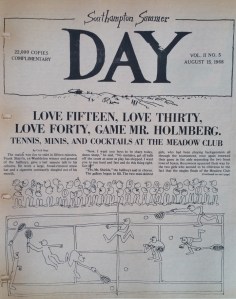
That left me in Southampton with my family closing their summer house and me at 6s and 7s. That is a British term meaning my life was in disarray and confusion. Fortunately, the confusion cleared fairly quickly when I happened to pick up a copy of the Southampton Summer Day. That was a free paper that was being given out in barbershops, museums and bars. I will let you guess where I found my first copy.

Now this paper was not very impressive at the time. It was 16 to 20 pages long, tabloid in shape and form, mostly in black and white type with some scratchy black and white cartoon drawings signed by a fellow named Dan. There might have been a second color added here and there, to the headlines, to some of the ads. Some of the black and white cartoon drawings were quite humorous and quirky. That was also true of the black and white printed stories. Anyway, this paper had a certain esprit and when I started to read it, I found out it was also written by another fellow named Dan. Putting two and two together, and in taking a look at the masthead I discovered that the two Dans were really one fellow named Dan Rattiner.

At the time, I was trying to figure out how to become a writer and I realized that Dan already was a writer. Now, as mentioned, there was something quite quirky and unusual about this paper. The articles were light-hearted, good-hearted, well-written and sometimes completely false. I am not sure what article caught my incredulous eyes, aliens landing in East Hampton or something like that. Now these stories, some of which were true and some which were complete lies, were all humorous and quirky. I have admit I signed on to the humor as soon as I realized that some of the stories were not really true.

It was then that I got a bright idea. I would submit some stories and ask for a job. That would allow me to stay in Southampton for the winter and there I could develop my skills as a writer. I do not remember just what stories I dug up or exactly what I submitted, but I sent some stuff off to the address on the masthead and addressed it to Dan Rattiner. After a few days, I called the newspaper.

I was surprised when none other than Dan Rattiner himself answered the phone. Apparently, his secretary was off for the day.

I asked Dan if he had gotten the envelope I had sent. Yes, he answered. I asked Dan if he read the enclosed material. No, he answered. I asked if he would he read the enclosed material. Yes, answered. With our conversation at an end, I left the telephone number of our summer house to call back. Dan promised he would.

Sure enough, Dan did call back and he suggested that we meet to discuss the idea of writing for what I thought was the Southampton Summer Day. Dan named a restaurant to meet near East Hampton. A couple of days later I drove out to the restaurant in question. I forget the name, but it was on Montauk Highway, before you get to East Hampton. It was right next to a tank that had been parked there to commemorate something that happened during World War II.

The restaurant, if I remember, was a kind of diner, quaint, but certainly not posh. When I got there, I found Dan sitting at a table. At first I was not sure who he was, but after blundering about I discovered Dan was the youngish looking guy seated alone at one the tables. I should have known because Dan was the only guy seated alone at one of the tables and all other tables were occupied by two or more people engaged in active conversation.

I introduced myself, sat down and pretty soon Dan asked what I wanted to eat. I surveyed the menu that had a bunch of things I didn’t quite recognize. I asked Dan what he was going to have.

“Lox and bagel,” He said.

I was not quite sure what that was, but I decided I would go with flow – it was the sixties, after all.

“I’ll have Lox and bagel,” I said, not quite knowing what I was ordering.

Dan and I had lox and bagels. I had iced tea and Dan had coffee. At lunch, Dan began to give me the history of the Southampton Summer Day. It turned out it was only one of four different newspapers that Dan was printing and distributing. The Montauk Pioneer was the first paper that Dan had started in 1960. After a few years, Dan added the Hampton Beach, the Southampton Summer Day and East Hampton Summer Sun. Circulation was as many copies as he could distribute to various barbershops, retail stores, bars, restaurants and discotheques, and that was usually around 35,000 copies.

In between Dan telling me the history of how he founded the Montauk Pioneer and these other papers, I told him my goals. I wanted to be the F. Scott Fitzgerald of the East End. Dan said that was a fine goal, but one day does not a writer make. It takes time and practice. I was a little discouraged by the word practice. It sounded so prosaic and somehow it seemed to imply work.

I asked Dan what he thought of the stuff I sent. Well, he said, somewhat hesitatingly, it was a little rough, but it showed promise, that’s why he wanted us to meet.

That me left more encouraged.

Going for the jugular, I asked if that meant he could give me a job.

Dan pursed his lips and said yes, he could give me job. The only problem was, he explained, that he did not need a full-time writer on his payroll.

What did he need, then, I asked.

“Well, what I need just now is a newspaper delivery man.”

Dan went on to say that this was an ideal way to get to know the newspaper business and to become a writer in the long run. Dan went on to say he would pay $60 a week for delivering papers and a penny a word for every word he published of mine. A penny a word did not sound like big money to me, but the combination of some firm cash and some extra potential income from writing did sound intriguing.

I had read “Down and Out in Paris and London,” by George Orwell, about how old George worked in a sleazy cafe on the Left Bank that became kind of trendy after a while for no logical reason. And I remembered that old George worked in garret and wrote at night and at odd times when he was not serving Steak-frites and glasses of vin rouge. It seemed to me driving a delivery truck and writing at odd times was kind of the same thing and so, I signed up to become a delivery boy and a writer.

Dan felt kind of good about this and he began to tell me a little more of his history. It seemed that he and some other guys founded the East Village Other in 1965, but after a couple of years doing that, Dan got disgusted with the drug scene that naturally gravitated to that publication and so he retreated back to Montauk and continued publishing the Montauk Pioneer.

At first Dan did it all. He put together The Montauk Pioneer, he set the type, he sold the ads and he ran around Montauk delivering the newspapers. After the first summer, he found that in spite of handing out free copies of the newspaper, he actually made a small profit after all costs. In other words, the ads more than paid for the distribution and printing costs and something was left over.

That experience encouraged Dan to add newspapers. I believe the second paper he started was the East Hampton Summer Sun. After more summers of putting together the papers,  selling the ads and physically delivering, the two papers also made money. By this point, it was becoming a little enterprise. Dan hired a lady to help to put together the paper and a delivery boy. By 1967, Dan had added the Hampton Beach and the Southampton Summer Day. Dan also put together a little business plan and went to the Bank of Bridgehampton and had gotten financing for his expansion. Each and every year Dan was able to show profits, proving to the Bank of Bridgehampton that Dan was a good financial bet.

After we had finished our lox and bagels and as we were walking out the restaurant, Dan said two things to me.

“Your hired,” and “I officially pronounce you a Jew.” This was because I had done such a stellar job of eating the lox and bagel, which, by the way, I thought was very tasty. Who knew lox was actually salmon?

So that began my fairly long association with Dan Rattiner. That winter I delivered the newspapers (I believe there was one other delivery boy doing penance with me) and, in between, I wrote articles for Dan.

One of my first assignments for Dan was writing a Guide Book to the Hamptons. To do this and not shame myself, I retreated to the Southampton library and did some actual research. Among other things, I read a history of Long Island. I was quite surprised to learn, according to the history I read, that there were five Indian tribes on Long Island when the Europeans first arrived and that Long Island was populated by almost 100,000 Indians before the Euros arrived.

I was also surprised to find how tough things could get in Southampton if you had a little too much to drink. Apparently, you were made to sit outside with your head and arms stuck in some kind of wooden clamp and then all the residents could throw eggs and lettuce and tomatoes at you while sat there helplessly stuck. Talk about a tough crowd. I was also surprised to learn after the Spanish American War almost 10,000 soldiers were sent to Montauk to recover from the various diseases they picked up in that war.

I got to throw in some current events, like surfing in the Hamptons or when one of the members of the Lovin’ Spoonful, Sal, got married. I am not quite sure how I stumbled on to this news event. I think I was on my way to the beach club (aka The Southampton Bathing Corporation), when I saw Sal in gloriously striped pants come romping out St. Andrew’s Church with John Sebastion and other Spoonful members in tow, throwing flowers and rice, playing tambourines and guitars. It was a riotous performance and the times they was a changing. Things was happening and I was happy to report on such goings on.

In short, I learned a lot of things about Southampton and Long Island. With the information that I gathered from research and gossip, I wrote the first draft to the Hampton Summer Guide. That was my first big writing job. Other things that I wrote were little blurbs on various restaurants and happenings. A particular event of no particular importance I remember reporting on was about a girl named Wendy, who I named SunBunny, primarily because she was the girlfriend of the other delivery boy and she distracted the newspapers printers in Newark, New Jersey, enough to threaten the potential delivery of the paper, or so I said.


My first article claims the Light-In was a Fiasco

My first article claims the Light-In was a Fiasco

By November of 1967, Dan published the first full article I wrote. This was a great thrill for me. It was in the The East Hampton Summer Sun. The title of the story was “1500 People Stand For Lighthouse”. The subhead was “Rattiner Calls Light-In a Fiasco”. This was not what Dan said, it was what I made up. I went on the report that Dan said there were 3 things wrong with the “Light-In”:

  1. The people were all wrong, there were not enough Hippies, just families with children.
  2. The police were too nice, they did not exhibit any extraneous violence.
  3. The music was all wrong, instead of rock music and flag-burning, a patriotic band played and all the people protesting were completely peaceful, very cheerful and, hence, all wrong.

I went on to say that the only consolation was that $400,000 was raised to save the Montauk Lighthouse. Of course, most of what I wrote was completely untrue, including the bit about $400,000 being raised. But it was true that 1500 people did attend the Montauk “Light-In” and it was actually pretty successful demonstration of support for the Montauk Lighthouse. And, by the way, Dan was successful in drawing attention to the plight of the Montauk Lighthouse, which, at the time, was gradually slipping into the sea.

And finally, as many people know, the Montauk Lighthouse was eventually saved.

I delivered papers that whole winter, but distribution was down because of the season. It was only in the summer months that the full range of drop-offs became evident. One of the things that occurred as a side aspect of delivering papers is that I got to go into a lot of strange places. At the time, head shops and discotheques were enjoying sudden and increasing popularity. Like all businesses in the Hamptons, they were seasonal and enjoyed their best business in June, July and August.

I remember a few. There was a head shop next to The Grotto of the Purple Grape, a restaurant between Watermill and Bridgehampton that enjoyed some passing success. The head shop, whose name was Soporific, was run by a young man named Billy who always wore aviator sunglasses, whether in the dark UV lit backroom of the head shop or standing outside, he always had on that pair of aviator glasses. I am sure he thought of himself as a kind aviator, if only in the mind.

The selection of merchandise was eclectic, to say the least. It included water pipes, cigarette papers, state of the art bicycles and brightly colored, extremely comfortable Peruvian hammocks. In the dark back of the inner head shop where UV light ruled was the full selection of cigarette papers, water pipes, bongs and other smoking paraphernalia. Upon on going back there, one was almost always greeted with the pungent and sweet smell of marijuana, occasionally intermixed with the smell of incense. Most often Billy was back there in aviator glasses behind a glass cabinet displaying the wide variety of cigarette papers and water pipes and other smoking paraphernalia. He always smiled.

Outside the head shop, before you entered the dark environs of the head shop, was a really high-tech assortment of bicycles and extremely brightly colored Peruvian hammocks. Sometimes, you would find the young aviator, Billy, proprietor and owner, swinging slightly in the breeze on one of his hammocks outside. Occasionally, when a customer came over to ask a question about one the $600 to $800 bikes (big bucks in those days) Billy would lift his head up and say,

“Yeah man, they are state of the art, I sell top end stuff.” That was usually the maximum sales effort that Billy made, but he would always punctuate it with a sly stoned smile that said to all others in the know that he was in the know.

Whatever his sales technique was, it seemed to work, because Soporific operated successfully for a good ten or fifteen years.

Another place I remember was a discotheque hidden deep in some potato field somewhere between Bridgehampton and Sag Harbor. How to get there, I could not tell you. What its name was, I could not tell you. Basically, you kept going down roads with endless potato fields on either side and eventually you got a dirt driveway and drove down that for a quarter mile and ended up at a large imposing wooden clapboard house and that was the discotheque. Strangely enough, other people found their way to this place and late at night The Velvet Underground, complete with Nico, Lou Reed and the original members, and other trendy, psychedelic groups would play late into the night.

I am still not quite sure how anyone found that place at night. I had found it during the day delivering newspapers. I was never able to find it at night. But with the guidance of my psychedelic cousin, who had powers beyond her age, I was able to find it late at night. But I will tell you without a spirit guide you would never get there and perhaps that was the point.

This was an early version of my clamdigging saga

This was an early version of my clam digging saga

I wrote and delivered newspapers all that winter and the next summer for Dan. Dan tried to get me interested in all aspects of the business, I guess all young business owners do. It is only natural. You want to share the joy, you want to create enthusiasm with your employees, you want to get people to sign on to your program. It is only natural and I can sympathize with this, even if my sympathy took 40 years to develop.

Dan tried to enlist me as a typesetter and there I drew the line. This is one of the big regrets of my life. I consider it on a par with never trying skiing when I had the opportunity. So I did not try type-setting other than a few half-hearted and momentary efforts. The reason being my mind goes faster than my physical movements and so I tended to forget things. In type-setting that meant forgetting to put in certain letters or words…generally I included most parts of most sentences. I still suffer from this disability. It seems that age has not improved my skills. Who knew?

No matter, I was a miserable type-setter for Dan, both in performance and in enthusiasm. In short, I thought it was not my job. Years later, I regretted this very much. Why?  It certainly would never have been something I was very good at. But no matter, it was something that I never properly learned, never experienced and it was the passing of an era. Yes, I did some years later, learn about type, the selection of type, the beauty of type, the subtlety of type, when I started working with a layout artist selecting type. And yes, I did that. But I never did what I should have done, except for a few rare cases. Stain my hands with the type, pick up the type pieces, put them laboriously in place, learn how Luther did it. It is a regret and I feel I owe Dan an apology. Hey, I was stupid.

There are other things I believe I owe Dan apology  for. He introduced me to Elaine K. Benson. I thought nothing of it. She had an art gallery and she wrote a column in Dan’s different papers called “Elaine K. Benson, Her Column”. Well, I did not know it, but that was a kind of guide to future possibilities, but I ignored it.

Along the way, Dan introduced me to people who I had no clue who they were. One lady was introduced to me as Jackson Pollock’s wife. We shook hands. I had no idea who she was. She had sad dark eyes and was somewhat overweight when I met her. In retrospect, if I had known who she was, I would have asked a whole bunch of embarrassing and interesting questions. No matter, the moment is the moment you know to make use of and I did not know to make use of the moment and now it is past.

Late that summer I was not in the mood to give Dan an apology. I felt my life was primarily delivering newspapers and negligibly writing. Dan must have sensed my frustration, because at the end of the summer, he published three stories all at once. This was pleasing and complimentary, but by that time, the summer winds were turning cool and I wanted to move on.

Towards the end Dan ran several of my stories

Towards the end Dan ran several of my stories

So that is what I did. This time, I found a friend who wanted a movie script written and I tried my hand at that. It was not successful. In the process, I got a job in my father’s business (not hard, since I knew someone who was connected). So for that winter, I wrote a movie script that never got produced and made fishing rods for my father that I did get produced. I can say at least I learned how to produce fishing rods.

The next year, I decided to take full advantage of my philosophy degree and so I went and applied to be a writer at Esquire, Newsday and the New Yorker. Let me sum it up and say neither my previous printed history with Dan or my philosophy major impressed anyone who was willing to hire me. Newsday did not think I wrote fast enough to be a reporter (in truth I was a hopeless typist), Esquire thought my articles did not have sufficient weight and New Yorker thought my writing was a kind of joke. So much for my new career search.

Fortunately, I had something to fall back on and fall back on it I did. I went back into my father’s business and a strange thing happened along the way. I kind of fell in love with it. So that is what I did for the next 6 or so years.

Then a strange happened. I went out to Montauk for vacation and I happened to notice that Dan’s different papers had gotten a little bigger. I think they were now running 36 to 48 pages. At the same time, I noticed that things were changing in Montauk. So, without really knowing what I was doing, I wrote a story about Montauk.

I sent the story to Dan, saying I had noticed the changes in the papers, that they had become bigger and that there was more use of color. They were still tabloid in format, but maybe they 36 to 48 pages in length and chock full of ads. And I could tell by their heft that Dan was having some success in selling ads and distributing papers.

Dan did something inscrutable. He published my article without telling me. This led to a new avenue of discussion. Always sensitive to the payment issue (it was not one of need, it was one of pride), I suggested Dan pay me at my old rate…one penny per word.

Silence ensued, but eventually a $60 check arrived, again unbidden, un-heralded, but appreciated.

This started a kind mini career with Dan. I started to send in some articles and he started to print them, religiously paying me one penny per word. I was grateful and this continued for about a year and half.

Then I started submitting stories to Dan that I suspect crossed a hidden editorial border. Let’s face it, Dan’s Papers are not here to change the world and the articles I sent him wanted to. And I will admit it, some were kind of depressing, so you could say he was down on them because they were depressing (I wanted to cover the population explosion and the bombarding of Iraq). Apparently, Dan did not think that was in character with the publications.

Dan composing for a future issue

Dan composing for a future issue

Over time, the publications became one single publication…Dan’s Papers. And so, it became the brainchild of the present creature. Somewhere along the way, Dan got the genius idea or someone got the genius idea to create a color wrap with a color painting for the cover. This was, of course, pure genius because the East End was rife with painters. You name them, they were all here.

I proposed other new ideas…some Dan accepted because they were in his editorial vein. I wrote an article on how my salad dressing was much better than Paul Newman’s and Dan published that. Other ideas fell flat. I knew they fell flat when I would not hear from Dan. I would send in a suggested story and silence would ensue.

I had what I thought was a great idea… I would write a story about the Shinnecock Indians starting their own casino. I had big plans for their casino. It would be right out of Las Vegas but with some special Hampton features. There would be tennis courts, marble side walks, girls would deliver drinks on rollerblades. Slot machines in Lilly Pulitzer patterns would be on either side of the marble walkways. I figured Hillary Clinton would arrange detente with the Indians, New York State and the Casino Industry. There would be a giant surf machine, producing perfectly formed 20′ rollers that super buff surfers could ride all day. The casino itself would be housed in a giant sprawling Hampton’s style mansion with large open porches with roulette tables and slot machines inside and out. Yes, it would be a class act.

Apparently, Dan did not think it was a class act idea.

“Those people are like without humor,” he said to me after I called him up after a month of silence, “They take these matters seriously.”

Maybe Dan was right, but considering the election year we are presently facing (this being the summer of 2016), I could see some added embellishments with Hillary competing to get the Shinnecocks true justice and health care and the Donald building a 30′ high wall to protect Hampton billionaires from the garish new casino in town that the Shinnecocks would be happy to pay for. Oh yes, I could have a lot of fun with that.

In any case, I did not pursue my Shinnecock Indian Casino story further, although I think it still has merit.

In the last twenty years, Dan’s Paper’s became a marketing and literary force in the Hamptons and in choosing the name Dan’s Papers, Dan was able to instill all of the original ethos of his original papers and add extra layers that just made it more successful, like when he added gossip on the inside in South of the Highway or fantasy in about Hampton’s Subway Newsletter and color paintings on the cover and a 24-48 page color wrap on the outside.

About six years ago, I invited Dan to lunch. I suggested The American Hotel in Sag Harbor.

“Yum,” said Dan and a few days later, off we went.

There I asked him what changes in the paper was he surprised by?

Dan thought a while and said, “I never thought gossip would be a part of my newspaper.”

He did not say this with regret, but rather with surprise. I think Dan was being honest in saying that. It was not his intention. It was not his plan. But things evolve, things go forward and I suppose that is what happened with Dan’s Papers.

I know Dan’s position has changed in the community. Dan invited me to the Fortieth Anniversary Party of Dan’s Paper and it was quite impressive. Held at beautiful East Hampton ocean front home, with Billy Joel, Peter Jennings and a whole bunch of other billionaires and celebrities in attendance. Yes, things had changed for Dan.

When I first started delivering papers for Dan, it was often hard to get the various establishments to accept his papers. That is no longer true. Today, Dan’s Papers is a staple of the community, desired in all its different locations. The paper became over a period of years, the leading publication of the Hamptons and I think you can say that this is still true today. No other publication, super glossy or not, comes close. As such, Dan’s Papers is the arbiter of the Hamptons, of the Hampton’s Scene, of that peculiar lifestyle that seems to combine wealth with celebrity.

At lunch, I told Dan my idea for this blog. It was to be a series of stories about myself and my family. I had sent Dan some early drafts of the kind of stories I wanted to post and Dan was encouraging, but somewhat distant on the subject.

“It is a good idea to have legacy and knowing whether you are local or national can be important.”

He went on to say that he had hoped to be national, but it seemed that he was local.

“Dan,” I said, “That is question for the ages, not the moment.”

We left to the conversation there. It has now been a few years since I have spoken with Dan. In the meantime, I have proceeded with this blog.

Dan has continued to be the Bard of the East End. That title was given him by Chuck Scarborough, I believe. Dan much deserves that title.

My father said to me that the people in the Hamptons always change, but the houses do not.

I am sure there are many billionaires and not a few builders who would disagree. To me, the Hamptons has always been a place for the privileged to display their privileges. Originally it was millionaire doings and now it is billionaire doings, but other than that, not much has changed.

Again, there are quite a few billionaires that might disagree, but I think my father was right.

I am sure there are many improvements to the creature comforts offered in the new improved billionaire homes – movie theaters for 60 close personal friends, bowling alleys, indoor Olympic sized pools, helicopter pads, etc., but the truth is that the privileged continue to come to The Hamptons and they always will. And the truth is that my father was right, the houses remain, but the people come and go.

In the case of Dan, he was able to sell his controlling interest in his paper and still continue to write 2/3rds of Dan’s Papers every week. That is a pretty good trick when you think about it. It was probably a good deal for all concerned. Dan was able to offload the heartache and frustration of running a day-to-day business and the new owners were able to get a successful newspaper pre-loaded with a continuous supply of content. It all worked out.

Posted in Uncategorized | Leave a comment

Growing Up Wet

Before Gray Hair and About 15 lbs.

Before Gray Hair and About 10 lbs.

By Cecil Hoge

I was born and raised in New York City for the first eleven years of my life. Very early on my parents took me to the ocean on Long Island. Sometimes we went to the Atlantic Beach Club. That was a kind of private beach club that was still very close to the city. We could get to The Atlantic Beach Club in about 45 minutes from my parents apartment at 520 East 92nd. If we were starting late then we would go to Jones Beach, which you could get to in about 30 minutes.

My father would drive us out in his green convertible Cadillac. If it was a sunny day, my father would put the top down. That was a fairly intricate job. His convertible Cadillac was not like the digitally driven cars of today. It was necessary to un-snap several levers above the windshield and push a button (a great innovation of that day) to persuade the top to begin its journey up and down behind the back seat. If all went smoothly, there was still some wrangling necessary to snap on a top cover to keep the convertible top down and out of the wind. Once this ritual was completed, we would drive from 520 East 90th to the ocean. My father was very proud of that car.

The Atlantic Beach Club

Even at the age of 4 or 5, I preferred the Atlantic Beach Club because it was less crowded, because it had a convenient hamburger and hotdog stand with tables where you could sit outdoors, because it had a swimming pool that was not too crowded and because the beach was just a short walk to the ocean. I am not sure exactly when my father and mother started taking me, but I would guess it was when I was 2 or 3 years old.

So on sunny summer weekends we would cruise out from East 92nd Street to either the Atlantic Beach Club or Jones Beach and bake in the sun and go swimming in the ocean. From that early age I always remembered that I loved the ocean and the beach. I loved everything about it. In particular, I loved when my father would bury me in the sand and the warm, hot feeling of the sand grains on my small body. From that early age, my father and mother would each take one of my hands and walk me into the ocean. At first I was terrified, but as I grew older and a little bit larger, I became used to the ocean and the waves became a little bit smaller, at least in relation to my size, and I loved to try and catch waves, to dive through waves and to body surf.

My father and his family had grown up summering in Quogue, so he was very used to the ocean and loved to take me in the surf. My mother, an Olympic class swimmer, was born on and around water, so she was also an enthusiastic ocean swimmer.

Occasionally, we would go out to the Hamptons and visit with my uncle who had a house rental in Southampton. This was at a time that almost anyone could afford a house rental in the Hamptons. Today that almost anyone had better be a billionaire. When my uncle was renting, a nice house on South Main Street or First Neck Lane might be two or three thousand dollars for the summer. Today, the same house might be $50,000 or $100,000…for the month! And if you want a really nice house on the ocean, get ready to multiply by 5, 10 or more.

So we can say that much has changed in the last 70 years or so and prices is one of those things. What has not changed is the actual Atlantic Ocean which laps up on the shores of Long Island’s beaches. There is a good 120 miles of oceanside beaches so there are plenty of places for people to go. These days the beaches, all of them, are pretty crowded. It was not so different 60 or 70 years ago.

The ocean was then and is now still pretty clean, excepting occasional occurrences of tar oil and brown algae washing up on our shores. In summer the ocean waters on the East End of Long Island can take on a turquoise blue color that makes you think you are in the tropics. This is because the Gulf Stream sweeps close to the East End of Long Island, making the ocean water, when clear, even more beautiful.

The ocean has its calm days and its rough days. In June, the ocean is still pretty cold. By July, it is usually in the low to middle 70s and it stays that way until October, although the temperature of the air starts to get pretty cool by the end of September. By the middle of September, tropical storms and hurricanes try to make their run at Long Island, but mostly they miss.

Generally there is a good 12 weeks of beach going weather and my father and mother took advantage of that just about every weekend from the middle of June to the middle of September. The trip to Southampton was quite long in those days and surprisingly the traffic was not much better than it is today. The highways were much more limited, so it could take three and half hours to get to Southampton. That meant that most weekends we headed to the Atlantic Beach Club. As mentioned that was my favorite ocean location because it was still quite close to the city and yet not as crowded as Jones Beach.

At the Atlantic Beach Club, my father taught me the fine art of body surfing at about the age of 5. It took me a while to become comfortable with body surfing. At first, I was terrified by the breaking waves, but by the time I was eight I was the proverbial fish. I loved the ocean, I loved the waves and when I finally learned how to body surf, I loved catching waves. When I would come out of the ocean, I liked to bury my body in the hot sand to get warm. If my father was in a good mood, I could usually con him into burying me up to my neck.

My mother, who generally was fond of French food, condescended to introduce me to the hotdogs and CocaCola available at the Atlantic Beach Club. So a good day at the beach included body surfing for hours at a time, coming out and getting buried by Dad in the sand and then conniving my mother to get me a hotdog and a CocaCola after I took a shower. The outdoor shower was not heated, so that could be as invigorating as going in the ocean.

It was on one of our weekend visits to the Atlantic Beach Club that I got to sit on Charlie Chaplin’s lap. I do not remember the event very clearly, but apparently I was running by and he started a conversation asking where I was going in such a rush (it was to the hotdog stand, if I remember correctly). I ended up sitting on his lap for about 20 minutes, jabbering, no doubt, about the ocean and the beach, while my mother also carried on an excited conversation with the famous actor, happy to have the opportunity to speak to a true celebrity. My father told me that Charlie Chaplin found me to be a very exuberant and very well-behaved child. Charlie was half right.

Bellport

When I was eight or nine, my parents decided to buy a summer house in Bellport, Long Island. Bellport was considerably further out on Long Island, just about 65 miles from New York City, just east of Patchogue. The house was a small two story Cape Cod cottage with three bedrooms. It was about a quarter of mile from the Great South Bay. It was easy walking distance on the gravel road right by our house directly to a small beach on the Great South Bay.

My parents had two friends, Smokey and Ethel, who lived about a half a mile directly on a small point jutting out into Great South Bay. At first I did not like Bellport because it was not on the ocean. To get to the ocean, you had to take a small ferry across to Fire Island where there was the Bellport Beach Club. It was a pretty primitive setup shared by 300 or 400 hundred Bellport residents. It consisted of a strip of little beach with changing closets made out simple plank wood. It had a dock where you landed, a wooden walkway from the dock to the Beach Club. There was a cold shower and the row of wooden changing closets. There was a male or female bathroom that was really an outhouse. Food and entertainment was provided by the hotdog stand, which when it was open, provided Coca Cola, Gingerale, coffee, hotdogs, hamburgers and French fries. You could tell the stand was open when the wooden window to the stand was propped up.

The Bellport Beach Club was a wonderful place if you loved the ocean and sun. I believe the Beach Club is now gone, wiped out by a hurricane or just plain abandoned. There is a place that you can take the Bellport ferry to now called “Ho Hum Beach.” That kind of summarizes what The Bellport Beach Club was like. You had ocean, sun and sand in spades. Some days you also had something else in spades…horseflies. When the wind was blowing offshore the horseflies came in and they could be murderous.

A swimming pool would have been nice, but there was none. There were some simple beach chairs and umbrellas. There was a supply of towels brought out by the ferry each week. Sometimes they were available, sometimes they were not. It was a supply and demand situation. If there was a big demand that day, the towels would run out early. So it was best to bring your own towels, which we did.

I loved that Bellport Beach Club because I loved the ocean. Each day we came, we would spend 4 or 5 hours on the beach, alternating between swimming in the ocean and sunning ourselves on the beach. This was before the time people were sun conscious and when it thought that a good sun tan was truly healthy. Yes, we did use suntans lotions, but those lotions were designed to enhance our tans, not to protect you against the sun. Coppertone was the leading brand of the day.

When we were hungry, we would get a hotdog or a hamburger. If you got too hot, you went into the ocean or took a cold shower. If you got cold, you went back out on the beach and sunned yourself some more. It was a kind of circle of activity.

It was at the Bellport Beach Club that my father almost drowned me. Perhaps, when I was 9 or 10, my father decided to take me into the ocean on a particularly rough day. Being smaller than I am today, I am not sure just how big the waves were. I am thinking they were 5 or 6 feet, but they appeared far larger to me, at least 12 to 14 feet. We went into the ocean in the usual manner. That is, me on top of my father’s shoulders. Now this system had stood us well for many a summer, but as time went on I got taller and heavier and my father remained his skinny, tall 6′ 3″ self. You might say as I got older and heavier we became, as a water going unit, top heavy and with time the center of gravity shifted upward. This meant that we were not the most stable in 2 or 3 foot waves and we were really unstable in 5 or 6 foot waves.

No matter, both my father and I liked a challenge. So we lurched into the Atlantic and for a while things went swimmingly. That is to say we were able to dive through and re-emerge after the first two waves. It was the third wave that got us. I am not sure what happened. I remember re-emerging triumphantly after the second wave only to be greeted by a third waves about four feet away. In short, we were caught in the crosshairs of the wave and there was simply no way to avoid it. It came crashing down on me and my father.

I am not sure just how tall that wave was, but for sure it was a lot taller than me and my father put to together. Within seconds we were no longer put together and I found myself tumbling for what seemed like forever underwater. Usually, in a situation where we had been up ended, I was able to pop up to the surface in seconds, but not this time. I just kept tumbling in the deep frothy water and when I finally did come up, I was immediately greeted by a fourth wave which propelled me back under the wave without the opportunity to grab even one short breath.

Things were now getting serious because I was still tumbling under water without any air. After what seemed like hours I did re-emerge for the briefest of seconds and got the briefest of gasps of air before being plunged under again by a fifth wave. Things were now more serious because I was still tumbling under water without air. Worse, I had lost my sense of direction. I started to swim frantically only to hit the sandy bottom. I tried to surge to the surface but a sixth wave came rolling in sending me tumbling once again sideways, upside down, every which way but to the top. I could sense that I was losing consciousness when a hand grabbed my arm and pulled me up. When I came up I saw my father proudly displaying me like a soggy fish. I gasped in some air and realized that I was among the living.

I came to love Bellport and our little summer cottage. In time, I learned to fish with a bamboo pole and a bobber. We used minnows that we bought from the local bait shop or we caught our own minnows with a seine. One day I caught 108 snappers in 40 minutes.

I also learned to crab. We used chicken heads tied to some string which we would throw into the water off of Smokey and Ethel’s dock. The line went out about 15 feet, we would stand on the dock where the water about 3 feet deep below and wait. This afforded a pretty good view of the line and the chicken head. When I saw the line move, I would pull the string back slowly and grab a nearby net that was on a long pole. I would pull the crab up close to the surface and then I would swoop in with my net. If you worked hard at this, you could get a couple of dozen crabs in a couple of hours.

I would bring the crabs back to Eldora, the black lady who looked after me, who cooked my meals and who cleaned the house. Eldora was afraid of crabs so I would have to be the person to put the poor devils in the boiling pot. Of course, they would try to crawl out and Eldora would scream in fright and I would scream in delight.

I did my fishing and crabbing mostly off of Smokie and Ethel’s dock. Smokie was well named because he liked to smoke, something my father did not approve of. Smokie and Ethel were also avid drinkers. My mother was very happy to have Smokie and Ethel around because she was a both smoker and a drinker. So on weekends, we would go over the Smokie and Ethel’s for dinner. It was usually a casual affair with Smokie, Ethel and my mother all having cocktails while my father drank Ballantine Ale, which I always thought was very cool. They would all sit around and talk and drink cocktails and smoke, except my father who stuck to his Ballantine Ale.

One day I learned a far more efficient system to crab off of Smokey and Ethel’s dock. I should say one night because that was when I learned how to catch a whole bushel of crabs in less than an hour. It was a dog stupid, dog simple system. Eldora would shine a light on the water off of the dock and I would swoop down with my trusty net. Some nights, literally hundreds of crabs would come up to the light at a time. All you had to do was swing your net down through the water and then you could scoop up 20, 30 or 40 crabs in one swoop. Eldora would hoot and scream as soon as she saw the crabs. She was terrified of them and she would not touch them, but she was entranced by the crabs.

“There’s they be,” she would scream, “Oh Lordy, look at those evil looking things. Theyse crawling, theyse creeping, don’t you bring them evil looking things near me.”

It was a true love/hate relationship between Eldora and blue claw crabs. I would have to carry the crabs back to the house at night. And of course, the crabs were not to happy about this so they would get busy trying to get out of the bushel basket. How many blue claw crabs were lost on the way home was never known, but we always had more crabs than we could eat. Trust me, I tried my best to eat every single crab, but after the first 20 or so, I would begin to lose interest.

At the house when we got back with the crabs that were still in the bushel basket, we would cook them up. Eldora would scream and yell while I put them in a big boiling pot of water we had for the occasion. The crabs would try to get out, but soon the boiling water would still their movements and then they would turn red. We ate those crabs on the little kitchenette table. We would cover the table with newspapers, get a pile of napkins, some paper plates and a couple of wooden hammers and Eldora and I would go at those crabs. She may have called them “evil looking things”, but she more than happy to eat them evil looking things. That table looked like an ancient battlefield after Eldora and I finally gave up eating as many as we could, with crab shells everywhere and bits of crabmeat flecked all over the table. But those crabs was good.

“Lordy, those evil, foul smellin’ things do taste good,” Eldora would say after twenty minutes of crab carnage.

Eldora was our cook, our maid and my best buddy. I did have a couple of local friends who would come over and teach me the fine art of fishing or of apple stealing. We had local apple orchard down the street and me and my friends would take great delight in trying to steal as many apples as possible, often eating them before their time and getting stomach aches as a result. That never stopped our apple acquisition program, although it did slow down and occasionally disrupt our apple consumption program.

If I was not out with my fellow tiny buddies, all aged around 10 or 12, I was out with Eldora dragging her out to some adventure she did not want to participate in. Somehow around that time, I convinced my father to invest in a small 16 foot boat and a 5 hp. I would gather up towels, fishing poles, crab nets and Eldora and I would motor across the Great South Bay. Now the Great South Bay was the same Great South Bay we took the ferry across. The ferry ride was unbearably slow, about 45 minutes, but the ride to Fire Island in my 16′ foot lap strake boat powered by my mighty 5 hp motor was even slower. Sometimes, it took two hours to cross the Great South Bay.

Now Eldora was not very comfortable with the water. The fact was that she could not swim probably had something to do with her concern about her safety. I never let that bother me. I always convinced Eldora that she had to come with me, that it was her duty to come with me. So Eldora would get into the boat remarking what a great tippy thing it was. But Eldora was a good sport and she screamed only occasionally.

Every afternoon the wind on the Great South Bay would come up out of the Southwest to 15 or 20 miles per hour. That often meant that we cruised over to Fire Island in morning in a dead flat calm and by the time we came back in the afternoon, it was windy, wet and the whole bay was covered by whitecaps. At age 10 or 11, it never occurred to me to think of safety. Most of the bay was only 2 or 3 feet deep and you had to motor very carefully or the prop would get tied up in salt water marsh grasses which covered most of the bay. I don’t remember if we had life jackets. If we did, they were the boxy orange foam block kind.

I have to tell you that one reason I preferred to swim in the ocean and not in the Great South Bay was that the Great South Bay was infested with nasty stinging jellyfish. So we would make the great one or two hour journey across the Great South Bay, Eldora and me. When we would finally get to Fire Island, I would force Eldora to walk with me across to where I could go for a swim in the ocean. Often we landed where there were no wooden plank walkways, only salt water marsh grasses and high sandy dunes. After we made our way through the tall, tough grasses, we would trek over dunes, and sometimes it was a half a mile or more. I would go then for a quick swim and then we would trek back. As you can imagine, Eldora had quite a lot to say about the indecency and hardship involved making this trek.

“Why you have to go this way, can’t you go where there is a walkway. I got sand in my shoes and I got bunions and theyse hurting.”

I would explain to her if we went to the Bellport Beach Club, it was two miles further East and a good extra 30 minutes by water.

“Why it’s 30 minutes to walk across them dunes and them grasses is just tearing at my bunions.” She would say.

Generally, I got my way because I was the captain of the ship and she was mortally afraid I might leave her in the boat alone. Her fears were well justified. One day I took her out to go fishing in the boat. We were about a half mile off shore. I was having a banner day pulling in snapper after snapper with my bamboo pole and bobber. Things was going good and then catastrophe struck. After hauling in a bunch of fish, I went to start the motor and to my horror, my beautiful little 5 hp power motor just rode up on the transom and slipped off. Down it went into the deep. Eldora greeted the catastrophe with a series of death curdling screams.

“Oh, Lordy, we gonna die. We gonna drown. Oh Lordy, this be the end. I knew I should not have gone out with that boy. The horoscope said something terrible was going to happen today and now, Lord, here it is. We are going to die.”

Frankly, I was more concerned with my loss of a motor than Eldora’s screams. Having a level head even at 11, I dropped anchor and decided I was going to dive for the motor. It was not that heavy and it was only about 10 feet deep in that particular spot. Unfortunately, I was unable to locate anything but jellyfish, which stung my legs, my arms, my face, my hands and just about every inch of my body. I persevered for a few more dives into the deep but soon the jellyfish stings seemed to have a cumulative effect.

Before going further let me tell you about the jellyfish that inhabited Great South Bay. They are very pretty, being almost a transparent silver color. They had long tentacles and regularly were two or three feet long. The real nasty ones had some purple blob coloring to them. Their stings were not so bad one at a time, but after twenty or thirty stings, you begin to feel pretty miserable. And if you have the misfortune to swim underwater and run into them with your eyes open, as I have, you can go blind for a week or so, as I did once. Fortunately, since I had previously gone blind from running into a jellyfish with my eyes open, I took great care to close my eyes every time a jellyfish came into view. That made looking for my motor somewhat more difficult and it still did not prevent me from groping around in the deep and being stung 20 or 30 times.

What with the stings stinging and Eldora screaming, I decided to give up my rescue effort to get the motor. That left me with a new rescue effort and that was to get back to shore. Fortunately there was an onshore breeze and, by throwing an anchor ever few minutes about twenty feet towards shore and then pulling it in, I was able to make slow, but steady progress towards the shore. This method took a full 30 minutes to get to shore. Eldora did not stop screaming until I had pulled the boat up to shore.

“Oh Lordy, thank the Lord, Ize back on land. God bless the heavens. I was lost, oh lord, and now I am saved.”

Eldora was only partially right because she had gotten out of the boat and was standing in the shallow water up to ankles. She was holding her two blue sandals decorated with two yellow daisies with one hand and her calico dress out of the water with the other. Part of her hair was hanging across her face, which was now one half hair and one half face. We had come back to land and we had survived. Despite the jellyfish stings and the loss of the motor, I was grateful I had gotten back to terra firma. And I was especially grateful now that Eldora had stopped screaming. And it only took about a week for the stings to stop stinging.

One of my most memorable experiences in Bellport was when a sailing catamaran appeared on the little beach where Smokey and Ethel had their dock. I was crabbing when a 25′ plywood sailing catamaran cruised up to the beach and crash landed on the sandy shore. That caught my eye. I felt a natural gravitational pull towards the catamaran. I had never seen anything quite like it. It had boxy sides created by the plywood construction. As far as could tell the bottom of the wooden pontoons were flat and the sides of the pontoons were also flat, although slanted inward and rectangular in shape. The pontoons did come to a point – a kind of V bow that widened out from front to about two thirds back and then they tapered back to a narrower square end. At the widest point the pontoons were only about one foot wide. At the narrowest point the bow they came to a sharp V. And at the stern of the pontoons they narrowed to about 8″ wide.

Two things struck me about this craft. It was huge. A good 25′ long and at least 12′ wide. The other thing was it had a huge sail and a large jib. It turned out this craft had been built by hand by a friend of Smokey’s and he brought it over to show his new, hand-made masterpiece. He asked if Smokey or anyone else wanted to go for a ride. Intuitively, I got on with Smokey. There were five of us on that catamaran. It took a little negotiation to turn the craft around. Basically, three of the sailors jumped in the bay and maneuvered it around so it was pointing towards Fire Island. The wind caught the sails and I felt the big cat lurch forward.

I heard someone say, “Here we go.”

That was an understatement. We started out slowly enough, about 3 or 4 miles per hour, just getting a hundred feet offshore. And then the afternoon Southwest wind broadsided the catamaran and we started to fly. The amazing sensation was the great surge of speed without the sound of a motor. We just kept picking speed. It was pretty windy day, with a 20 to 30 mile from Southwest. That was strong, but as mentioned every afternoon on the Great South Bay, the wind picked up from the Southwest.

The 20 to 30 mile wind almost immediately propelled us at 15 to 20 miles per hour. Now I was used to my 16′ lap strake boat with a 5 hp engine. That was slow, especially if there was a chop, as there was every afternoon. I was used to my 16′ boat slowing down in the chop, but that is not what happened with this new kind of sailing catamaran. The further we went out in the bay, the faster we went. We just skimmed over that bay. The catamaran hardly leaned, it just listed slightly with the wind and whenever there was a gust it surged forward even faster. I just could not believe it. This was the 1950’s, so I said, “Cool!”

If it was the 1960s, I probably would have said, “What a rush, man.”

Whatever I called it, it was without a doubt the most exciting sailing experience of life. We skimmed across that bay in about 25 minutes and almost ran Fire Island over. Before crashing into Fire Island, we came about and raced back. The return trip was even faster, no more than 20 minutes. That was the fastest I ever crossed the Great South Bay. In Smokey and Ethel’s open Chris Craft, an old classic with a wood deck and sleek lines, it was a good 40 minutes, mainly because you had to slow down in the chop that rose up every afternoon. On the Bellport ferry that went from the town dock to the Bellport Beach Club, it could be an hour and twenty minutes in heavy chop. And in my 16′ lap strake boat with a 5 hp motor, it could be an hour and three quarters or even two hours.

So to skim across the bay without the noise of the motor and only the splashing sound of the freshly painted plywood hull skimming over the two or three foot chop was simply amazing. The only thing remotely like it was riding an iceboat one winter across the Great South Bay. That was just about as fast, but bumpy and scary as hell and noisy as hell. Riding that sailing catamaran was not bumpy or scary or noisy. It was just fast as hell, exciting and quiet.

That was the first and last time rode on the catamaran. Every time I went Smokey’s dock after that experience, I looked for that catamaran to show up. I would ask Smokey when it was coming over. Maybe next week he would say, but it never did. And I never, ever forgot that sailboat ride. It left me with a lifetime love of sailing catamarans that one day I would fulfill.

In Bellport I had my first real experience with the true power of a hurricane. I should have known that this was a truly powerful hurricane because a few hours before the hurricane began in earnest, I walked down to our little beach on the Great South Bay. There was already a 40 mph wind coming across the bay. The whole bay was all white caps with 2 or 3 foot breaking waves. That was impressive enough in itself because most of the bay is so shallow, it cannot really have higher waves.

But what caught my eye was Fire Island. There in the distance (it was about 5 miles across the bay to Fire Island) I could see ocean waves breaking on the dunes. Above the dunes, I could see the ocean spray rise up after each breaking wave. That was really impressive because I knew the dunes were 50 or 60 feet high. I am guessing the waves breaking on Fire Island were at least 30 or 40 feet high. This was before the hurricane had actually arrived. This was early evening. The hurricane was not supposed to arrive until the early morning the next day. This was Hurricane Carol and the year was 1954. I was 11 years old at the time.

For me, a hurricane was a time of extreme excitement.We did not have the weather channel then, but even then radio and tv reports tracked its every movement up the East Coast. It had hit Cape Hatteras and it was headed straight up the coast aiming directly at Long Island. At that young age, it never occurred to me that such a hurricane could be dangerous. For me, there was only extreme excitement and anticipation. In retrospect, that hurricane could have wiped out the town of Bellport and could have washed away my little Cape Cod house. But that did not happen.

Now, having gone through 20 or so hurricanes on Long Island, I can say that Hurricane Carol was easily the strongest hurricane to hit Long Island in my lifetime. Nothing I experienced later came close. Hurricane Gloria, Hurricane Bob, The Perfect Storm and the most recent Perfect Storm, Tropical Storm Sandy were all pretty serious hurricanes or storms to hit Long Island, but Hurricane Carol was substantially worse. It arrived with steady winds of 125 miles per hour and at times, the winds gusted to 145 mph. It was a really serious hurricane and it hit Long Island directly.

Just about everybody in New York realized how serious Hurricane Carol was. Everybody except my father who confidently told me the reports and predictions were exaggerated. My father remembered the hurricane of 1938 and that, in his mind, was the only serious hurricane ever to hit Long Island. He told me, as a young boy, he remembered seeing a 50 foot motor yacht, securely lodged 25 feet up in a tree on a Golf Course. Well, I have no doubt that the Hurricane of 1938 was an extremely serious hurricane and maybe even stronger and more dangerous than Hurricane Carol. That said, Hurricane Carol was surely the second strongest hurricane to hit Long Island in the last 100 years.

But my father was adamant. The weather reports always exaggerated the strength of storms coming. Most of the time they just missed and the reports were wrong. Therefore, my father decided he has going to drive to New York City in the midst of Hurricane Carol when it was raging at its height. And that is what he did. I knew immediately my father had mis-judged the strength of the hurricane. As he went to open the side door to the garage, the door was thrown inward and my father was flung to the floor, just as he was saying what a minor storm it was.

I will say my father was not deterred. He got off of the floor, carefully maneuvered his way out the door and with great effort pulled the door shut behind him. He said few more words just emphasize how minor the storm really was and then he lurched back out the door towards the garage. It did take some time for me and my father to get the door shut, but with my father pulling from outside and me pushing from the inside, we managed it in about five minutes of tussling. Shortly thereafter, I saw my father’s Cadillac pull out of the garage and head down the street. I did not see my father for the next two days. My mother and myself survived fine. The house did not blow away. It did not wash away. We lost electricity about a half hour after my father left and it did not return for another two weeks, but I had a great adventure. I was the master of the house and we did fine.

I later learned that it took my father about 6 hours to make what was normally an hour and half trip. Apparently, he spent a good deal of time dodging trees and electrical wires. The closer he came to the city, the more he found his way blocked by abandoned cars, but my father was serious businessman and he did make it into the city and he might even have gotten some work done. Thinking about this from the viewpoint of the present over-cautious age, it was an outrageously stupid and dangerous thing for my father to do. And certainly, it could have ended in disaster for my mother and myself or for my father or for all of us. In the end, it was just something we all experienced and went through with no one the worse for wear.

Southampton

By the time I was 14, I started spending my summers in Southampton. Since the divorce of my father and mother was dragging on and my mother’s condition was deteriorating, it was felt that it would better for me to be in the Hamptons with my father, his brothers, his sister and their extended families. And that proved to be a wonderful thing for me, for suddenly I had a whole bunch of cousins and friends to hang out with. So I spent summers in Southampton living in the rental house shared by my father, his brothers and his sister. Since his brothers and his sister were all married and all had kids, that meant that basic operating unit of the house was 14.

Now people came and went so the house was rather like an accordion, sometimes extended, sometimes contracted. During the week, the men of the house, went to the city to conduct their work. The exception to this was Ivan Obolensky, the husband of Barbara, my father’s sister. Ivan was the sole representative of Taittinger Champagne. Ivan spent his week calling on restaurants and other accounts on Long Island and in New York. That connection served us well when the family had parties.

My time and schedule was simple in Southampton. Get up pretty much when I felt like it. Have breakfast and then ponder whether to go to the beach club or the Meadow Club. That depended on whether I thought there was surf. Surf ruled my life at 14. If there were waves, then I went to the ocean. I was a mat surfer by this time, using the Hodgman canvas air mattresses that were sold at Lillywhite’s, the local toy store. These were pretty simple rigs with a rope handle, a bicycle valve to inflate through, the air mattress was rectangular in shape, blue, white and red in color.

Over time I became a truly excellent mat surfer. I could ride just about any wave up to about 14′. Me and my surfing buddies would spend literally hours in the ocean, if there was surf. Not only did we compete to catch the biggest wave, we would try to find ways to wipe out our fellow surfers. The most effective way to wipe out a fellow surfer was to station yourself at the bottom of wave where you thought a fellow friend might come by. Because the Hodgman air mattress had a rope handle at the front, this was an easy target to grab as your best buddy was coming down the side of a really big wave. All you had to do was wait at the bottom of the wave until your best buddy was almost on top of you and then reach up with a stealthy and deft move of one hand, grab the rope and pull down.

The result was truly delightful. The nose of the surf mat at would dive down into the wave and your best buddy would begin a wonderful somersault in which he was completely turned upside down and then the wave would complete its work by driving your best buddy into the sand. It gave the phrase “pounding sand” true meaning. If this was done delicately enough, your best buddy would not see you at the bottom of the wave and he would be beginning the exhilarating thrill of being propelled down the side of the wave, only to find something has gone terribly wrong and instead charging 75 or 100 feet down the side of the wave towards the beach, your best buddy would be tumbling helter skelter in the wave soon to eat sand.

Nothing was more fun and hilarious than to bring your best buddy to doom. It was worth 5 minutes of hysterical laughter. And of course, if you were successful it would lead to retribution by your best buddy. When you are the receiving end of such an insult you quickly realize how little you can do about it and how quickly your fate is sealed, for suddenly a hand would emerge out of the deep, grab the rope every so gently and pull down. Sometimes, you would see part of a face emerge from the water just before disaster strikes. It would always be smiling. And then you find yourself tumbling helter skelter through the surf, soon to be ground into the sand.

Since the sand was just sand and not rocks, there was really never any damage to your body. Just your pride. You just tumbled through the surf, gasping for air, confused by what was going on, but never really hurt. Often you would emerge just in time to be crushed by yet another wave. And if the sabotage was exquisitely done, several waves would crush you in a row. No matter, it seemed that even the biggest waves and the most humiliating spills did nothing to harm you physically, aside from not being to breathe for short periods of time. In truth, all of us admired a good ambush as much as we loved a good ride.

So that is how we occupied our days on rough ocean days. And after we had been in the ocean two or three hours, we would come out for short time to sit on the beach and warm up in the sun. Even at that age, I still loved the sensation of laying directly on the sand and warming up on the toasty granules. For some reason I have never understood, the plague horseflies that sometimes infested the Bellport Beach Club, never affected Southampton. It was if some old stodgy, long dead Society matron stood invisible on the jetty to Shinnecock Inlet, 24 hours day, all summer long, saying, “Halt thou vile horseflies, you are not permitted beyond this jetty. This beaches are consigned to families of good standing and upright moral character, not foul black insects with green heads that consort with horse manure.”

On calm ocean days, we would go to the Meadow Club and play several sets of tennis. And some days, we would hang out as a group, chit-chatting endlessly about inconsequential things, like whose party to go that night, whose house. It was a carefree life and I enjoyed for five or six summers before doing anything remotely serious. Unlike many kids, who when they got to be 16 or 18, immediately took a summer job, I never worked during the summer. No, I spent 100% of my time playing tennis, swimming in the ocean and going out to parties in the evening.

When I was just 14 there were not many parties to go to, but by the time I got to be 16, I came to hang around in a more sophisticated group of kids. Most these kids came from really rich families. I will not name names, but many were the sons and daughters of some of America’s great industrial and financial companies. As such these kids had money on their own. Not only money, but when they came to be 18 or 19, also nifty little sports cars. XKE Jaguars, little Porches, Corvettes, Mustangs, Mercedes Roadsters. Everybody that is except me. I had almost no money and only occasional driving rights to my parents Nash Ambassador. No matter, I hung in with my peers, even if I could not keep with their level of luxury.

One of the things we used to do was go to beach parties. This was a time in Southampton when the west end of Dune Road was just dunes. Today, those dunes are covered with billionaire homes and there is no public access to what were dunes and to the ocean itself. In those days, however, the dunes were wide open and just about anybody could go there. Rich, poor, male, female, young or old, black, white, Asian, green, pink, anybody could park on Dune Road and walk over the dunes to one of the most beautiful beaches in the world.

In the early days, we would bring transistor radios that did not sound great and some beer that did taste great, even if it was not. We would be in somebody’s house, doing nothing, and somebody would suggest going to the beach for an impromptu party and that is what we would do. 20 or 30 of us would mount up in various vehicles, some very sporty and luxurious, others very simple and functional like the Nash Ambassador that I borrowed from my parents and off we would go, first to pick up beer and munchies, and then to the beach, armed with a hopelessly underpowered transistor radio. Whatever, we always had fun, even if it was a long walk across the dunes and a long walk back.

In later days, these beach parties became more elaborate as some of my fellow buddies came into more money, they would hire a band, round up lobsters, hamburgers and hotdogs and get a cases of beer or kegs, depending on the size of the celebration and then we would all migrate to the beach for a real party complete with funky band, sodas and beer, food and snacks. On those occasions we would gather driftwood and light a huge bonfire. Then we would gather round the fire to listen to the band or the radio and maybe even dance on the beach. And sometimes we would go skinny-dipping in the ocean.

Swimming in the ocean naked at night was exciting because you could not really see the waves that well and you felt kind of unprotected and vulnerable. I mean what might happen if a crab went nipping? Another question was the waves. They just rose up out of nowhere and crushed you if you were not careful. Still another interesting aspect of swimming in the ocean at night was the phosphorous, which was all about you and which lit up, like millions of underwater fireflies, whenever you took a stroke swimming.

At the end of each summer, hurricanes would take aim at Long Island and make their run. Often the hurricanes missed Long Island by hundred of miles, but even if they did, there would be days when the surf got really big. Often on these days, because a hurricane was passing by, the wind would shift around to the Northwest or Northeast and you would have an offshore wind.

Now, as many people know, the surf on Long Island is generally small and choppy. Usually you get a Southwest wind in the afternoons and a chop would rise up. The surf could get to 3 or 4 feet, but generally not much higher. And because these waves were essentially wind blown, they would be sloppy, not break evenly and not have a clear defined shape. Sometimes, in the summer, a set would come in and the waves would rise out nowhere from almost nothing to 6 or 8 feet in a matter of minutes. That would be because some waves were reaching us from some offshore storm which could be hundreds or thousands of miles away.

In late August or mid September, when the hurricane season was underway, then the really big swells could come in and they could be 12 or 14 feet under certain conditions. And if there was an offshore wind, the waves would take on much more defined shapes, more associated with the West Coast or Hawaii. The offshore wind would clean up the shape of the waves and they would come rolling in and as they came to rise up and break, with great white wisps of water and mist being pushed back off of the top of the waves by the wind. This was when the waves could be at their highest and have the most defined and clean shape. They were beautiful to behold.

As I and my friends became better mat surfers, we would begin to ride the waves that broke offshore on sandbars a quarter to a half mile offshore. Usually, we would just ride waves inshore. These were short but fast. The waves out on the sandbars beyond the first break, were generally larger, better formed and far more powerful, especially if there was a hurricane within two or three hundred miles. Then the waves could be really impressive.

Getting out to the sandbars where those waves broke took a lot of effort on the old Hodgman air mats because those air mattresses were pretty thick and rectangular in shape. It was not like paddling a surfboard out which cuts through waves far easier and can be paddled far faster. So It was hard paddling surf mats out to the sandbars and getting beyond were the waves broke was even more arduous and sometimes very frustrating. Often as you got close to the big waves a big wave would catch you and knock you back 200 or 300 feet, giving you a long and quite unexpected ride that you really did not want.

To get the ride you wanted, you had to catch the wave at the top of the crest just as it was breaking and ride it all the way down the curve of the wave and beyond. So getting knocked back 200 or 300 feet, when you had not caught the wave as it was breaking was not what you wanted. Again, it was not easy to paddle back and often you would get knocked back towards the shore again and again. The Hodgman surf mats had great buoyancy which floated you above the water, but that also meant the wave could push you back to where you came from very easily. It took a lot of determination and a lot of energy to paddle your way through the break of the waves on a sandbar and beyond where the waves actually broke.

So a great deal of effort was expended in just getting into position to catch a wave. My friends and myself did go out to the sandbar waves whenever the waves were large enough. Once you were out there, it also took time and judgment to catch a wave. You could easily squander all your efforts to get out there on a wave that either was not worthy of your efforts or was more worthy than you realized. On the not worthy waves, you would get a slow disappointing ride that kind of fizzled out. On the more worthy waves than you realized, the wave would break in front of you before you could actually catch it and come roaring down on you and it might give you a fast and very bumpy ride.

Often such a wave would wipe you out, throwing you off the mat and sending it shoreward. And then you might have to swim two or three hundred feet to get to your surf mat. And by the time you did that, you were one tired puppy and you probably reconsidering your judgment to come out there in the first place. Sometimes, if a wave broke just behind you and if you acted quick enough, turning to get into position and then paddling hard to catch the wave, you could get a pretty great ride, even if often had a very bumpy start, bouncing you up and down three or four feet at a time, until you finally landed on the surface of the wave and started to skim down it like you were supposed. That could be a really great ride.

One of the disconcerting things that would occur from time to time was that you would look down and you would notice 5 or 6 sharks swimming below. Now it was generally 10 to 15 feet deep where the sandbars were and most of the time you could see the bottom clearly if there were no waves breaking at the moment. And that was then we would see the sharks.

To fair these were not big sharks and more importantly, they seemed to have no interest us. They just seemed to like to swim below where we were floating. When we first saw these sharks, we tried to figure out how to get our bodies completely on top the 28″ x 42″ Hodgman surf mats. That was not easy. The only successful way to do that was to kneel. That worked for a while but it could become uncomfortable kneeling for long periods. Over time, as we came to realize that the sharks had no real interest in us and we would lay down on the mats, our legs dangling in the ocean water, ready meat for the sharks below.

We found out from our local lifeguard that these were sand sharks and that generally they were harmless. That is not to say that there were not other sharks swimming in the same water who had a more material interest in our body parts. Some years later a Great White Shark was caught off of Montauk. It was 25′ long and apparently had a ready appetite for humans. No matter, we were never molested in our surfing endeavors and no one I knew ever got bitten by a shark or suffered any bodily harm that I know of from surfing the outer sandbars.

One year a hurricane came near the Hamptons and brushed us with 40 or 50 mile an hour winds. The next day I went out and decided that I was going to surf the outer break with a couple of friends. The surf was bigger than I had ever seen it. In shore 14′ to 15′ waves were breaking. Overnight the wind had turned around to the Northeast and was blowing offshore. This had the effect of knocking down the waves slightly and giving them almost a perfect surfing shape. They were majestic rollers rising up and rolling in. There was no chop, only the clean curve of the mountainous waves as they rolled in.

I know by Pacific standards, these were not the truly large waves that sometimes came to Hawaii and the West Coast, but they were truly humongous by East Coast standards. So I and two other buddies mounted up and headed out on our trusty Hodgman mats. Just getting through the shore break took some doing. You had to wade out two or three hundred feet to get to the break and to dive repeated times holding on to your surf for dear life. In doing so, we would have to dive into the waves backward and pulling our surf mats with us through the giant waves. Often the wave would still catch us and pull us back 30 or 40 feet, but we kept at it and eventually we made it through the shore break.

Once outside the shore break we could paddle to the outer sandbar which was almost a half mile offshore. I should at this point mention that the offshore wind had the advantage of aiding us paddling out to the second break, but that was also a terrible hazard. If we got tumbled in the surf and separated from our mats, we could easily have our surf mats blown out to sea by the strong offshore wind. This was not only inconvenient, it was dangerous, because it was highly unlikely we could swim and catch out surf mats. So, if we did get separated from the mats, we would have to make the half mile swim to shore at a time when we were particularly exhausted from our surfing efforts. Fortunately, that did not happen to us. We were aware of the conditions and we held on to our mats literally for dear life.

So out we went, three teenagers, between 15 and 17, paddling to the get out beyond the second break. The second break by the sandbar proved to be far more difficult than the shore break. That was because when you were paddling out, in the ten to twenty feet of water we were in, there was no way to dive under a breaking wave. The idea was to paddle like hell and get out beyond the sandbar break. This was difficult because the waves broke a good 500 feet in front of you. So you could paddle for 50 or 100 feet and then a wave would come rolling towards you. Then you would have to decide. Which was easier. To roll off of your mat and hold onto the rope or to paddle right into the breaking wave and hope it did not take you too far back. I tried both methods. Getting off the mat and holding onto the mat generally resulted in less loss of territory, but both involved losses of territory that you had paddled hard to get beyond.

This process proved so difficult that my two friends headed back, giving up on the effort. But I was made of sterner stuff. There was something in me that would not allow me to quit. So I continued to try and plow my way out beyond where the waves broke. It took me a good 45 minutes of fighting forward, being knocked back and then fighting forward again, to just get beyond that second break, but I finally succeeded. I took a ten minute rest just beyond where the breakers were.

This finally put me in a position to catch a wave. Now I was out just beyond where the waves were breaking I began to realize just how enormous they were. As they rolled, I had the feeling that I was floating over and under mountains. When on top of the rolling wave came, I could see all other rollers coming in the distance beyond, then as the wave passes, I would fall into the valley between the two waves and it would seem like being between two mountains in motion. In front of me was giant wall, behind me was a giant wall. And these walls, rolling under me, rising up and then rolling by. When you were between two walls, it was almost dark in the valley and all you could see above you was blue sky, while the two walls enclosed you, with no sun in the valley.

Somewhere about that time, it occurred to me that this was probably not a very good idea. I was out beyond second break. There was a stiff 20 or 30 mile offshore wind attempting to blow me to England. I had to keep a close watch on the shore to be sure I was not being blown out to sea. I also had to keep a sharp eye on the incoming waves to be sure they were not going to break and not pummel me into the deep. It was a tricky situation because I also knew I had to catch the crest of a wave if was to get a good ride. So I hung out there for almost another 45 minutes waiting for the perfect wave.

And then it came, a Mount Everest among the Himalayas. When I saw it, I was not sure it would even break. Then it started to rise and rise. It was an easy 20′ from the bottom of the wave to the crest of the wave, which was not yet breaking. At that time, I was about 5′ 6″, all of 130 lbs., riding on this 28″ x  42″ surf mat. I turned toward shore and started paddling not sure if I was to far in or not close enough to catch the wave. Meanwhile the coming wave continued to rise up, like some elemental force of God.

I caught the wave about 4 feet from the crest, but the crest had not broken. Below me was the moving 16′ deep valley. The wave caught me, I was at about 60 degree downward angle as I was suddenly propelled down the side of the wave. And then it did something no other wave ever did to me before. It threw me out 20 or 30 feet ahead the wave before it even broke. And then it did break. At first I was still being propelled ahead of the wave, skimming over the surface at a tremendous speed with no apparent form of propulsion. And then the breaking wave broke, the top 8 feet of the wave turning into a 6 foot wall of white foam. The 6 foot wall of whitewater caught up to me and thrust me forward. I had to hold on to that surf mat with all my strength. Somehow I emerged from the wall of white and again found myself skimming over the surface of the wave 20′ ahead of the breaking, foaming white wall, apparently with no source of propulsion.

Soon the source caught up with me and shot me forward again, skimming ahead of the breaking wave, as if carried forward by an invisible force.

This recurrence of the breaking wave catching up with me and then spitting me out ahead occurred 5 or 6 times before the actual breaking wave caught up and carried me forward as I bounced up and down 400 or 500 feet on the breaking crest of the wave. This was, without question, the most exciting ride of my life on an ocean wave and I will never forget it. The terror and exhilaration and adrenalin mixed in equal parts and with fear and joy and infatuation as I raced down the side of that wave.

I have no doubt that the surfers of today experience far more exhilaration and fear and astonishment on the many rides surfers get on far bigger waves, but my ride was before the time people used surfboards widely and for me, at that time, it was the most exciting thing I had ever done.

I spent summers in Hamptons from the time was 14 to the time I was 22. During this period I graduated from a Catholic Prep School, Portsmouth Priory, spent two years flunking out of The University of Virginia, two years getting back into The University of Virginia and two years graduating. This was a fairly standard method of curriculum going to The University of Virginia since it happened to be known as America’s biggest party school. It was also known for having a pretty high standard of academic training, especially if you went to classes. I found the freedom of that school literally too intoxicating, but I was able to get back in and I was able to eventually graduate in Philosophy, a course of learning that proved to be of dubious use in my father’s business selling fishing lures and inflatable boats.

After College

No matter, I graduated and after some sharp career changes – Clam Digger, journalist, newspaper delivery man, script writer – I went into my father’s business. The year was 1968 and that year was the same year that my father purchased an inflatable boat company. His theory was if he could sell dress forms, paint brushes, fishing lures, TV repair books, fertilizer, dance lessons, surely he could also sell inflatable boats. After all, inflatable boats were reasonably small and came in boxes and you could use that new delivery service, UPS, to deliver our boats. He was right.

At that time, my father’s main business was mostly fishing lures and ladies’ dress forms. Of course, there were a few other odd products – AutoCast fishing rods which had an internal spring to cast fishing lures about 30 feet, Lure Glow, a kind of toxic glow powder, that made fishing lures luminous (“Illegal in 13 States” was my father’s brilliant headline copy), Addiators, a mechanical precursor of calculators, that added and subtracted with a hand stylus and now inflatable boats.

Admittedly, it was an odd collection of goods, but my father was a true marketing genius and, one way or another, he found ways to sell all of these odd products. But the moral of this part of the story is that I now found something to get interested in because now my father had this weird inflatable business. One of my first duties in my father’s business was to write copy for a catalog on the boats and get pictures taken of the inflatable boats.

Now for someone who all his life had only known about rigid boats, the whole concept of inflatables seemed crazy. However, after paddling and trying out these boats for a few weeks I began to get the idea. Here were boats you could pack in your car, store in closet, keep in garage, that you could take out, blow up in a few minutes and literally go paddling. It was and still is a whole different concept of boating. The hardest point to get my head around was fact that inflatable boats actually worked and could be used in many different ways.

So I spent some time just getting to understand the new business and the meaning of inflatable boats. The particular meaning to me was that I now had a whole bunch of reasons go boating and to use these new boats. And of course, because we had bought the boat business, I had the boats to do all this.

Well, one thing led to another you might say. I went to work for my father. My cousin, who was not sure what to do after college, came and did a stint in my father’s business. We moved into a little rental house on Lake Panamoka in Wading River. Of course, we brought some of our new inflatable canoes to the house and every evening if it was not raining, we went paddling on the lake. Not long after to moving into that house we met my wife to be and after some little tussle between my cousin and myself, I ended up with a new girlfriend and my future wife, Ginny Whitehead. That proved to be convenient because she lived three houses down from the house my cousin and I had rented. So my future father, mother, brother and sister-in-laws were nearby.

Not long after that my cousin decided he wanted to become a lawyer and he went off to law school in Washington. That left me with the house and my new girlfriend. We got married after a few years, moved to another part of Wading River into a very cool, very tiny house situated on Cliff Road, coincidently over-looking a 100 foot cliff out to Long Island Sound. There again, I brought along my boats even though it was logistically difficult to do, since you had to climb up and down a 100 foot cliff. Eventually I built a wooden stairway to make that somewhat more practical.

As I got more involved in my father’s business I naturally migrated towards the boat business because it gave me an excuse to do things on the water. I started to take the boats out to get pictures and started to write copy for catalog because we had none. Now, I had been an amateur photographer for sometime, but in truth, the emphasis should be on amateur. So the first thing really needed to do was find a photographer. I enlisted my new cousin, Freddy Havemeyer, and he took the first shots of our products on the water. That forced me how to learn to write copy and advertisements.

Having spent all my life inculcated with advertising, I had naturally absorbed something before even starting. As I started working on little ads and little brochures, I learned how to get photographs taken (not difficult, you tell someone to take pictures and then watch them take pictures), how to get ads laid out (you give a layout artist some words and some pictures), how to get catalogs laid out (you give the same layout artist more words and more pictures). In truth there more to it than that, but my father’s business came with built-in relationships with photographers and layout artists. It was not hard to find your way. Start at A and go to B.

Now when it came to my father’s other businesses, I did not find them particularly interesting at first. I came to understand them and to do reasonably good work in them, but they definitely were not my passion. I can’t say that inflatable boats were passion, but they were a whole lot closer. Why? Because doing ads and catalogs for them meant we had to go out on the water, take pictures and use the boats. And as I came to understand and appreciate them better, I began to really like being in the boat business.

Me Running the Chatooga River in Georgia

Me Running the Chatooga River in Georgia

So after meeting my wife in Wading River and moving from Lake Panamoka in Wading River to Cliff Road in Wading River, one thing remained constant. We went out boating. And when we moved to Cliff Road, my wife met a couple who came to be our best friends. I had been in Europe visiting our new French supplier of inflatable boats when my wife told me she met this really neat couple and when I came back I would love to meet them. And that’s what I did.

By this time, I had already been producing ads and catalogs, mostly with the help of my new cousin-in-law, Freddy Havemeyer who became our boat photographer for a while. When I got back, I met the couple down the street, Michael and Joellen Schillaci. And my wife was right. They were a really neat couple. Michael was a Vietnam vet, and presently a spackler in the construction trade. He and Joellen had recently married, she was an art student and a recent college graduate.

I introduced Michael and Joellen to our boats and soon we were taking weekend camping trips. One of our first photography trips was running a river in Pennsylvania in our kayaks.  I told Michael and Joellen about taking our kayaks down the Youghieheny River and showed them the pictures. That was enough to get them interesting in trying river running. Pretty soon we were taking river trips down various local rivers.

It is strange how people influence other people. My wife, who had been making jewelry for a few years, introduced Joellen jewelry design. I, who been getting boat photographs taken for a few years, introduced Michael to photography. One thing led to another and over time, JoEllen started making her own jewelry and Michael started taking photographs. In a few years, Michael became a photographer of our boats and Joellen became a full time jewelry designer.

Running The Farmington River

Running The Farmington River

For the next 30 years, our lives were kind of entwined. We went off for numerous river and camping trips using our boats on lakes and rivers. Michael became our photographer and pretty soon we were organizing river trips and camping trips to take pictures all around the Northeast. My wife Ginny and Joellen started doing jewelry together. Each spring and summer we would go off on these river and camping trips, 10 to 15 people, gathering together boats, food, drink and heading off to the mountains and running a river or setting up a camping scene in which we all participated. It became a kind of lifestyle.

Strong’s Neck

After living in Wading River, first on Lake Panamoka, then on Cliff Road overlooking Long Island Sound, I found a new, somewhat bigger house in Strong’s Neck, a part of Setauket, on the North Shore of Long Island. One thing remained a constant – we were still living on the water. This time, instead having lake right outside your back porch or Long Island Sound down a 100 foot cliff, I had bay in my backyard about 100 feet from our new house.

Me in 2015 on a Kayak I Designed

Me in 2015 on a Kayak I Designed

This is the house that we ended up living for the last forty years and it continued what I had been doing since I was about two – that is, it continued my life and love affair with water. Many things have changed over those forty years, but what has not changed is that I still go kayaking or rowing or swimming or boating whenever those activities are possible. Now, you might think that is a June to September activity, but in fact I go boating all year. My only rule is not to go boating when the ice freezes over the bay. That makes January and February often difficult, but even then I usually able to paddle or row 5 or 10 times in each of those months. The rest the year I go more often, usually 5 days a week, weather and tide permitting.

Circumnavigating Long Island.

One the many interesting experiences that I have had over the years was to follow a guy who chose to row around Long Island in order to raise money to support cancer research – a kind of strange quest in itself. Each of those trips took 8 to 10 days to go around Long Island. Why did it take so long? Well, for one thing, Long Island is pretty long – about 120 miles long and about 300 miles to circumnavigate when you go in and out of its many harbors and bays and inlets. For another thing, the guy I was following (Rick Shalvoy was his name), although in peak physical condition, was still human, so the fastest he could row was about 4 or 5 miles per hour. And that was with the wind and tide at his back. On some occasions Rick actually went into reverse when wind and tide were not co-operating.

On those trips I was the support boat and, as such, I carried enough water, food, radios, gas and electronic equipment to complete the whole trip, if I had to. And although I never had too, I had numerous run-ins with the natural elements of nature and I came to have a strong appreciation of how alone a human could be if you got into a little trouble, even if you were just a half mile offshore from a beach crowded with beach-goers. In doing these trips, I came to know and understand and to respect the many different waterways that surround Long Island.

I did that for 10 years in a row and each time it was an interesting and new experience for me. I have written a pretty long story on those experiences in this blog entitled “Circumnavigating Long Island Ten Times”, so I will not dwell on all the gory details, but suffice to say these experiences expanded and enhanced my other experiences in, on and around the water. Long Island, as seen from the water, is, in my opinion, a whole different place than Long Island, as seen from the land.

Why?

You may ask why anyone would write such a long article about going on the water? What is important about that? Well, it is important to me and I have a theory about that. This may be where my college degree in philosophy comes into play.

Here is my theory. I think we live in two worlds – the inside world that we work, play and sleep in and the outside world that we pass through and occasionally observe. To me the real world is the outside world. To me the artificial world is the inside world. I believe I get my almost daily exposure to outside world by going paddling or rowing and I believe it gives me another view of the world. It is a view that I believe cleanses me and makes me aware of what is really around me.

Now you can go for a bicycle ride or a jog and yes you are outside, but what will you see? Roads, houses, buildings, driveways, telephone poles, cars, all supporting characters in the inside world. And while it is true you will see houses, boats and other people on the water, you will also see wide horizons and bays and birds and sunny, blue skies and wet, gray days, hot sometimes, cool sometimes, cold sometimes. To me that is the true world.

Of course that experience can be further improved on by taking trips and paddling or rowing or sailing on truly remote and beautiful waterways. And yes, there still is a lot of real world out there. And guess what? You are free to go anytime you wish.

This is very important me. I feel if we lose contact with what I call the real world, we will inevitably destroy it. And if we inevitably destroy it, in doing so we will inevitably destroy ourselves. So I think that is important and should be remembered and understood by all.


Posted in Uncategorized | Leave a comment

Cecile and Freddy Find Love

FullSizeRender

by Cecil Hoge

It never occurred to me that it was possible for my friend, Freddy Havemeyer, to fall in love with my cousin, Cecile Hoge. Quite simply, I just never would have put the two together. I would have thought that the two were mutually exclusive.

Frederick Havemeyer the III came from an extremely wealthy and well-known family. His great grandfather and his grandfather had controlled 90% of the sugar coming into the United States. In the 1800s several Havemeyers had been mayors of New York City.

At the time I met Freddy he was not one of those Havemeyers concerned with wealth accumulation. His family’s wealth had been secured generations before Freddy and it was not thought to be necessary for anyone in his family to work. And in fact, no one in his family had worked for 2 generations. Freddy was not a playboy, but he certainly made a good imitation of one.

He drove around in a wonder sports car of the day, a little green Porsche, if I remember correctly. Although this car held just 2 passengers, it had an extremely large motor and sleek undulating lines. When you sat in the passenger seat, it seemed like the hood disappeared and a great expanse of the road was immediately in front of you. Usually, I was not the passenger. That pleasure was reserved for Helene Fagin, a tanned beauty whose lithe figure adorned alternately Freddy’s Porshe or the beach or the pool of the Southampton Bathing Corporation.

Freddy met Cecile in 1969. It was after Freddy and Helene had split up and I remember it was one of the years we were in the Zirinsky house. Our group of families (3 Hoges and 1 Obolensky) had been sharing house rentals in Southampton for over 20 years and Zirinsky house was the grandest one of them all. It had 13 or 14 bedrooms and was plopped down on 2 acres of Southampton’s finest non-beachfront real estate on First Neck Lane, about a half a mile from the Meadow Club.

With 4 families and rooms loaded with aunts, uncles and cousins, this arrangement was not quite legal except for the fact that we were all related. Needless to say, the Zirinsky house was full night and day. As my aunt Helene said, “Even the house guests have house guests.” This was because all members of our families would invite house guests for the weekend who in turn would extend invitations to other house guests.

To say that it was a busy house with odd comings and goings would understate the odd comings and odd goings. This was the end of the Sixties, that exuberant and odd period of time of micro mini skirts and alternative substances. A nice feature of the Zirinksy property was that it had a small cottage in the back where I and my alternative cousins would retire from time to time while the elder members of the family enjoyed the traditional pleasures of the cocktail hour. In short, it was a confused period and a wonderful summer.

If am right, the exact moment Freddy discovered that I had a cousin named Cecile was on the lawn of the Zirinsky house one early evening when we were engaged in our favorite before dinner activity, when several of us guys were sipping beers on the front lawn and throwing a Frisbee back and forth and Cecile came bouncing out of some boyfriend’s car that had just sped onto the nearby driveway. It was unusual that Freddy was there because Freddy was generally not fond of beer or Frisbee, but such were the strange aspects of fate.

Freddy turned to me and said, if I remember correctly, “Who is she?”

Those three simple words marked the nano second when I believe Freddy was smittten by Cecile. I explained she was my cousin. There was some conversation from Freddy asking where she had come from. In this case, I think she had just arrived from the city for a weekend in the country, bringing a boyfriend who was, you guessed it, a house guest. Freddy seemed awestruck that he had never noticed Cecile before, although he vaguely remembered her as that thin, gangly and giggly teenybopper who hung out with Hope Cromwell.

But Cecile, while still thin, was no longer gangly and giggly. She had filled out and had become, as happens with many a young girl, a beautiful young woman. And Freddy noticed.

It seemed like only week later Freddy showed up one day when Cecile happened to be without her boyfriend. And then it seemed like it was only a week after that they started to go out. And then, after yet another week, it seemed to me they became a couple. And after that, Cecile and Freddy were simply inseparable. And within a year they were man and wife.

Now Freddy, being the scion to a wealthy family where no one had worked in generations was somewhat bewildered as to what to do. He tried various things, none of which were designed to actually earn a living. The idea was to find something that was compatible with what he liked and did not break the cardinal rule of the family – Thou shalt not work. It was not easy being a Havemeyer.

For a while he was a captain of a charter boat, but that career waned when he recognized that it was considered part of the job to provide some entertainment for his clients. Entertainment on a fishing boat generally consisted of telling stories about fishing, providing sandwiches and ample quantities of beer. For Freddy, that was a little over the top. Catching giant Marlin way out to sea was fine, even catching smaller, less elegant fish was fine, but feeding and liquoring up his clientele was not what he had signed on for.

So that job ended and Freddy took up another idea. This time he would be a photographer. Freddy decided to do it right. He landed a job as one of Richard Avedon’s photography assistants. Not a bad place to start. So Freddy began working with one of the greatest living photographers in the country.

It so happened at this time I was working in my father’s business and had begun my career in trying to sell inflatable boats. One of our problems was that we did not have any catalog, only a few products and the leftover inventory of my father’s new partner, a Frenchman named Guy Rabion. Somehow it fell to me to write, design and get the new catalog photographed. Since Freddy was already in the photography business and now officially a relative, I asked him if he wanted to be our photographer.

Freddy thought this might be a good opportunity since he had mostly worked in studios and had not done a lot of outdoor photography. I had seen some of Freddy’s photography and I thought he already was a great photographer. So off we went.

I gathered up a gaggle of long-legged female cousins, some male cousins, some college buddies, some girlfriends of theirs and they became our models of the moment. This was a low budget affair. Models got beer or soda and sometime eats. We did pay Freddy some money for his time and film, but nothing up to Havemeyer standards. But considering the fact that it was almost forbidden for Freddy to work and he has interested in getting outdoor experience, this setup seemed to work for both of us.

At first we went to shoot at local bays and beach locations setting up mock camping shots of our family and friends frolicking by the water, in and out of our kayaks, sometimes even trying to ride them in the surf. Since no one was actually working and everybody was not in a rush, we just took our time and spent weeks getting shots other people might get in a day or two.

The pictures were beautiful. Freddy had a real sense of light, of setting up the shot and getting everybody to look like they were happy and not look like it was staged. Cecile acted as Freddy’s assistant, carrying film, cameras and other photography gear, coming over to bring makeup to my cousins who did not want it and adjusting their hair in ways they considered unnecessary.

Miraculously, it all worked. We decided to go on 2 more ambitious photography shoots – one to the Rappahanick River in Virginia and one to the Youghiogheny River, known as the “Yawk” to whitewater fans, in Pennsylvania, near Pittsburg. Our plan was to shoot yacht-tending pictures using our boats on the Rappahanick and whitewater shots of our kayaks running the mighty “Yawk”.

It was on these trips that I came to know Freddy and Ceal as a couple. Ceal was the nickname that Cecile preferred. Freddy and Ceal always stayed close to each other and would whisper little jokes and sweet nothings to each other. They were obviously completely in love.

Freddy and Ceal moved at their own pace and never rushing anything. Often they came after cousins and friends had inflated all the boats and gathered all the props and often Freddy and Ceil arrived after all the “models” had gotten ample warmup time. It was understood, love could not be rushed. And truly all my cousins, family and friends held them in awe because Freddy and Ceal seemed so obviously right for each other.

When we went down to Virginia to take pictures on the Rappahanick River, near the ocean. Mostly these were yacht tending shots, using my buddy Rich Miller’s parent’s sailboat. My cousins and college mates would row and motor around the 40′ sailboat, pretending they were yachting while Freddy snapped pictures and Ceal held props.

In the evening we would go back to Rich’s parents’ guest house, cook hamburgers or spaghetti and drink beer and play Yahtzee. Freddy and Ceal were not the beer and hamburger type. They would drink sparkling water and munch on various kinds of salads. Invariably, Freddy and Ceal would slink off just after dinner to be with themselves. Maybe, they would stick around long enough to make some remarks about the weather.

“Front’s moving in,” Ceal would say to Freddy.

Freddy would look deeply at an approaching cloud bank, “Yes, Ceal,” Freddy would say, “It won’t be long now before the wind shifts to out of the Northwest. It’s going to get cool tonight.”

“Your right Freddy, it’s going to be chilly”.

Those were the words they said, but I knew those words had a whole different meaning for Freddy and Cecile.

Here is what I think they really said to each other.

“Freddy, I love you more than any woman can love any man.”

“I know that Ceal, I will love you always and forever. I do not know what I would have done if I had not found you.”

“Well, it is good thing it going to be chilly tonight.”

“Why, Ceal?”

“Because I am going to keep you warm tonight.”

And then they would smile blissfully at each other and their hands would find each other and in a few moments they would be gone for the evening.

Of course, I cannot say if my translation of their words is accurate, but I am pretty sure my interpretation captured the drift of their feelings.

So Freddy and Ceal would sneak off to be alone with love on their minds and we would play Yatzee raucously late into the evening deleting many a beer.

Freddy and Ceal accompanied us to Pennsylvania to film our efforts to go down the mighty Youghiogheny River. I had never actually paddled our inflatable kayaks on white water, but I figured it could be too different from the ocean surf I romped in every summer. That turned out to be partially right.

We had acquired a customer on the mighty Youghiogheny River, a white water rental company and the owner had convinced me that I had to come down and check out the river and get some pictures. So off we went, Freddy and Ceal, some college buddies with girlfriends, me and my wife Virginia. It was quite a crew, I, my wife and college buddies, their girlfriends, all in faded jeans and Freddy in the fine traditional of Hampton wear, red Lilly Pulitzer trousers, pink knit Alligator shirt and Gucci moccasins, Ceal in mauve summer blouse, white micro skirt and white high heels.

We checked into the local motel which might make a Super 8 proud and headed out for steak, fries and beer. Ceal and Freddy sipped club soda, nibbled on some kind of salad and discussed incoming weather fronts (not really).

The next day we went out to reconnoiter spots to shoot. The Youghiogheny River makes a loop through the little town we were staying in, so it was possible to walk from the put in on one side of the town to the take out about a half a mile away on the other side town. We checked out several spots, everything looked good and then we retired to beer and burgers, except for Freddy and Ceal who sipped club soda and tested the local salads available. I gathered from the expressions on their faces Freddy and Ceal did not think too highly of the available cuisine or frankly, of our enthusiasm for local dining and drinking.

I should have been a little sensitive to the possible pitfalls of this shoot when after lunch we decided to give the river a final look see before goofing off for the rest of day. We went down to river to see what we were subjecting ourselves to. Freddy and Ceal came along, cameras and exposure meters in hand. When we got down to riverside, Freddy took off his Guccis to stick his toe in the water and handed Ceal his camera and light meter. That proved to be a good move. This is where we discovered there are some differences between an ocean beach and a river’s edge.

I didn’t really see how it happened. Freddy was closer to the river and sticking toes into some obviously shallow water. I turned away and heard Freddy say,

“I wonder how deep it is?”

I turned around when I heard Ceal scream. It sounded as if someone had pushed her off the Empire State Building.

“Iiieeeeh!” screamed Ceal.

When I looked to see what the noise was for, I sensed something was wrong, but I was not sure what. And then it dawned on me. Where was Freddy? The only evidence of his presence was some small bubbles on water just out from where Freddy had been standing. Almost immediately Freddy emerged, soaking wet, his Lilly Pulitzer trousers a sad, soggy tale, his pink knit shirt now dripping gallons of water. At first Freddy was not able to get out because he had just come to realize he was in water way over his head – something not easy since Freddy was an easy 6′ 3″ in his bare feet. Then, to the relief of Ceal, he grabbed a nearby boulder and managed to pull himself out.

I was impressed. He had the foresight not to wear the Guccis and he had also handed off his camera and light meter to Ceal. Freddy was not so happy – he was wet, cold and embarrassed – this sort of thing does not happen to Havemeyers. Cecile was just happy that the love of her life was back on the planet.

I should have known that this might be some kind of hint of things to come. The next day started out perfectly. The weather was glorious and we were all ready for our first experience of white water as models. Fred and Ceal stopped by the put in point. Freddy was now showered, dry and looking fit and trim in a new pair bright green Lilly Pulitzer pants handsomely framed out with yellow shirt and, you guessed it, Gucci moccasins.

The plan was simple enough – Freddy and Ceal would walk around to the appointed shoot location which overlooked some pretty nasty white water rapids. We would paddle down the river about a half mile, wait 45 minutes and then shoot down that particular section, which was known to the locals as “the washing machine”.

Freddy and Ceal set off hand in hand, loads of photographic gear slung over their shoulders. We started down the river. The problem with rivers, as I soon found out, is that many spots look almost identical and while I had clear idea in my mind of what I thought was the proper starting point, as I went down the river I soon realized that many spots looked almost the same.

So problem number one was we did not actually know where we supposed to wait for Freddy and Ceal. No matter, we stopped somewhere we thought appropriate, waited 45 minutes, and then resumed our journey. Pretty soon we came upon the dread “Washing Machine”, charged through it, almost immediately flipping our fine inflatable kayaks. Before we knew it, we were in the town, by the take out.

All this would have been fine if Freddy and Ceal had been at the shoot location, ready to capture our haphazard efforts in glorious Kodachrome. Unfortunately, Freddy and Ceal were nowhere to be seen.

To this day, there is some dispute as to who should have been where, but I can only say for sure that Freddy and Ceal did what they thought they were supposed to do and we did what we thought we were supposed to do. I might suggest that Freddy and Ceal could have moved a little faster, but Freddy and Ceal were officially Havemeyers at that point and Havemeyers cannot be rushed.

But no matter, all’s well that ends well. The next day the weather was perfectly fine and we set out, wiser models, wiser white water paddlers and wiser photographer. We even did better going through “the washing machine”. I, myself, made it through at least once upright and 3 other times upright enough, for a few seconds, for Freddy to get a few shots in before I was wiped out. The result was some pretty spectacular white water shots, looking as if some of the paddlers actually knew what they were doing.

The trip to Pennsylvania and the trip to Virginia were times I got to know Freddy and Ceal best. It established in my mind not only when Freddy and Ceal met, but also what a truly loving relationship they enjoyed.

Ceal Havemeyer was active in many charitable fields

Ceal Havemeyer was active in many charitable fields

Now Freddy and Ceal enjoyed a long and successful marriage. Two beautiful children came from their marriage, Charlotte Havemeyer and Frederick Havemeyer, IV. Freddy the third, became a town supervisor and was well respected for his sensible and even-handed judgment in preserving the scenic beauty and environmental integrity the town’s waterways. Ceal went on to develop an unsuspected vocation of helping the needy, something you may not have guessed was at the forefront of her mind.

She became a longtime member of Southampton’s Town Anti-Bias Task Force initiating and pushing forward more fair hiring practices and Spanish-language signage and personnel at Southampton Hospital. She also promoted bus shelters for public transportation and the creation of playgrounds for children.

But that was only the beginning. She led drives to provide food and clothes for various disasters, including Hurricane Katrina in Louisiana and 9/11 in New York. She worked for the preservation of various Southampton landmarks such as the Halsey House and the Parish Art Museum. She helped get local high school students tuition for college. In short, in contrast to the life she could have led, she worked many hours and many years to help the needy and to preserve the character and historical legacy of Southampton.

About a year ago Cecile found out that she had stage 4 pancreatic cancer. I should have known something was up because she gave me call while I was out having lunch. That was unusual because while often had conversation and contact at family gatherings, she rarely called me.

Cecile started the conversation very directly and simply. She wanted to know what kind of cancer my father had. That was curious I thought and then, without waiting for me to reply, she just blurted out the truth.

“Well, actually I am very sick and my doctor wants to know what history of cancer there is in our family.”

That of course came as a big shock. Cecile was not only beautiful girl and woman, she was a very beautiful and dignified lady. I knew she never was tinged with any of our family’s weaknesses. She almost never drank, she didn’t smoke, she ate health foods all her life.

I told Ceal that my father had Squamous Cell Skin Cancer for about 60 years and only late in life did it become serious and fatal.

“Well, that’s clear. There is no heredity connection to his cancer. I am dying. I have stage 4 pancreatic cancer. And there is nothing anyone can do about.”

It was a kind of brusque and brutal way to reveal her own condition, but it was totally honest and totally in keeping with the way she talked. Cecile was not a lady to mince words or to beat around the bush.

Of course, I was extremely saddened to hear about her cancer and I wished her what I wish all cancer patients – that the cancer was not terminal or as severe, that the doctors were wrong, that the doctors would find a cure.

Unfortunately, in Ceal’s case, the doctor’s were correct and Cecile was correct and the cancer did advance and, within a period six months the cancer became fatal.

Ceal persevered through the debilitating agonies of that disease and survived far longer than her doctors had predicted. At first they tried to give her chemotherapy. That almost killed her on the first application. Thereafter, Ceal refused all further medication and methodically went about setting her life in order, finishing her will, signing papers about what to do as death came near, planning her final journey to hospice where sphere could pass away in dignity outside of the constant observation of her family.

Cecile decided that she would not let her children know of her condition until her son Freddy had finished some course of business studies he was taking. She did not want to jeopardize his studies. She wanted it that way.

Cecile lived at home for the first several months of her disease and when the time came sho moved to the hospice she had chosen. She died at the age of 68, having lived a full life, dedicated to her husband, to her children and to the help and betterment of others.

Posted in Uncategorized | 3 Comments

Some Were Short-Timers

My mother was a born hellion - this is her in 1920

My mother was a born hellion – this is her in 1920


By Cecil Hoge

Not so many years ago a Secretary of State blamed some attacks in Iraq on “pockets of dead-enders”. The Secretary of State was referring the fact that some of the attacks had been perpetrated by suicide bombers. This was after the then President Bush had declared the Iraq War as “mission accomplished”. I always thought that the reference to dead-enders was strange given the fact that, in the end, we all are dead-enders. Early or late, as an unknown poet once said, we stoop to fate. Sooner or later, the time comes for each of us to go.

Most of my family have lived reasonably long and full lives by this century’s standards. By that I mean most of our family members lived into their seventies or eighties and they got to do many things and enjoy their stay on earth. Only a few of us were what I will call short-timers.

If you were not aware, the lifespan of humans has greatly increased over the last 100 or so years. This is because of a number of factors…women and children are no longer dying in childbirth, the advent of penicillin and other antibiotics reduced or eliminated many infectious diseases, running water and clean lavatories prevented diseases, cleaner hospitals and newly developed treatments prevented death or prolonged life, the advent of central heating and cooling protected humans against hot and cold weather, the replacement of horses in cities by buses, trains and automobiles greatly reduced the amount of manure and urine on city streets. For these reasons and other reasons, we enjoy far longer lives than our earlier ancestors.

Despite the improvements in health and longevity in every family, some members die earlier than others and live far fewer years. I would like to mention a few members of my family who were not so lucky to live long, full and rewarding lives.

The first two short-timers that I will mention are two cousins, both the children of my aunt Diane. Diane Shewan was my mother’s sister and, for whatever reason, she did not marry well. Diane was a beautiful woman and grew up in luxury that was excessive even by today’s standards, so it may be hard to know why her marriage did not work out. As I understand it she liked to drink a lot and she married a man who liked to drink a lot. His name was Jack Munhall. He had been a soldier during World War II and he came back from World War II a shattered man with a great thirst. He was also a handsome shattered man and so it happened Diane fell in love with him and they became married and Diane became Diane Munhall.

From that marraige, came two children, Leslie and Jay. Jay was the younger of the two and in some ways his story is the sadder. While Diane had grown up in environment of great wealth, living 5 houses around the world, cruising around the U.S. and Europe in my grandfather’s three large yachts, her father, my grandfather, managed to spend almost all of his fortune in his own lifetime. And the man that Diane chose to marry turned out to be man unable to earn a living wage.

Within a relatively short period Diane went from great wealth to relative poverty. At first the newly married couple settled into a pretty comfortable apartment in the Seventies on the East Side of Manhattan. Leslie and Jay were born in that apartment and that is where they grew up. That apartment did not last long because it soon it became apparent that Jack Munhall had a real problem holding down jobs. I am not very familiar with the jobs he had, but as I remember it he started in public relations, had a good starting salary and then got canned after a couple of years. I gather Jack was noted for his inability to show up regularly during the week. Thereafter, jobs came and went with great regularity.

At one point, Jack, after losing several fairly good paying jobs, ended up working for my father in some capacity, but apparently that work was also too much for him. My father told me that one day Jack came into the office and said he was leaving. My father begged Jack, knowing his need of income, to stay on and give the job a chance. But Jack said no, he had leave that very moment and could not work a minute longer. My father told me later that Jack was having a “nervous breakdown”.

“Nervous breakdown” is not a term used very much these days, but in the fifties it was quite popular. Usually, it referred to someone reaching some kind of crisis point their life and then being unable to carry on and going literally insane for a short or long period. Today this condition happens often to people, but it often passes quite quickly and it is often not called a nervous breakdown. In Jack’s case, it resulted in Jack going off to an institution periodically to spend a few weeks or a few months there to get the courage to come back to the world and function.

As mentioned, nervous breakdowns still occur in this day and age, but usually they are called different names. Whatever the condition is called, most of the institutions that used to treat that type of condition are closed and have been replaced by psychiatrists who sit in local offices and prescribe various kinds of drugs to solve the condition.

Whatever the solution, then or now, the condition either goes away after one or two short episodes or persists and returns periodically. In Jack’s case, the condition tended to persist. He would come back as a new man, all confident in his abilities to deal with the world. Shortly thereafter, he would start drinking again, have more problems keeping a job and become ineffective in taking care of his family. Jack Munhall was a wonderful, caring, sensitive person and if you met him in a good period, it would never occur to you that he had problems. He was a handsome man with a sweet and tender smile. You tell sometimes that something was wrong because sometimes the sweet and tender smile would fade and curl downward as if some doubt had snuck into the corner of his mouth.

Within a relatively short time of coming out of one institution, Jack Munhall would have another breakdown and then return to some institution to try and solve it. In his case, the problem was never solved and he spent the rest of his life in and out of institutions.

That left Diane, who also enjoyed her drinks, as the wage-earner for the family. Diane was considerably more stable, if not more sober, and she was able to hold various jobs and bring in some income to her family. By this time, her once very rich father had passed on, leaving no inheritance, no yachts, no houses, no nothing, having spent it all in innumerable ways. This meant that Diane had to support her family on her relatively low paid job income and on Jack’s sometime income, if he happened to be functioning.

It was not many years before Jack stopped working altogether and ceased to provide any income for his family. Eventually, he dropped out of the picture and Diane was left to fend for herself and her family on a meager secretary’s salary. Because of the realities of their financial condition they moved to the West Side in the upper Eighties into a shabby apartment in a shabby neighborhood plagued with crime and poverty. This is where Jay and Leslie attended schools and grew up in their teens.

Jay was the first to start having difficulties. One day in their original East Side apartment Jay decided it would be a good idea to threaten his parents with suicide.     At that time, his parent were still operating as a relatively normal married couple. Jay decided that the best way to get attention was to threaten suicide and so he hung his body out of one their 7th floor apartment windows. Luckily, there was a iron grate installed on the window and it was difficult to simply jump off. Jay did get most of his body over the iron grate just before his mother grabbed him by his legs and pulled him back in. I do not think anybody ever found out why Jay wanted to commit suicide. He was obviously upset about something, but I never learned the reason. I was present in the apartment when this happened and I remember the episode fairly clearly.

Years later, I started hearing stories about him being unruly in school and sniffing glue. He was in 8th or 9th grade at the time. First Jay was temporarily kicked out of school for his unruly behavior. Pretty soon Jay was in and out of Juvenile Court. His grades were terrible. He was hanging out with a bad crowd and he was taking various kinds of drugs, the most popular of which seemed to be glue, primarily because it was so easy to obtain and so cheap.

To make a long story short, Jay was in and out of Juvenile Court, in and out of jails. Occasionally, he would be sent to a psychiatrist for evaluation. Invariably, they prescribed short stays in various institutions and various drugs to calm him down or stimulate him, depending on what they diagnosed the problem to be that week. As time went on and his life preceded, the treatment options changed, other drugs were proscribed to make him better. But after being in and out of jails and institutions and taking different kinds of drugs, some to make him better, some to make him worse, it all arrived at the same place. It seemed Jay was unable to get along with people and thereafter, he was sent to a correction facility in upstate, never to emerge.

Now Jay was a short-timer only in the sense that his workable life ended by the time he was 20. Today, he may actually still be alive. I do not know. In any case, his opportunities in life closed out before they began and before he had the opportunity to experience life, he was put away and kind of discarded.

His sister, Leslie, my other cousin, soon had problems herself, but these problems were different. She very pretty, very sexy and very confused. A striking and attracting feature of Leslie was that fact that she had a full growth of red hair offset with strawberry freckles. I gather she inherited these features from her Irish father, Jack Munhall.

I remember a time when Diane and Leslie came to visit my parents at our little summer house in Bellport, Long Island. I was 14 and very shy and immature, she was 12 and about ten years more mature and experienced than me. Even at the age of 12 she had a full and voluptuous figure. Somehow we found ourselves up in my bedroom hugging and kissing each other. It did not go any further than that, but I felt forever attracted to her by that experience.

Leslie was soon out dating boys of all kinds and I gathered she matured fast, like many young girls brought up in poor and crime-ridden neighborhoods. I did not see her much but thereafter she was going steady with a string of different boys. One time I was in the city and went to visit her and her girlfriend. She brought her latest boyfriend and soon they went off to a nearby bedroom. That left me with the girlfriend who soon kind of enveloped me. I was still very young and very inexperienced and I found myself amazed by how forward my cousin’s girlfriend was.

I did not hear much or see much of either Leslie or her girlfriend. I did hear from my aunt Diane that Leslie was having stomach problems and boyfriend problems. I did not hear any real details, but I gather that her relationship problems somehow affected her digestive tract and her stomach had literally tied itself up in knots.

By this time I was 18 and headed for college.

Over the next 6 years, I did not hear much from Leslie. Every once and while I would meet her at her mother’s. By this time, Diane had divorced Jack Munhall and had struck up a relationship with a guy named Bill Riley, another Irishman. Bill was a cameraman and a kind one man production studio. Diane started working with him, helping him with getting clients, completing scripts, making films, which mostly were documentaries and commercials. Bill and Diane drank a lot and it was wise thing to visit them in the early afternoon, not in the later part of the day.

Occasionally, Leslie would stop in and about all I would see of her was a quick hello and quick goodbye. She was still beautiful and she did not look like she suffered from either boyfriend or health problems. By this time, she was a young married lady. I don’t think she shared her mother’s enthusiasm for alcohol, but she always seemed nervous and unsure of herself and very beautiful in spite of it. She may have been taking some kinds of drugs by this time, amphetamines or barbiturates. I do not really know, but something seemed wrong. She was nervous, high-strung and always seemed to be biting her lip.

Over the next years, I graduated from college, tried a stint at being a writer on a local paper in the Hamptons and then went into my father’s business in St. James, Long Island. Occasionally, I would go over to Diane and Bill’s. It was kind of exciting for me because they led a kind of Bohemian life, producing documentaries or commercials for anyone they could convince to accept their services. Working at odd hours and drinking at odd hours. In spite of their somewhat bohemian habits, both Bill and Diane were very likable people.

They had a “production office” on the West Side, somewhere in the 50s, near what used to be called “Hell’s Kitchen”. I used to go over there and visit in the afternoons, if I happened to have some earlier meetings that day in the city. At the time, I was going into the city pretty regularly from Setauket, Long Island to meet a layout artist to complete various ads we were doing. So I would come into the city, meet with the layout artist, have lunch and then, if there was time, I would stop by Bill and Diane’s. Inevitably, if it was afternoon, they would start their drinking. It was exciting for me and probably not the best influence, but it was what it was.

This was also my way of keeping in touch with what was going on with Leslie. Mostly, I never saw Leslie. She was off in another part of the city, living her married life, with her new husband. Occasionally, she would show up and drop off stuff or pick up stuff. She did some errands for the production studio, which mostly consisted of running film back and forth to various places. Either editing studios or TV stations.

By this time I had entered the real working world and had become more or less entwined in my father’s business. I had not intended to work for my father, but like many others before me, I found myself drawn in. Then a strange thing happened. I started to like my father’s business and soon I was working hook, line and sinker.

I kept in touch with Bill and Diane and I came to learn after a couple of years that Leslie’s marriage had not worked out and they had separated. Then I heard she remarried. I was not very impressed with the man she chose to remarry. When I went to meet them in their new apartment, I could see that he was a good provider. The apartment was clean and full of modern conveniences…new kitchen, new furniture, a new stereo, a huge new TV. From a distance it looked like Leslie had finally found a man to make her happy and provide her with a stable living condition.

Then I met him. He was a little above average height, thin, handsome in a dark Italian kind of way, and very hyper. He explained to me he needed the big TV to watch football games up close and be sure not to miss any detail. Monday night Football, Saturday football games were big events for him and he had the big TV to watch it all. While I could sense that he was a good provider, that he had a good job, that he was a stable kind of guy, somehow I could not see it working out with him and Leslie. He just seemed too intense and demanding for Leslie. He also seemed to have a sharp temper that would show up occasionally in his conversations with his new wife. I had the feeling that sooner or later Leslie would get fed up or lose interest in her husband.

It was only a few years later that I heard Leslie had separated from her husband and she had moved down to Miami. Diane said she was worried about her daughter and that if I ever got the chance, I should drop in on her and see how she was doing. It happened that I was exhibiting at the Miami Boat Show that year and so I called Leslie up and told her I would like to take her out to dinner.

I took some time off from the show and cruised over to her house. It turned to be a small bungalow in North Miami Beach. You almost had to drive an hour from where the Boat Show was being held, but I got there on a warm Miami evening. We went out to dinner and everything was going fine. We were chatting each other up, talking about childhood memories, about family, about how our lives were going. Leslie seemed to have a lot of hopes and dreams for the future.

Then somewhere after dinner, just as I was bringing her back to her bungalow, she kind of snapped and literally became a different person. The strange thing about this is that it happened mid sentence. One second were chatting and laughing, the next she was accusing me of trying to take her back to New York to her mother. Since I had no intention of taking her back to New York, Leslie’s accusation came as a complete surprise. Not only did she change her entire mood and frame of mind during our conversation, she seemed to change her whole personality.

I do not know if you have even met a truly schizophrenic person, but Leslie turned out to be truly schizophrenic. I found myself literally unable to continue the conversation. It had gone from fond reminiscences and laughing cheerful talk to deeply troubled and troubling accusations. Somehow, within the space of a few seconds, Leslie had become convinced that I was plotting to take her back to New York and deliver her to her mother.

I tried to talk my way out of this and convince her that I had no such intention. I tried to explain that I was just out to buy her dinner and chat up old times. But Leslie simply did not buy it. In her mind I had become this alien trying to take her back to her mother. There was no way to convince her otherwise. I did the only thing I could, I said I was going to head back to my hotel in downtown Miami and I would call her the next morning. I kept insisting that I had no intentions to take her back to New York, but Leslie was convinced that one way or another I was against her.

I headed back to my hotel kind of dazed and confused by my cousins strange accusations. The next day I did call her up and almost immediately it became apparent that she was the old Leslie, the cousin I remembered, laughing, joking, saying she had a great time. She said absolutely nothing about her accusations and about my efforts to persuade her that I was not trying to take her back to New York. All of that had passed away, forgotten and forgiven, as if it had never taken place.

I did not see Leslie until many years later. By this time, she was back in New York. Once again, I took her out to dinner. Leslie had seemed to have stabilized, but her health seemed to be terrible and I did not know just what was the problem was. I could see that she was thin and unhealthy looking. Her once rosy, freckled cheeks now looked sallow. Her once beautiful figure was now thin in some places and overweight in other places. So her arms were now puffy and heavy, her stomach paunchy. She was still thin, but overweight in places, as if her body was getting out of shape in some places, but remaining thin in other places.

The place she was living was kind of horrible in itself. It was a kind of run on kitchen living room bedroom, really a one room studio that was not wide enough that started out as a kitchenette and then became a living space with a bed at the end of it. It was the kind of Manhattan apartment that people only rented if they could not afford anything else. It was somewhere in the 30s on the East Side in an a neighborhood where all the apartments were next to each other and you could hear different neighbors, making conversation, sometimes fighting and arguing, sometimes watching TV, sometimes playing loud music. There was no real privacy, no sense of space. I was glad to have the opportunity to take her to dinner and get her out of there.

Leslie did not live many years longer. I heard from her mother that she had passed away and that there had been a funeral. My wife and I were living out on Long Island and I had been on a business trip to the West Coast when I heard that she had died. She must have been in her middle 30s. I never did learn what she died of. All I heard was that she had stomach problems and they got worse. She went into the hospital with some stomach pains. There were complications and within a week she died. And so her life ended just when she should have been enjoying married life with kids. Considering that her mother Diane came from great wealth and Leslie died in great poverty, her death is all the more tragic.

My uncle John was another person in our family who did not get to live a very long life. I do not remember that much about him. I remember a picture of him standing in front of the Southampton Bathing Corporation just before going into the beach club for a swim and lunch. He was a relatively short man for his family, really a man of average. He had a slight paunch which he stuck out, almost as if he was proud of his stomach.

All three of his brothers were considerably taller. My father was the tallest at 6′ 3 & 3/4″, a tall, lanky and impressive man. Hamilton Hoge was the second tallest at 6′ 2″, a man with a healthy ruddy face and a good athletic physic. Francis Hoge was almost a tall, even more handsome and even more well-built. Even John’s sister, Barbara Hoge, was as tall.

All of that said, John was a handsome man and, according to my father, “all the girls loved John.” Apparently, he liked to go out to nightclubs, was very popular and was well liked by both male and female friends.

I do not remember him that well, but I remember him driving me from New York City to Southampton a couple of times. He had what I believe was a Dodge Convertible. I remember it was a big deal when he put down the top. I loved the open air feeling of that car, but putting down the top was a kind of elaborate procedure that did not always go well. Sometimes he had to fuss with the handles to release the top. Sometimes the handles did not want to close when the top was put up.

He was my favorite uncle, but he died at a relatively young age. He was always full of jokes, always telling stories, always talking as if he really enjoyed his life. I could see why he was so popular with the ladies. Apparently, he had some kind of heart disease. Today, of course, very few people die of heart disease, at least immediately. The doctors have figured out ways to keep people going for quite some time with the help of heart medications, stints, pig valves and various operations. But this was before those medical innovations.

I remember a family gathering when the whole family sat around my grandmother’s living room at 1165 Fifth Avenue and discussed his health. John had just learned that he had a serious heart condition from his doctor and that he would have to amend his lifestyle. I am not sure he had a bad life style. I do not think he drank a lot, even if he liked to go out to nightclubs. I do think he liked to dance and stay up late. He did not smoke, something his brother Hamilton did with great enthusiasm.

“You are going to have to make a change,” I remember my father saying. By this time in life my father was a very serious young businessman. My father was excellent at following advice he gave to others. He rarely drank, he did not smoke, and he ate simple healthy food. In the end, he lived just about as long as his brother Hamilton who ate lots of red meat, drank lots of scotch and smoked lots of cigarettes.

If John had a vice, it was eating red meat. Apparently, my grandmother raised all her kids on red meat. “They needed red meat,” she told me, “we never ate much red meat in Louisiana, but when I moved up North and had my sons, I fed them all on red meat.”

“Don’t worry about me,” I remember John saying to his brothers, “I am going to outlive you all.”

Whatever the reason, John proved to be wrong. He died one or two years later. I remembered him as this wonderful cheerful man, who was always joking and who was normally accompanied by a beautiful lady of the time. I noticed that the faces of the ladies changed. What did not seem to change was that all the ladies who accompanied him were beautiful and all seemed in love with John. It would seem that my father was right, “the ladies did love John.”

Mom liked hats

Mom liked hats!

The last short-timer I would like to discuss was my mother. Her maiden name was Anne Barbara Shewan and she, like her sister, grew up in great wealth. I have written about some of the antics of my grandfather on my mother’s side. He had, as I have mentioned in other places, the largest repair shipyard in the United States and during World War I, his shipyard, Shewan Shipyards, prepared most of the navy’s ships for entering that war.

Shewan Shipyards gave my grandfather great wealth. The business was established by his father, a Scotsman, James Shewan. James had come to this country in 1869, as a ship’s carpenter and he built the business up from literally nothing to be the largest shipyard in the United States, the only one capable of lifting an entire battleship out of the water and repairing it from the bottom up. According to my father, James Shewan was the dynamic founder. My grandfather, Edwin Shewan and his brother, James Shewan, were more the dynamic squanderers of this great business.

According to a book I have on Scotsmen in America, James Shewan had 40 acres of prime waterfront on 25th, 26th and 27th Streets in Brooklyn, just as you were coming into New York Harbor. James Shewan and his two sons had over 2,000 men working in their repair shipyard, so it was really quite an operation.

All of this was before my time and I do not remember my grandfather, although I am told I liked to crawl under his desk. I still have the desk, one of the last remnants of my grandfather’s great fortune.

Of course, I do remember my mother and to my mind, she was the most beautiful woman in the world. She liked to wear very stylish hats and dress in beautiful clothes. She was a great horse lady and a great swimmer. She tried to interest me in horse riding, but after what seemed like a really long fall from a really tall horse, I decided horse riding was not for me. In later life, I came to regret that decision and to wish I had learned to ride horses, but by that time, it was too late.

I do remember my mother taking me to what was then known as the Squadron A, which was then on 94th and Madison. It looked like a giant red brick castle that had been plopped down on 94th and Madison Avenue. You could ride a horse in the Squadron A itself or you could walk outside with your horse across Madison Avenue, over to Fifth Avenue and into Central Park. As mentioned I never truly got the hang of horse riding, but I do remember walking horses in Central Park with my mother as a young boy, feeling very uncomfortable way up high on this impossibly big horse, bouncing up and down, as we walked the horses down the pathways that were there for horse riding in the Park.

I think the tragedy of my mother is that she came from great wealth and was unimpressed by it and yet she married a man, my father, who aspired to great wealth and who worked very hard to get what absolutely bored my mother. It was not that my mother disliked wealth. She obviously liked some of the accoutrements of wealth. She loved jewelry (Cartier was her favorite store), she loved big glamorous high fashion hats, she loved beautiful, well-tailored dresses, but having been born with all of that she never understood my father’s great desire to earn money and be a financial success. Nor did she ever understand the need for money and necessity of earning an income. It had always been there and it was a surprise to my mother when money was not always available.

My father, who was an optimistic and intelligent and hard-working man, came through the  Depression and took it on himself to try bring wealth and security back to my grandmother’s family. In truth, they had never enjoyed great wealth, but they came from an upper class, wealthy background and were brought up to believe that people from good families should have and enjoy reasonable wealth.

I say reasonable wealth because my father’s side of the family were not used to excessive wealth. My mother and my grandfather were used to great wealth and that was quite simply their upbringing. So my grandfather had a house on Fifth Avenue about two blocks from the Metropolitan Museum of Art. In addition, he had a house in Palm Beach, a house in Arizona, a house in Greenwich and, last, but not least, a house in Paris. He had three large yachts, the smallest one coming in at 72 feet, and the largest one coming in at 98′ feet. And of course he had crews to captain his boats.

By today’s standards of billionaires and of hedge fund managers earning 50 million dollars in a year as a bonus and of giant yachts and absurdly expensive, absurdly large houses, this may all seem pretty small potatoes, but for his time, it was pretty high living and that was the world my mother was born into. In the winter my grandfather would cruise with his family down to Florida or to the Bahamas, in the summer they would cruise over to France, to Deauville or to the Riviera or just park the boat in a nearby port and head for Paris. It must have been an interesting experience and an interesting life. My mother Barbara and my aunt Diane grew up with a French Mademoiselle whose job was to keep the two exuberant daughters from getting in trouble and to teach them French. I am not sure Mademoiselle succeeded at keeping them out of trouble, but she did teach my mother and aunt some really good French.

The main result of this upbringing is that my mother and father would take me to the Carlyle for turtle soup and the Stork Club for Coca Cola while they had more adult beverages. Now, as mentioned, my father was no longer a party guy. So, if he had a drink, he would sip it forever. Apparently, before the depression, he was the life of the party, full of fun and jokes, but when the depression came, as my uncle Francis phrased it, “he put the hair shirt on” and became very serious and intent on making a great fortune for his new wife and for his extended family.

My father never succeeded in making a great fortune, but he worked very hard and he often had periods of great success, sometimes followed by periods of great failure. Overall, my father was revered by many men in his field as a genius before his time. Basically, my father was an advertising guy and he thought advertising was the great American gift to the world. He saw it as the great equalizer. My father thought that a man with an understanding of marketing could make his way in world and grow great businesses from just his ideas and his efforts. Of course, my father was right in that assumption, but he was never able to transpose his own marketing genius into his own great wealth. That said, he often had over a hundred people working for him and he generated an incredible amount of sales for an incredible variety of different merchandise.

Thinking back on it, if my father had succeeded in his efforts, I suspect it would not have been good for me or my mother. Every truly wealthy person I ever knew, was screwed up in some way, especially those who did not actually earn the great wealth. I know this was a problem for my mother and I know this was problem for some of the very wealthy youngsters I grew up in Southampton. Americans, it seems to me, do not handle great wealth very well. Europeans, those who I have who I met and who came from great wealth, seemed better prepared for the temptations and the challenges and the responsibilities of great wealth.

Of course, there are some families that seem to deal with it better than others. I have read a book on the young Teddy Roosevelt and it would seem that his family had a better sense of wealth and of the responsibility of it.

In the case of my mother and my aunt, I think you could say they were kind of destroyed by great wealth. My mother in particular had a hard time adjusting to the fact that she was no longer living grand houses around world, no longer eating artichokes, rich exotic French foods, no longer sipping Champagne, no longer munching on caviar, no longer sailing on grand yachts.

Again, I think part of the problem was that my father aspired to be something that he could not achieve, something that my mother grew up with and just expected to have. Whatever, I grew up in a relatively small apartment at 520 East 92nd Street. It was around the corner from Doctor’s Hospital (now closed) where I was born and just a block away from Gracie Mansion. At the time, it was quite a nice place. There were tennis courts stationed in the center of about 4 small apartment buildings, one of which we were in. Not many years after moving in, the tennis courts were replaced by two more apartment buildings in order to maximize the original real estate investment.

Our life in the city was very nice, my mother still had many of her wealthy friends, but it was by no means, the glamorous and wealthy life she had grown up in. We did kind of move up in the world when moved into a 9 room apartment at 1215 Fifth Avenue, during a high period of my father’s advertising business. There we had more stylish meals and went out to the Stork Club more often. Still, it was well short of the big time wealth my mother grown up in.

Now my mother suffered from several problems. Like her sister she liked alcohol a great deal. This was kind of natural since grandfather had been a one or two bottle a day scotch drinker. My mother also liked, like many people of the period, smoking. She liked mentholated cigarettes, generally Cool Cigarettes or Belair. She often used an elegant cigarette holder which she supposed would protect her from the tobacco.

About ten years into her marriage and eight into my childhood, my mother decided that marriage to my father was not working out. As an eight year old only child this was very hard for me to understand since I loved both my parents and yet, for some reason, they just did not seem to be able to stay together. I am pretty sure my father did not want the divorce, but he seemed powerless to prevent it and so it went forward.

My mother ended up living with me in our small Bellport summer house where she literally drank and smoked herself to death. It did not happen exactly that way and the process ended up taking almost ten years. It seems that when things take a turn for the worse, often they stay worse and that it is kind of what happened to mother.

My father could see, of course, what was happening to my mother and he stepped in and got me sent off to boarding school. There are a lot bad things you could say about going to boarding school and a lot of good things. For one thing, in a boarding school you are in a true way completely on your own. I, of course, missed my parents, but away at boarding school I found new ways to deal with life. I was not good at studies, but I proved to be pretty proficient at sports and games. In particular, I played hours upon hours of ping pong and pool and finger hockey. Finger hockey was a game where you twirled tiny hockey figures on a small, mechanical hockey field (it was about 18″ x 36″) and the tiny hockey figures shot marbles into goals. I turned out to be truly excellent a finger hockey player and I would play it for hours on end.

While I did not think of it at the time, I suppose many of my schoolmates came from similar families where the parents were going through divorce or other problems, so without knowing it, I suppose I shared unknown bonds with my schoolmates. While I was always happy to come home from boarding school, I can say I found an alternative life and was able to find things that I excelled at, even if they were not the most important things to excel at. In short, I survived quite well.

The same was not true of mother, who kind of fell apart living in the country. She took to drinking a bottle of scotch every one or two days, to smoking two or three packs of cigarettes a day. People can do a lot of damage to their bodies for a long time, but sooner or later it takes a toll. I am pretty sure my mother was not made of the strongest stuff to begin with. It had been years since she had been an Olympic class swimmer and active horse lady and while having been that no doubt helped her survive for a while, soon the drinking and the smoking did its damage.

Now often people do not always die of what is killing them and that was true and not true of my mother. What happened is a couple of years later, while I was boarding school, she got into a car accident, broke her hip and some ribs and went into the hospital. There it was discovered that she could no longer walk and she also had cancer. In essence, she never left the hospital environment, although she was moved to another hospital as her cancer advanced.

It took about eight years for my mother to die and I found it unbearably sad and difficult to visit her. I would come with my father and find her kind wired up with tubes. She could still smile occasionally and in the first few years she could talk. Later on she was in an out of consciousness and one did not really know what to say or what to do. About all you could do was come in, usually with my father, and sit at her bedside and try to talk to her even though about all she could do was nod and occasionally smile.

My mother died when I was 20 and I have to say that I was truly relieved when it happened. She was 46 ears old, which is an awful young age for someone die when you had been a truly beautiful woman. I felt very sad and her death hung over me for several years, but after that no death had the same kind of impact, no death created the same kind of sadness and grief. You could say I was all griefed out.

So that is the story of my mother, one of the short-timers in my family. I am happy to say that aunt Diane proved to be considerably more durable than my mother. She had many of the same problems, being both a drinker and a smoker. Her smoking resulting in her having her throat removed and speaking with a vibrating microphone pressed against her open throat. Even after her throat removal, she still craved tobacco and in the early days after her operation you would see her actually put a smoking cigarette through the hole in her throat. Such was the strength of her addiction.

Diane proved to be made of sterner stuff than her sister. She never quite managed to give up alcohol, but in her later years she switched from Vodka to white wine and that she drank quite sparingly. Bill Riley, her partner, eventually died from his continued consumption of alcohol, but as he got older, he too slowed down and did not drink the quantities of alcohol he did when he was first in the film business. Diane continued to live in the city by herself after her partner died, but she often came and visited us.

By that time, Diane had outlived her partner by a good ten years and had lived with her hole where her throat for more than ten years. Eventually, she gave up trying to poison herself with smoke and realized there was no pleasure in it. Thereafter, she lived a very dignified, if slightly tipsy life for another ten years or so. She lived to be 68, which I think was kind of remarkable for someone who lived the way she did.


.


Posted in Uncategorized | 1 Comment

I Go Backstage With The Grateful Dead

Fillmore East When It Was Cooking

Fillmore East When It Was Cooking

By Cecil Hoge

Accomplishments are relative to the perceiver. A business friend of mine was a pitcher for the Boston Red Sox. At the age of 22, on September 16th, 1965, he pitched a no-hitter in Fenway Park against the Cleveland Indians. That record was held by him for 36 years, unbroken. Only in 2001 was his original record broken by another Red Sox pitcher, Hideo Nomo. In addition, he pitched relief in two games in the 1967 World Series. That must have been a pretty heady thing for a young man in his early 20s. His name is Dave Morehead. In later life, he became a buyer for Gemco, a California chain of sporting goods and discount stores. After about 15 years with Gemco, Dave founded his own independent sales representative agency to sell sporting goods and related products. And about 25 years ago, he came to represent our company and sell our Panther Martin lures, among other products.

For those of you who do not know how an independent sporting goods rep works, essentially, he, or sometimes she, represents ten or fifteen companies selling different kinds of sporting goods. In the case of Dave’s company, Pacific Crest Marketing, he represented our products in California and Arizona. His company is composed of him and three other representatives that work for him. The idea is to represent different companies in different fields so you never end up representing two direct competitors. This does not always work out in this age of corporate buyouts and changing company structures. Anyway, Dave and his guys have represented our products for the last 25 years and over time, I came to know him quite well.

Dave is the modest type, so he never really tells anyone that once upon a time he was a famous pitcher for the Boston Red Sox. Over the years I have talked to him and asked him what it felt like to pitch a no-hitter and be in the World Series. Dave is reticent on the subject, but he admits that it was a hard adjustment to go from a young and successful baseball player to working in the business world selling sporting goods. It happens that Dave has also had a very successful business career.

Thinking about what Dave did got me thinking about what I did as a young man around his age. The only thing that I could come up with is going backstage with the Grateful Dead. Now, as I said at the beginning of this story, accomplishments are relative to the perceiver and I am not sure that anyone but me would consider going backstage with the Grateful Dead on a par with pitching a no-hitter or pitching in the World Series. And while I admit that my accomplishment is not the same as Dave’s, it is really the only thing that I can think of that comes close.

I have to say that the story of going backstage is more complicated than you might think. It happened I was attending a debutante party on a winter evening in 1969. I do not remember what young lady was being introduced to society, but I do remember the event was being held at the Pierre Hotel. The Pierre Hotel, in my opinion at the time, was the second best hotel in the city for debutante parties, with the Plaza taking the cake in that department. Both hotels were very impressive, but the Plaza’s ballroom had the Pierre beat. Not to say that the Pierre was shabby. As I said, it was the second best hotel for debutante parties in New York and it also had a pretty dazzling ballroom.

This is Not Me, But it is what I Wore

This is not me, but it was what I was wearing

Anyway, on the night in question, I was dressed as is required – that is, I was wearing tails. Tails makes a young man look good whether he be emaciated, fat, ugly or tipsy. On the night in question I was tipsy. It also happens that I had and still do have a bunch of pretty female cousins. One of them, my cousin Cynthia, appeared at the Pierre out of nowhere. Appropriately dressed in an evening gown, I thought nothing was a amiss when she grabbed my arm and said in a whisper, “Come on, we have to get out of here.”

“Where?” I asked innocently.

“Downtown,” she said just as I found myself being led to a cab. She said something to the cabby and before I could protest, I found myself kidnapped, headed downtown on the East Side.

“Where are we going,” I asked again.

“You’ll see,” and then after a looking at me she added these words of advice, “Lose the tie.”

Obediently I pulled my white bow tie off and stuffed it in a pocket. I was cool with going wherever Cinny had in mind. I had several glasses of the bubbly, was feeling quite on top of things and I was guessing she was taking off to meet some of her more bohemian friends. I was right in more ways than I knew.

In the meantime, I was watching where the cab was going and realizing we were going further and further downtown. We must be going to the East Village I surmised. I was very close, because we stopped at 6th street on Second Avenue and got out of the cab. I, being the elder relative and male, I paid for cab. So, here we were, Cynthia in her long evening gown and me in tails without a white bow tie.

The first thing that I noticed was that there were swarms of young people hanging around a really banged up steel door and they all were wearing green Army jackets and jeans. Normally in that period I was never bothered by Green army coats and jeans. In fact, at the time owned several of each, along with some government issue bell bottom trousers, a dress must of the period. That evening, with me in Tails and Cinny in an evening dress I felt somewhat out of place. As a matter of fact, I was quickly becoming concerned for my safety. If I had sniffed the wind a little more closely I probably would have realized that these young people in army jackets were not going to harm anyone. Simply put, they were too stoned to do anything harmful to humans. Of course, I did not know that.

Anyway, Cynthia took me by the hand and led me past legions of young people waiting in what appeared to be a line to the banged up steel door. Now these young people all sported the required freak long hair and that meant that it was impossible to tell who were male and who were female. Now some of the people also sported beards so I knew they were guys. I am guessing the only sure way to tell the sex of the others would be to open some of the green army coats and look for lovely lady lumps. But that would have been bad taste and unappreciated by the green coated folks.

Pretty soon Cynthia whisked by everyone on the line and came up to some kind of hippy doorman. Cynthia shouted a name in his ear and suddenly I found myself and Cinny being let in. The crowd of people in green coats did not like this. Well dressed people were being let in ahead of them and I could see really see their point. Nevertheless, I was happy when the door shut and hoots and howls of disapproval subsided.

Cynthia, still leading me by the hand, was like a woman astronaut. She had been trained for this job and she was going to get us there. There turned out to be backstage. We whisked past a bunch of seats, mostly filled with green coated and long-haired folks, the flagrant and distinct smell of marijuana everywhere, the very air and light cloudy with hanging smoke, we went down different aisles, up to the front of the stage and then around to the right and up some stairs and towards the back of the stage. Cynthia leading me like she had done this mission many times before. That turned out to be true. The band, who were on stage, not all there, but with some members in place, we’re kind of tuning up, with guitars and symbols and harmonicas and drums whining, twanging and banging. They looked pretty scraggly, in jeans, wearing tie-dye Tshirts. Some were playing little riffs while others were picking absent mindedly on guitars. “Pigpen” was setting up on an electric organ. After a while, they began to play, with some Grateful Dead members playing and others taking their time getting on stage.

We went further backstage and sat on a wooden ledge that made a nifty bench. There were about 50 other people seated on the same ledge. It was pretty cozy. Most were not in evening clothes, although strangely, there were several others in something other than green army jackets and jeans. There were a few business types, some casual but quite well dressed types, 5 ladies in long flowing tie-dye dresses who looked like they had just flown in from the late, great city of Babylon, 20 or so stoners and us. You might call it an eclectic crowd.

The audience was like a sea of green, black and brown. The green was the aforementioned green Army coats, the brown and black were leather coats. It was, after all, winter and these folks had to come in coats. The Filmore East was not the best condition. It seemed kind of dingy. Everything had a second hand feeling. The seats, the aisles leading to the stage, the stairs…all had a dirty, unkempt, over-used feel. But no one seemed to mind. The place was packed with teen to thirty somethings, all cleverly hidden in clouds of marijuana smoke hanging over the audience.

This was going to prove to be one very long evening. It was already around 10:30 pm when we arrived. The seats were only now beginning to fill up with all the people who had hissed and howled when we were being let in free of charge. I can tell you if I had been in a green army jacket, I would have been one of the persons hissing and howling.

Backstage it was quite a scene as Grateful Dead members moved back and forth, sporadically tuning up, playing some side tunes, clinking symbols, some discordant noises from stray harmonicas and organ sounds, twangy guitars and then, gradually, the whole group started playing together launching into some of their better known songs. Some were from their recently released album, American Beauty. “A Friend of the Devil” came on to the approval of almost all and was shortly followed by”Sugar Magnolia”. They played five or six more songs, some slow and bluesy, some hard and driving and then some of the band members took a short break while Jerry Garcia and Bob Weir played some acoustic songs.

“See hear how this thing lead up to this thing and it is just like any other day,” Jerry was singing.

The Dead Get Going

The Dead Get Going

Backstage, big things were happening. People were passing around plates of funny looking cigarettes and little white pills and pieces of paper with little purple dots. I could see this was going in a bad direction for me. I admit to taking an occasional pull on those funny little cigarettes – of course, I did not inhale. Fortunately, I was able to score a beer. That might have looked a little out of place. A guy in tails drinking a beer. So much for style.

The heavy smoke was particularly dense backstage and was probably contributing to an uptick in my mood, perhaps, augmented by an occasional direct pull on one of those little cigarettes. Cynthia seemed to be having a good time, chatting up some of the local backstage buddies and smiling sweetly as the Dead began to start up. She was a girl of the time. She had straight long blonde hair and a calm, complacent and ice cool look on her face that said there is nothing on planet earth that surprises me.

After acoustic songs of Garcia and Weir ended, they walked off and the stage went dark for few minutes. I guess in the music trade they call that a pause for the cause. Shortly thereafter the Grateful Dead slowly began to come back on, Pigpen, Bill Kreutzmann, Jerry Garcia, Mickey Hart, Phil Lesh and Bob Weir, each member came back, in slow and sporadic order, almost as if each member had just realized they had a show to put on.

Then they began to play, this time long, winding psychedelic music, starting off with St. Stephen, with Jerry Garcia and Bob Weir singing. The music kind of rose and fell, starting off in one place, fading away and then going on to something else and then coming back, almost as if the band members momentarily forgotten where they were and then remembered that they had started one song and had to get back to it. At one point, there was a long period of drums and an occasional symbol, which was then enlivened by guitars weaving in and weaving out. This section went on and on, some of it very interesting, some of it, kind of boring. It was, after all a Dead Show.

Everyone back stage and every on stage and everyone in the audience kind of swayed and nodded. In particular, the five Babylonian ladies, just recently in from 1300 bc, seemed to be thoroughly enjoying the progress of the last three thousand years. They was swaying and nodding, arms waving in air, looking like five mysterious Mona Lisa’s dancing along to the music of some ancient  Babylonian god. Everyone was having a good time. Speaking of time, it was running forward fast and pretty soon I noticed it was around 1 pm. But the night was young Dead Wise, as I was about to find out.

After the long and winding psychedelic set, which had some actual songs, but mostly was instrumental, went on for over an hour, the band again took another pause for the cause. At that moment, a whole bunch of people arrived on the set with cowboy hats and long scraggy hair. They set up a sign and it said New Riders of the Purple Sage and they began to sing country music, sort of. It was and it was not country music. It had some banjos, a sitar and symbols, a few acoustic guitars and a mess of electric guitars.

The New Riders of Purple Sage led off with few songs and then some of the members of the Grateful Dead, Jerry Garcia and Bob Weir, joined them and began to play along with them. The music was more country, more acoustic, less psychedelic, but it had a fun, more modern feel with odd elements. It definitely was not your father’s country music.

After a set of ten or so songs, the New Riders folded their tents, so to speak and left the stage. After a few minutes, other members of the Grateful Dead came back. It was now about two in the morning and the trays of little cigarettes and pills and powders were still going around. In the meantime, I was having a hard time scoring beers. Two guys, who had brought a big white cooler full of beers, had moseyed on and I was left beerless.

In the meantime, the Grateful Dead started up for what seemed like the hundredth time and starting playing some hard driving, fast moving rock. Cynthia was still sitting next me, taking in the scene, giggling every now and then, swaying back and forth. She was not alone in the swaying department, the 5 Babylonian babes were swaying and dancing like they were in the gardens of Babylon. Eyes closed, faces with Mona Lisa smiles, undulating and swaying, arms raised to gods before my time.

During the psychedelic section the girls from the ancient city of Babylon were kind of a group of spirit ladies, dancing around in a cabalistic circle in their long free flowing tie-dye skirts, eyes to the skies, occasionally raising their hands to the darkened ceiling of the Fillmore East, kind of chanting, kind of singing, I kind of expected that they would vanish in a puff of smoke. Certainly, there was enough smoke was to vanish in.

Just about 3pm, after the Dead were a good three songs into their latest set, the highlight of the evening occurred. It happened to be a particularly hopping Grateful Dead song, like Truckin’. In fact, it may have been Truckin’. In any case, Jerry Garcia came over, hopping up and down with a guitar, playing with his back to the audience. For those of you who have never seen Jerry up close, he was not a very tall dude, 5′ 6″ or 5′ 8″ I would guess. It was kind of hard to tell, because as I said, he was hopping up and down. His face bore a wide open grin that could not go wider.

Not only was he hopping up and down, he was hopping up and down next to Cinny. To my surprise, he started talking, that is, if a guy playing guitar hopping and down can talk. It was more like shouting and I could tell he was in a good mood.

“Cinny,” he said bouncing up and down, “Cinny, we are going to play all night. Until dawn, man. You got to hang with us.”

Well, this led to two discoveries. One, my cousin was on a first name basis with the famous Jerry Garcia. Two, the Grateful Dead, or at least Jerry Garcia, planned to play until dawn.

Well, I don’t know what Jerry was smoking or ingesting or inbibing. Whatever it was, it kept him bouncing up and down and I must say he was in a good mood. I could tell by the giant grin on his face. Then he bounced about 50 feet towards the front of the stage and started singing to the crowd. Now this was a young Jerry. Not the chubby, cherubic looking gnome with gray long hair he came to be. No, this was the young, dark haired Jerry Garcia. Thin, trim and I am guessing, without too much cause for doubt, substantially stoned. Hey, man, it was that time.

After three or four more songs, I pleaded mercy to my cousin. She was not impressed with my feeble excuse about having to go to work at 9am the next morning, but I kept whining about the hour. With great disgust and some reluctance, Cynthia got up to go around a quarter to four and we made our way off the stage, past the thousand in green coats and out on to Second Avenue. I had been worried that it might be a problem to catch a cab at that time of night, but when we came out into the cold winter air there must have been a dozen or so cabs waiting. It seems that word had gotten out that there was a Grateful Dead Show going on at the Fillmore East and there might be a few customers needing a ride late that evening.

In the cab, Cynthia whispered that, yes, she had known Jerry for about year and had met him and the whole band at Billy Hitchcock’s farm in Millbrook, along with a few other notables, such as Ken Kesey and Tim Leary. They all were friends. Who knew? Yeah man, it was that time.

And it certainly was a memorable evening.

Now I know you are probably still convinced that going backstage with the Grateful Dead really is not as great as pitching a no hitter in Fenway Park, but I think it was kind of cool.

Posted in Uncategorized | 1 Comment

How The Stomach Eliminator Almost Eliminated Me

The Ad That Launched 770,000 Stomach Eliminators

One of the Ads That Launched 770,000 Stomach Eliminators

By Cecil Hoge

In 1985 I was frustrated with the state of our family business. Our two businesses, Panther Martin fishing lures and Sea Eagle inflatable boats, were both making some money. In retrospect, we were doing quite well. But that was not how I saw it. Being young and by that time, somewhat ambitious, I thought our business should be doing better, I thought the sales should be higher. But how? That was the problem.

At the time I was on my annual European trip, about halfway through, I just arrived in Paris, comfortably ensconced in the Hotel Lutetia. For those of you who do not know this hotel, it is a well-appointed 4 star hotel located on Boulevard Raspial, on the left bank of Paris. While it is not the best hotel in Paris, it definitely falls into the very nice category, being a kind of ornate arte nouveau building with tall ceilings, comfortable beds and well stocked minibars. It is also a relatively short walk to the Left Bank student section of Paris with thousands of little cafes – quaint and crowded with impoverished students, well-heeled tourists and Paris evening goers.

Since I had just gotten in from Charles DeGualle Airport and had nothing scheduled, I was simply looking to take an afternoon break and ponder my possibilities. I had just come from Milan, taking the flight over the Swiss Alps into Paris. The flight, as you may know, is not very long and the transition from Italy to France was, as usual, quick and jarring. Considering each country regards itself as the premier provider of great food and drink, it is very easy to be over-fed and over-served. In Italy, my fishing lure supplier and my inflatable boat supplier both made great efforts to give me the best meals and the best drinks of my life.

I can tell you after six or seven days of the best meals and best drinks of your life, you want to take a break. You want to take it easy, have a simple meal, have a couple of glasses of wine and then to bed. That was my plan for the remainder of my first day in Paris. I had planned on this trip to keep some time open to ponder my opportunities and my options. For this reason, I had left myself with a 4 day gap in my business meetings to hunker down and hang out in Paris.

So immediately after appropriating a Kronnenbourg from the minibar, stretching out my legs, flicking on French TV which appropriately was covering the French Open, I began to ponder – what was I going to do? Not wanting the thought to go away, I immediately replenished my beer and resumed my pondering. Hummh, it was too early to go to dinner and I did not feel like a nap. And so I did what I always do when I had some time in Europe. I finished my beer, got up, took the elevator downstairs and walked out on to the Boulevard Raspial.

Immediately, I instinctively headed toward the student section to see what was happening. It is really more an evening place, but there are still cafes with people sitting and sipping coffees, aperitifs and beers. I just kept wandering, walking aimlessly down streets I did not know. Since I had stayed at the Hotel Lutetia 3 or 4 times before and was already familiar with most of the surrounding areas it was not likely I would get lost. After about an hour and half of wandering up and down different quaint streets, I headed back to the hotel with the thought I would rest up for an hour or so and then go out for Steak Frites, some mellow red and then maybe listen to some music at a nearby cafe. That was my plan. That is almost always my plan when I hit Paris with a few hours to spare.

On the way back, only a block from my hotel, something caught my eye in a drugstore. It was a small cardboard figure pulling a strange spring device. There must have been some kind of electric motor which manipulated the strange spring device backwards and forwards, pulling it out and then letting the springs pull back. Since I could not read the French placard, which I assumed was explaining the merits of the product, I could not understand completely what I was looking at, but the moving figure held my eye. By and by, I realized that the spring device, which had a footrest, a handle and 3 springs, was some kind of exercise device. Moreover, I realized that it’s principle benefit was that it supposedly reduced the size of your waist. That was enough to sell me.

Coming at that time, when I was just off a plane, exhausted after a six days of the best meals and drinks of my life, the opportunity to reduce the size of my waist sounded like a truly excellent idea. So I dashed into the drugstore, purchased the strange spring device and was completely amazed. After I did the math (converting francs to dollars), I realized that it cost just $15. This was truly a dream come true. The opportunity to reduce the size of my stomach for just $15.

I have to say my original intent was simply to alleviate the bloated feeling I had after 6 days of glorious pasta and vino in Italy. So I took my new exercise device back to my hotel room and immediately tried it out. I must say I was impressed. It duplicated, as far as I could tell, the beneficial exercise of rowing. After about 30 minutes of working out, I began to realize that I was getting hungry. That was fine because by this time it was getting dark and it really was dinner time.

I went out again onto Boulevard Raspial, turned left and headed back up to the student section on the Left Bank. I found a little sleazy student restaurant where you could sit outside, ordered steak frites and une verre vin rouge. After about 20 trips to France, my menu French had become almost good. With a simple meal and two more verre vin rouge, I came across a genius idea. Maybe, I could sell that thing – the strange exercise device with 3 springs.

Now some people might consider even supposing such idea was premature. For one thing, I did not know who made this thing. I had no idea whether whoever made it would sell it to me. But, no matter, I was my father’s son. I had the idea and that was enough. Later that evening, when I went back to the room, I pulled out the strange device and looked at the box it came in. Here, I was frustrated because I was hoping to see the name, address and phone number of the manufacturer, but there was nothing on the box. Only inside the box did I notice some writing on a tiny piece of paper that said “made in Italy”. That really pissed me off. I had just come from Italy.

Now it happened that I was scheduled to meet with my fishing lure supplier in Denmark the next week at a fishing tackle trade show there. So I formulated a new plan – I would ask my Italian fishing lure supplier to find out who made the exercise device. And that is what I did and by and by, my Italian supplier came back with some information, Italian Style. You see it was the end of July and the sacred period of August vacation was approaching. So my supplier dutifully promised, after the sacred period of vacation passed, to get me the name of the people who made it. And that is what they did. Only they did not get me the name of the actual supplier, they got me the name of a company who they thought made it.

Now it was September of 1985 that I got this name. This was still the period of the telex – before the time of faxes, before the time of e-mails, even before the time of cell phones. Fortunately, because we had been an importer for over 20 years, we had recently installed a super high-tech clunker typing machine, aka the telex. The way this kind of machine worked is that you typed a message, kind of like a telegraph, with a keyboard instead of tapping out dots and dashes (at least, that was an advance). Usually, you would send a telex in the afternoon and the next morning, maybe, just maybe, you might find answer. This was the apogee of international communications at the time.

Sometime on an early September day, a telex rumbled in (it really clanked more than rumbled) and we got a message from our lure supplier – “we think these are the guys” – and then it listed a name and a telex number. Wanting to jump on this right away, I clanked out a return message to the new telex number – do you make that strange 3 spring device?

The next day a new telex clanked in – “No, we are not the guys, but we know who the guys are – try this telex number.”

So that is what I did – I sent a new telex to the new telex number, asking if they made the strange 3 spring exercise device and, if they did, how much it cost.

The next day a telex came back asking why do you want to buy the device? I then replied with a little more detail, saying I had no idea if I could sell it, but I wanted to run an advertisement for it and if the advertisement worked I would buy 2,000 immediately. That is, if they had 2,000.

They came back and said, Yes, we have 2,000 – the price is $2.18.

I came back – I will buy 2 – tell me where to wire transfer money, send the 2 by air and I will photograph and write an ad.

To be kind to the guys who made the product, as I was later to learn, they were very advertising and promotion savvy, so they really understood immediately what I was trying to do.

From here the story gets really complicated. They flew exercise 2 devices over. I photographed the device with somebody far more buff than me using it. I called the device “The Stomach Eliminator” and my ad copy focused on the fact that it was a portable exercise device you could use anywhere. It went on to describe the many benefits of the product – great exercise, fits in any travel bag, goes wherever you go and can be used anywhere with enough space to pull on it.

I decided to run my first ad in the East Coast edition of the Wall Street Journal. I knew this was a responsive medium because we often advertised our boats there. The deal was pretty simple. The ad cost $1700 for running one day in the East Coast Edition, our selling price per unit was $24.95 and we needed to sell at least 150 Stomach Eliminators for it to pay out. Since we had an 800# in the ad, I also knew I needed to get at least 10 orders by phone on the first day. If we got 10 or more orders the first day by phone, we could safely assume that we would do 20 times the first day’s phone orders. Then, if that happened, I would telex Italy, order the 2,000 Stomach Eliminators, wire more money to them and start scheduling ads. That was the plan.

Now, I have to say that many times we had run ads in the past and many times they had failed or broken even or just made some money. So, at that time, I was not personally familiar with a true mail order success. A truly successful mail order ad is defined by making at least $1 for each dollar spent on the ad, after all other costs – i.e. product, labor, shipping, etc. A really successful ad can make $2 or $3 for every ad dollar spent.

In our regular business, we were able to run a schedule of ads for our fishing lures and our inflatable boats because we had the base of existing businesses. So, the trick in our two traditional businesses was to keep our ad costs to a small percentage of overall sales. This was relatively easy to do, but making money right out the gate on a stand alone ad – that was relatively rare and really hard. So, while in the past, I had some close successes, none were truly stand alone self-driving mail order successes.

But the Stomach Eliminator was to be my first true mail order success and maybe my only true mail order success. The story of what happened is remarkable. The first day we got 18 phone orders. On the basis of that, I wired the money for first 2,000 Stomach Eliminators and within 3 days they sent the first 2,000 units by air. One week later we had the 2,000 Stomach Eliminators. Since this was already September of 1985, I knew I had to move fast. On the basis of my first ad, I scheduled a full run in the Wall Street Journal the very next week – at the time there were four editions – East, Midwest, Southeast, West. I also scheduled the New York Times Sunday Magazine, the New Yorker, Smithsonian, Natural History, And, in a really gutsy move, I took a 1/3 of page on the masthead of Time Magazine – that was a very visible, far forward position that usually did very well for our boats.

I must remind readers that this was a time when print media was actually read and was actually effective. By the end November, we had already grossed $50,000 in sales and were flying in 10,000 more, at a clip of 2,000 Stomach Eleminators a week. By the end of December 1985, we had done $100,000. By the end of 1986, we had done $4,200,000. At that point, we had dropped the price to 19.95 and were taking in a 40′ container a month – each container held 10,000 Stomach Eliminators. All of this gathered momentum and in 1987 we sold another $4,600,000 of the strange 3 spring exercise device. In 1988, we sold another $4,200,000. In 1989 we sold less than a hundred thousand dollars of the Stomach Eliminators and were trying to exit the business as fast as we could.

By that time we had sold 770,000 Stomach Eliminators.

You might be asking yourself, what happened? Why did we want to get out? Why did sales fall off so sharply? Well, you could say my experience was kind of like the sub-prime housing bubble. When it was going up, it seemed like it would never stop. When it began to slow down, it seemed like it was only a temporary problem. And when it collapsed there was a sudden and incomprehensible realization that it had all gone to hell. I might use a more forceful expression, but I am trying to keep my blog reasonably wholesome.

So what really happened? Well, first my print ads were doing great and we were making money hand over fist. Then we got the bright idea to make and run 2 minute TV spots. At first these did not seem profitable, but after some rewriting of the copy and then lowering the price to $19.95, the TV ads starting making money hand over fist. That meant, by the way, that we had to lower the price of The Stomach Eliminator in our print ads to $19.95. Then, a competitive product began appearing in ads and on TV. Strangely, the first result from the added competition was that our prints and our TV ads did even better.

Before recounting the collapse, I would like to mention some aspects of the success. As soon as it became clear that we had a hit ad, we began to gear up to handle the inflow of orders. There were many aspects to the new situation. First, we had to hire more people. That is something we did almost week to week. We started out as 26 people, but almost immediately we added an extra ten people to take orders on the phone, to type in orders on the new IBM 36 we had recently gotten and to pack and ship orders during the day.

Pretty with our Stomach Eliminator

Pretty girl with our Stomach Eliminator

In the first two and half months of the introduction of this product we sold 5,000 pieces of this new product or just over $100,000. That was pretty good when you consider only four months before I had seen the product in a drugstore around the corner from my hotel in Paris and was sipping some red wine when the brilliant idea came to me to try to sell it. But the first two months of sales were small compared to the next month of January 1986. We sold 10,000 units in that month alone. By that time, we had a new night shift in order to keep up with typing in orders and shipping orders, not to mention one very crowded office during the day to keep up with the taking of phone orders and the typing in of those orders on the new IBM 36.

About three months before selling Stomach Eliminators, we had a Data General computer that was struggling to keep up with the regular orders for lures and inflatable boats. So before my trip to Europe we decided to go for what was, at the time, a newer state of the art system. This was an IBM 36. This did prove to be a pretty stout machine once we got it working. The problem was that it took about 3 years to get it working.

When we listened to the smooth sales talk of the IBM sales rep and of the software “company”, Pat Pepplar and Associates, it sounded like we would be up and running in 30 days. On the basis of these glowing sales pitches we took the leap. By the time I got back from Europe the IBM 36 had been in place 3 months and still was doing a decent job of handling our lure and boat orders. In retrospect, it was the right thing to do, but the 3 years of agony to get the thing working seemed pretty onerous.

When we started inputting the orders Stomach Eliminators, the brand new IBM started to retrogress. I will say that it accepted orders and it spit out shipping labels like a champ. That was not the problem. It was all the other things that a computer has to do that was the problem. Keeping track of inventory, calculating currency conversion costs, foreign duties of 3 different ranges of products, calculating sales of individual ads, keeping track of inquiries, ad costs, showing profits or losses of individual ads and individual segments of our three businesses and actually adding it all up together and generating an income monthly statement. These were all additional things that the new computer system was supposed to do and, in the first six months did not.

No matter, we were selling stuff faster than I ever knew possible. It was an extraordinary experience. Each month I would schedule new print ads and make projections of expected sales and each month I was wrong, but wrong in a good way. Because each month the sales were higher than I had projected. I had, by that time, been projecting ad sales and trade sales (sales from customers who bought from us) for over 10 years and the one thing I could almost always be sure of was that my projections were wrong, but generally they were wrong in a bad way. That was because I almost always projected higher sales and they were almost always lower. It may be that I am a naturally optimistic person. That is, until I started projecting Stomach Eliminator sales. Then my projections were almost always wrong, but in good way, because the sales were almost always higher than I projected them. This was truly a first for me.

So by January 1986, we were already in the brave new world of mail order marketing, struggling with logistics of taking orders fast enough, hiring new people almost everyday. In January we had sales of $250,000 of Stomach Eliminators alone, not including fishing lure or inflatable boat sales. Since January is a slow month for both fishing lures and inflatable boats, this meant that as of January, the Stomach Eliminator had become our principle business. February and March, the same situation pertained because sales of the Stomach Eliminator were even higher. That was to continue for almost 3 years.

In March, 1986 the software company, Pat Pepplar and Associates, were still taking up space on our premises just as it becoming clear that we needed still more people and the miracle computer system was not yet up to snuff. As matter of fact, it was barely working. The crack software company kept saying it would the next Wednesday or Friday that it would be up to snuff, but while Wednesdays and Fridays came with great regularity, a fully working computer did not. I have to admit over the weeks and months that came and went, things did get better. Pretty soon it was adding up sales and spitting out results. The computer was far from telling us what it was supposed to, but it was telling us some things and what was clear was that we were selling a hell of a lot of Stomach Eliminators.

By May, I was getting ready to wind down our 8 months of selling exercise devices. Everybody we knew in the sporting goods business, and we knew a lot of people, told us exercise dropped dead in the summer. So that is what I was planning for, but by this time we had made our first TV commercial, finding a couple of models who looked fit, flying them to Lancaster PA to make the commercial at a local TV station. The first TV ads we ran did not do very well, but we kept testing, kept messing around with the copy and we lowered the price to $19.95.

And then another weird and unexpected thing started to happen. Just as the print ads started to fall off, the TV ads started to work. And when I say work, I mean really work. This was my first introduction to the intoxicating world of TV ads and I soon found out, that if they worked, they could work in an incredibly fast way. The thing about print ads that you had to schedule them one or two months ahead of time. Even newspaper ads took one or two weeks to run. But with TV spots they could run the next week. In fact, they could run the next day if the TV station had the tape to run.

The other thing about spot TV ads that I learned that all costs could be negotiated. TV stations have a problem, often TV station and TV networks had airtime when no ads were running. That meant they had open time that was bringing zero income, so if someone could give them some income for that time, any income, that was better than zero income.

I did not know any of this before I began, but we got some good advice along the way from a gentleman named Malcolm Smith. He had been first an employee of my father and then a partner of my father and over the years, after he learned the trade, he had sold hundreds of millions of dollars of records through TV ads. You could say he wrote the book on TV ads. So, with the advice of Malcolm Smith, we were able to learn a lot of the ins and outs of TV advertising and it was a whole new world for me.

At first we had just one guy, George Clay, the nephew of Malcolm Smith, buying spot TV ads. George and I wrote the first ad on the Stomach Eliminator and George scheduled the first test. As I said, originally they either broke even or lost a little money, but because we were doing so well in print advertising, we kept testing.

It turned out that the key to successful TV ads on the Stomach Eliminator was the $19.95 price with free shipping on a COD basis. That meant we got orders from TV ads for Stomach Eliminators and we sent them out COD though UPS and the UPS delivery man would collect the $19.95 before turning over the goods. While this proved incredibly successful, there were a couple of problems with the process. Often the customer refused the shipment because they did not have the money, often the customer was not at home and often the customer did not remember even ordering the product.

No matter, despite the above problem, selling Stomach Eliminators on a COD basis through TV ads was incredibly successful. That is not to say that there were no problems with this method of sales. One problem was these goods started coming back almost as soon as we started selling them on TV. We solved that problem by repacking Stomach Eliminators at night everyday they came back and that turned out to be everyday we were open. Another problem was the fact that the brand new IBM seemed to have grave difficulty figuring out what UPS owed us. It had one number, UPS had another number. That problem came back to haunt us just as the great explosion of sales was collapsing.

So in the summer of 1986, just as I was expecting to take a relaxing vacation, sales of the Stomach Eliminator began to really soar. Instead of selling 10,000 a months, we zipped up to 20,000 at month. That’s $500,000 a month of cash sales on a product that we only started selling 9 months before. Again, I was in a strange new country. I was used to projecting sales each and every month and I was used to those projections being down. Now after 9 months of being up, I was getting a whole new feeling. I was in control of my destiny. I could dial the sales I wanted. Yes, I truly felt like those bankers creating all interest mortgages – there was no need to worry about anything – I was in a position to create my own sales, write my own ticket.

Things really started getting exciting from that point. I started flying back and forth to Italy, first meeting my new supplier, then visiting regularly going over future plans for world domination. It turned out the “guys” who made the Stomach Eliminator were two old-time school buddies. One was the sales guy – his name was Massimo – the other guy was the genius inventor – his name was Allessandro. I have to admit these guys were pretty cool. They were two young guys in their thirties and they were located just outside of Milan. That was perfect for me because I had two other suppliers within 40 miles of Milan. One, my long-term fishing lure supplier, was located in downtown Milan, our other main inflatable boat supplier, was located in Varese, about 40 miles from Milan. So, whenever I came to Italy, I could visit all three suppliers and have the best meals and best drinks of my life that you can fit into 7 or 8 days.

The Cover of our new exercise catalog

The cover of our new exercise catalog

Because Massimo and Allessandro made a whole range of exercise equipment, I set about creating a whole line of portable exercise equipment to sell in the U.S. under the name GoGym. By this time, I was convinced that I had stumbled on the fountain of youth and my new found success was only beginning. I was ready to build an empire and that is what I set about.

In retrospect, it is wise to consider the base upon which you are trying to build an empire on. Such thoughts never entered my mind. I had created sales out of nothing. It seemed self-evident to me that I would succeed in every new endeavor thereafter. That did not turn out to be the case.

What happened is that we sold an incredible amount of Stomach Eliminators and some other exercise equipment along with it. We started attending lots of trade shows. I started traveling and attending trade shows around the country and around the world every two months. Our little company of 26 people went to 110 people fairly short order. We ran day and night shifts so we could ship all of this new business out of our Long Island warehouse. Since we also had a warehouse for our boats in Milwaukee, Wisconsin, we started stocking and shipping Stomach Eliminators from there.

I hired a national sales manager, a man recently employed by the then failing Montgomery & Ward Company. His name was John Newicki and he proved very professional at his job. He managed to get us Sears and Roebuck, Montgomery Ward, KMart, Sports Authority and many other retail chains of the time as customers of the Stomach Eliminator. Soon we were doing a large trade sale business with the Stomach Eliminator in addition to our direct marketing sales.

All of this activity was nothing, if not exciting. Even my father, who had never been very impressed my selling capacities, came to me and said, “Thank you for making our little family enterprise bigger.”

My father had many such mail order successes in his time so it was not surprising to him that we were enjoying a mail order success, it was just surprising that I had not done it sooner. My father, in strange and noble gesture, had passed the ownership of the company to me and his wife in 1976. He went off to write books on Mail Order Marketing, with which he had some major success. In the meantime, he had been looking at our business wondering when it would finally get going.

Well, I finally did get it going and new things were happening everyday. To accommodate the need for more office space, we added new offices. To accommodate the need for more warehouse space, we added more space in Milwaukee.

In the summer of 1986 I was so excited by the new business we were in and in the success we were enjoying that I made the decision to go ahead with a major house renovation which was supposed to cost $45,000. To make this convenient for my family, I rented a 5 bedroom house for the summer. Like many initial quotes for rebuilding, it ended up costing a little more than I had planned for. After a year or so of the builder asking me to give him $5,000 to $10,000 a week, I had to tell him to stop. By that point, we were about $145,000 into the project and only about 2/3 thirds through. So much for house building.

I can say not all of my success was frittered away, even if it was soon to collapse. I did some things that  in retrospect proved to be good for our future and future survival. I did spend more money in advertising both the lures and boats. That helped their sales. I invested in a plastic floorboard system for our inflatable boats that we still sell around the world. So not all was wasted.

So what brought it to a rattling fine conclusion? Well, a few problems began to surface. A competitor emerged who began to sell a similar exercise device. That was called The Gutbuster – not a bad name if I do say myself. They started selling on TV and print and they were even more successful, even if they copied us. We found later that according to the Federal Trade Commission, they sold over 2,000,000 units of a 1 spring copy. It was not as good as a device as ours, but it had a catchy name and it sold better.

Then another thing began to occur. We began to get some complaints of a spring breaking on one of our devices. This did not occur often. In first year or so we got less than 10 complaints of a spring breaking on one of our Stomach Eliminators. The thing was that when one of the springs did break, sometimes, just sometimes, the spring came back and hit the user in unfortunate places. Sometimes, on the arm, sometimes, in the face, sometimes in the groin area.

I had no way of knowing that would become a big problem at the beginning. It seemed like our new product either appealed to guys who liked to exercise in the nude. I never really found out why. What was clear was that some guys liked to exercise in the nude. That proved to be unwise if a spring happened to break and spring back, as springs can do sometimes. And sometimes the spring that snapped hit in an unfortunate place.

Our company’s experience with product liability had been faultless up until that point. We had sold literally millions of fishing lures and tens of thousands of inflatable boats with absolutely no insurance claims. So, it never occurred to me that this new product, which I had already been faithfully using for over a year, would have some kind of liability problem. Pretty soon we would get these stray letters from people who had a spring break and who had gotten hit in some unfortunate place. Again, these cases were really rare. In the first year and half, after selling over 250,000 units (i.e. a total of 750,000 single springs), we got maybe 15 cases of people breaking a single spring and 5 cases of people hitting themselves with a single spring.

Naturally, we spoke to our supplier. They assured us that they would eliminate any weakness in the production of springs that could occur and we kept on selling. Meanwhile we started to get letters from our insurance company saying that maybe the premiums needed to go up. And that is what they did, but just modestly in 1986. We had been paying $40,000 for product liability and it then it went up to $92,000. That sounds like a big leap, but most of it was caused by the fact that our 1985 sales of $4,600,000 went up to $10,200,000 in 1986.

You would think that with the introduction of a competitor our sales would suffer. The opposite occurred – our sales increased in total units and in velocity. In fact in the fall of 1987 we sold over 100,000 units, literally 20 times what we sold in the fall of 1986. And that was just the beginning. In the winter of 1988, we sold another 200,000 units.

By this time our TV advertising program was getting into fourth gear. We had hired 3 other full-time TV media buyers. Their job was simple. Call every logical TV network, big city station (NYC, Chicago, LA, etc.) find out what time they had available and bid on it. We’d call and ask what they had available, we would tell the networks what we were looking to pay, they would tell us what they were willing to sell at. If the price and time seemed right, we would go ahead with the buy. At this point we were spending $5,000 or $10,000 a week on TV spots and we were selling $50,000 or $100,000 a week. And that was only on TV.

At the same time, I was scheduling more and more print ads. These were just repeats of the original third page ad (we did change the price to $19.95, but basically, we ran the same copy), either running in black white or color. We ran in prestigious publications, we ran in newspapers, we ran just about anywhere we thought we would make money. If the ads made money, we bought more ads in those publications. If they did not make money, we scratched them off the buy list and moved on.

In the middle of the summer of 1987, the TV sales escalated our sales when we thought they would collapse. It was then we took the extraordinary step to rent a 747 jet to pick up Stomach Eliminators in Milan. It cost $50,000 to rent the plane for the one flight from Milan to JFK, but since we able to cram 25,000 Stomach Eliminators onto to the plane, it only cost $2. per Stomach Eliminator. This was far more than sea freight, but still livable since we found ourselves with 15,000 Stomach Eliminator orders and no stock.

Young Master of the Universe Before the Fall

Young Master of the Universe Before the Fall

All of this reached an amazing crescendo in January of 1988, when we sold 100,000 units in just that month, or $2,000,000 in 30 days. On the first working day of January, we got an amazing 15,000 orders or $300,000 of sales on that one day. By that point, we had 110 people working day and night. About 60 during the day and about 50 at night. We were opening envelopes, typing in orders, packing orders, taking back returns from COD orders, unpacking the COD orders, repacking Stomach Eliminators and often shipping all of the returns the same day.

We had appointed one recently married young lady, I would guess she was only 24 at the time, and put her in charge of handling all of the people processing orders. Her name was Lori Michel and she had started in our business packing fishing lures about six years before. You would think that packing lures was not a very good education for processing hundreds of thousands of orders for our Stomach Eliminator and managing the 70 or so people who were doing the work, but it turned out she was perfect for the job. She still works for us today running our fishing lure business.

UPS trucks, container trucks were backing up to our two shipping doors day and night. Some dropping off, others picking up. It was exciting times for us. Stuff was moving. In the meantime, we had fired the hotshot software team who had claimed 9 months previously that our new IBM would be up and running and hired as their replacement an inveterate night owl techy, Terry. She was a kind of unique in that she would show up at 10 or 11 at night and work until 10 or 11 the next morning. Terry was single and fancy free. This might of worked for her but for the fact that she was working for several clients. So her time for a free roaming love life was very limited.

Terry came and went on different days and at different hours. Sometimes, we would not see her for days. Sometimes, we would find messages that everything was fixed. Inevitably, they were not. Sometimes, she would show up just as the computer was crashing.

I will say the IBM 36 was staggering toward figuring out all things we were told it would figure out in the first 30 days. And although the $15,000 that we had paid the first “software team” had migrated into $45,000 before we terminated their services and although we were paying Terry $2,000 to $3,000 a week, the computer was actually doing some very useful things. Keeping track of ad costs, ad sales, figuring out whether they were profitable, were all things the IBM did pretty well. Calculating how much money UPS owed us in COD and calculating whether we were making money overall were things that the now old IBM 36 was still having some difficulties with.

In any case, our sales program for the Stomach Eliminator was a moving train that had left the train station. There was literally no way to stop things. In 1986, we knew were making money and when our accountants did the statement for the year, they announced we had made over one million dollars on $10,200,000 of sales. In 1987, we were able to pop that up to $10,800,000. We were making money and growing faster than I had ever imagined. However, when our accountants did the statement, they determined we had made just a little over a half a million dollars. That was disappointing considering the fact our sales actually increased, but we realized that we had acquired a lot of extra unexpected costs, so we were satisfied that it was still a good year.

As you might imagine, when a business is growing at a very rapid pace, things are changing daily. One of the things that I did as our business started to explode was to hire an internal finance controller to keep track of our businesses and tell us how things were going. His name was Steven Kevey. He was a very nice Hungarian gentleman who had worked most of his life for New York Life Insurance as their controller. It probably should be said that roller coaster world of mail order was probably never meant to be his bag.

That said, one day he came to me quite concerned with a very serious and worried look. I remember I had been talking to one of our media buyers, going over that week’s buys when I felt a tug on my suede jacket. I turned around to see Steven with a deeply troubled face. I asked him what was the matter.

“I am very worried,” he said and I could see that from his face.

“Why,” I asked.

“I am very worried,” he repeated.

“Why?” I repeated, getting into the flow of things.

“Come with me,” he said.

I followed Steven over to a cabinet which he pointed at.

I looked at it and could not see anything very wrong.

“Open it,” he said.

I opened it and could see it was full of envelopes. It didn’t really register anything to me, so asked Steven what the problem was.

“It’s full.”

I could see that and came back with the proverbial “so?”

“They are all full. All the drawers are full.”

I looked at the other drawers below and sure enough it was true. I was now beginning to understand what he was getting at because they were all letters and I noticed the letters were not opened. It did not take me too much longer to deduce that these were unopened Stomach Eliminator orders.

Anyway, I called over Lori who also looked at the draw and also said, “so?”

After only six years in our place, three of them packing lures, Lori was already old school mail order.

“How long, I asked.”

Lori eyed the three draws. You could she was computing.

“4 days,” I could see the young 24 year old was guessing as to the number orders in the 3 draws (let’s see that looks like about 5,000) and then dividing by 1200 (the number of orders we were manually processing daily at that time). Voila, 4 days.

At that moment we both turned to Steven and asked “So, what’s the problem”.”

The problem was this very nice gentleman was used to the insurance business and they never had 3 draws full of anything unfinished and this was very, very disturbing. For me, I was kind of happy. That was what we call a backlog. The only thing better than having a ton of orders is having a ton of orders to process on top of the ton of orders you were processing. That was good. Of course, it meant more overtime, some extra people. I figure the guess of 5,000 orders those 3 draws was pretty accurate, meaning there was about $100,000 of checks or credit card orders in those three draws. It was very exciting for Lori and me, but not so much for Steven.

In the end Steven’s instincts were right. It all did go hell in the next 18 months, but it did take a while to fall apart. First, we started getting more pictures of people who had hurt themselves. Then grim letters started arriving from our insurance company saying the we had to pay immediately higher premiums. Our annual premium migrated from $40,000 a year to $92,000 to $250,000. Now there were about 25 cases of people actually hitting some part of their body with a single spring that had broken. By the spring of 1988, we had already sold about 500,000 Stomach Eliminators with 1,500,000 springs.

But that was only one of several things going wrong. By this time, our competitor, The Gutbuster, had sold 1,000,000 of their devices. And those devices had real quality problems because they had only one spring and because it was not a very well made spring and they broke far more often with some pretty disastrous results. That apparently caught the attention of the U.S. Government (specifically, the Federal Trade Commission) and eventually, because we were in the same basic business, we caught the attention of the same government agency.

But that was not the end of our problems because by this time there were literally dozens of copies coming out on to the market. It seemed like every container ship coming to the U.S. had 40,000 or 50,000 spring exercise devices on it and they all were cheaper than ours.

And that was about when the whole big bubble burst because pretty soon all of these other people were cutting their prices even though they were crappier and crappier copies. So now the United States was awash with spring exercise devices, all the result of me stopping in a drugstore and having a few glasses of red wine. There must be a moral in that.

Our sales in the spring of 1988 were still great, but in the summer they started falling off fast. By that time, people were literally hawking spring exercise devices in the streets of New York for $5. So the Stomach Eliminator Christmas Party came to a roaring, screeching halt. In the meantime we had been cleverly continuing to order more Stomach Elimnators and they were still coming. By the end of 1988, we had sold over 700,000 Stomach Eliminators and all sales had stopped. Worse, we had about 78,000 Stomach Eliminators still in stock.

So here is how those five years of sales went

1985 – $4,600,000 – $100,000 of which were Stomach Eliminators

1986 – $10,200,000 – $4,200,000 of which were just Stomach Eliminators

1987 – $10,800,000 – $4,600,000 of which were Stomach Eliminators and other exercise equipment

1988 – $13,700,000 – $7,000,000 of which were Stomach Eliminators and other exercise equipment

1989 – $4,200,000 – with almost Zero Dollars for the sale of exercise equipment!

Looking at these numbers, it really takes someone with some small business expertise to understand how miraculous the ascent was and how disastrous the collapse was.

Family businesses, especially when there is more than one partner and especially if the partners own equal shares, can become nasty fast. In good times, partners tend overlook the failings of other partners. In bad times, partners become convinced that their worst fears were correct. And so it was with me and my stepmother. As mentioned earlier, in 1976 my father had divested his ownership of the company and given 50% to me and 50% to my stepmother. And by the way, just because my father off-loaded his ownership in the company did not mean he offloaded his opinions of the company.

Now all of this, both the rise and the fall, was clearly caused by me. If I had not passed that drugstore in Paris, purchased the strange exercise device and later had a few glasses of French red in a Paris bistro, none of it would have happened. Now when I first proposed to sell this weird exercise device, my stepmother’s attitude was that it probably was fated to fail, but she would sit by and let me try. When I did try and it did succeed, at first she had a lot of difficulty understanding that it indeed was a success. After getting over the initial success, she came to enjoy the ride. It was plain and simple exciting to double the business in a single year. However, when things went South, it just brought back all the original doubts about the project in the first place and me in particular.

So as the sales of Stomach Eliminators began to collapse and then halt, I became the official punching bag of both my step-mother and my father. This is not to say that the criticism was not deserved. It was. I had made my own bed and now I had to sleep in it. But who knew, starting out, how uncomfortable that might get.

I should have known something was afoot when heard Steven say one day,

“She saves the pennies, he spends the millions.” – Steven was referring to my step-mother and myself, of course.

By this time Steven also had sussed that his worries about draws full of orders and other economic confusions were well-based. The ship, if not actually sinking, had come into some heavy weather and was listing to port. By the fall of 1988 it seemed like all the containers on all the ships coming to the United States contained spring exercise devices, some of them were ours, but most of them were other people’s knock-offs. And most of the knock-offs were selling at far cheaper prices.

Despite these warning signs, we were charging ahead, full of optimism and hope for the new year. And indeed 1988 started out fantastic, We were still selling Stomach Eleminators at an incredible pace and were even selling some of the exercise equipment that I put together. In the month of January 1988, we sold $2,000,000 in Stomach Eliminators and related exercise equipment. I had high hopes for 1988 and indeed that turned out to be the peak year of sales, even if everything fell off of cliff by the end of the year.

But we did notice certain things were changing. There were more and more knock-offs on the market. Some of initial trade customers, Sears and Roebuck, Kmart went into their own knock-offs of the Stomach Eliminators that they had once purchased for us. Worse, thinking they were smarter than us, they started running copies out at $14.95 and then, in a couple of months, $9.95. Meanwhile, our 4 media buyers were charging ahead buying more and more time, thinking none of this would slow us down. At the same time, Gutbuster must turned up their team of media buyers and they too were running TV spots like crazy. In January and February our ads were still making money hand over fist, but by March ads became more borderline. We thought this was because of the season, we thought it was because of the weather, we thought it was because of economy. In short, we thought it was because of everything and anything but the fact that the giant fad was crashing.

As the year progressed, each month got worse, even if we were selling tremendous quantities. Huge quantities were being sold each week, but as the summer took hold, we suddenly realized that sales were dropping in relation to the sales the year before. By then, the unthinkable began to happen. Ads, both print and TV, started to break-even and even lose money. At first we thought this was just the summer doldrums. I was convinced that things would right themselves in fall when my divine right to sell Stomach Eliminators would be renewed and revitalized. But that did not happen.

What did happen was that all the ads stopped working. Then, other things began to go wrong with amazing rapidity. The insurance company said we now had to fork over $500,000. Soon after they said that would no longer sell us liability insurance. Now, the insurance company was not raising their rates because they had paid out huge claims. Quite the opposite, they had not paid out any substantial claims, but the number of claims had escalated rapidly and while no single claim was for a large amount, a number were going to trial and it looked to our insurance company that they might have to pay out substantial claims. In fact, they never ended up having to pay substantial claims, but neither the insurance company or ourselves knew that at the time. The one thing we knew for sure was that our insurance had become vastly more expensive in 1988.

Other problems occurred almost immediately, in spite of doing vastly more in sales, our cash flow began to disappear. Suddenly, we were paying for print ads and TV spots that no longer working. It was easy enough to stop the TV spots, but print ads took longer. Since we only knew in the late 1988 that ads were not working, we still had about $500,000 of ads breaking. That helped get rid some of the excess inventory we still had coming, but it did not prevent us from losing money on each and every sale.

When it rains, it pours, they say, and that was surely true of the year 1988. Just about everything that could go wrong, did go wrong. Murphy’s Law, I think we all know Mr. Murphy, “Whatever can go wrong, will go wrong.” That is the law in question and it proved remarkably true. Strangely, inflatable boat sales and fishing lure sales decided to take a tumble that year. We blamed it on the cold spring weather and tightening economy that year.

And then there was the little matter of our relatively new IBM36. It said UPS owed us over $1,000,000. The only problem was that UPS said they did not. They said they owed us $150,000 and that is what they paid us, $150,000. That left an additional $850,000 loss in our statement.

Meanwhile, I was living in this wonderful 5 bedroom house that we had rented for the summer until my house was supposed to be finished. Every week, without fail, the builder doing the renovation of my house, showed to ask for an extra $5,000 or $10,000. It was costing a little more than he had calculated, he said. There were some unforeseen costs he could not have known about. He just needed another $5,000 or $10,000 and it all would be finished and beautiful. The end of the summer came and our house rental was up and we had to move back into a half-finished house. It seems that builders and tradesmen sense of finishing things is different from mine.

So, amid that personal hysteria, and despite reaching the highest sales we had ever achieved, $13,700,000 in sales, I managed to lose one and half million dollars in 1988. At least that was the opinion of Coopers and Lybrand, the prestigious accounting firm that was then doing our accounting.

My father said one simple thing to me, “You have got to declare bankruptcy.”

He repeated that statement on four or five different occasions.

I can only say that I understood fully the reasons he was saying that. He could see that the successful print ads and TV spots were no longer profitable and we’re going to lose more and more money. He could see that we were rapidly running out of money and losing our ability to pay suppliers and for basic business expenses. I also saw all that, but I refused to declare bankruptcy.

I remembered when my dad declared bankruptcy in the early 1950s and I remember the shame and agony it brought him. I decided I would not subject myself to that.

So, how did I come back from the abyss? Not easily, I can tell you. 1989 was the year it all came crashing down. Stomach Eliminator sales were almost completely eliminated. By the beginning of 1989, we still had 78,000 Stomach Eliminators and almost nobody who wanted them. Even at that point, I had some hope. A big bread company came forth out of nowhere and brilliantly decided to get in on they thought was the “boom”. Late in the summer of 1988, I negotiated with them to print a Stomach Eliminator ad on their plastic bread covers. They claimed it sell 300,000 pieces or more because the ad was on 6,000,000 bread packages. Cleverly, since I already knew we were having trouble selling even 3 Stomach Eliminators, I did not go out buy another 225,000 to prepare for the promotion. That was good because the promotion ended up moving about 3,000 pieces. At that time, January of 1989, any sales were welcome, but that still left me with 75,000 Stomach Eliminators, most of which were in our Milwaukee warehouse.

How did I avoid bankruptcy? How did I get rid of the remaining 75,000 Stomach Eliminators. I avoided bankruptcy by refusing to go bankrupt. You have to declare bankruptcy to go bankrupt and I was simply unwilling to declare bankruptcy. Regarding my excess inventory problem, I am not quite sure how we finally got rid of them all, some we sold off at cost to QVCTV at cost or less, some we gave to charity, some we sold in losing ads, some we threw in the dumpster. Somehow, by the summer of 1989, we had gotten rid of all of our stock.

That was good because that was when the FTC (aka Federal Trade Commission) went after Gutbuster and ourselves. To be fair, Gutbuster had enormous problems by then. They had over 1,000 lawsuits from people who had hurt themselves. We had 62 lawsuits, some of which were legitimate, many that were phony, where no real damage had been done to anyone. No matter, the FTC not only forbid us to sell Stomach Eliminators, something we had already stopped selling, they also said we should take back and pay every single person who had ever bought one.

By this time, we were really quite close to bankruptcy, unable to pay many suppliers and reps, with far more payables than we had receivables.

I went down to Washington and met with this lady in small dark office in this gigantic, bureaucratic building that was the Federal Trade Commission offices (you literally had to walk about a half mile down dark, somber hallways to get to her small dark office). I had a simple message, “dead ducks pay no bucks.” Fortunately, I had my lawyer cousin Chris along with me, and he explained to the lady that we simply could not do what she was asking, but we would do our best to go along with anything they proposed, as long as it was financially possible. In the end, we settled on us running a few public ads saying the product had been recalled and that we would pay anyone $15 for each and every returned Stomach Eliminator. In addition, the FTC sent out their own press releases that the product had been recalled and it was picked up and reported on every major TV network of the time. That ended up costing us about $45,000 in refunds and the cost of the ads. Somehow, we managed to pay it, even though everyday someone was calling and screaming at me for money.

All of the above still does not explain how I managed to escape declaring bankruptcy and going out of business. As usual, the light at the end the tunnel came by chance. I was enjoying an outdoor barbecue at the parents of some friends when the father of one of my friends sidled up me and whispered quietly that he just sold a half-acre lot for $565,000. That caught my attention. Especially since his empty lot was two blocks from our two acre lot which also had our 10,000 square foot building on it. The fact that he had sold his lot for over a half million dollars gave me the idea that we might be able to sell our lot and our building for more.

As soon as the next week commenced, I started calling around the several local businesses that I thought might have an interest in buying our 2 acres. I called just about everybody except the person who had just bought the empty lot next to me. That’s because I thought it was just an empty lot. That mistake cost me $120,000. Anyway, while I got a lot of interest from all of the logical neighbors, no one actually wanted to spring for our property, especially for the $2,000,000 price I was graciously offering. At that point, we called the real estate broker who had originally sold us our property. He said he would look around.

To make a long story short (a little late at this point), the real estate agent located the people who just bought the empty lot next to us. They turned to be a leading local car dealer. Two guys showed up later that week and said yes, we want it. How much? $2,000,000 I said. We did not get the 2 million, but we did get $1,600,000 and the real estate agent who happened to know that the lot next to us had been sold for a lot more, got $120,000.

All things considered, it did end up happily, even if we spent that money within one week of clearing the check. Some of it went to taxes – there was $100,000 fee on any sale in New York over $1,000,000 plus a 7% sales tax. We gave $600,000 to our bank and $300,000 to our boat supplier, $200,000 to our lure supplier and it was gone, gone, gone. But we did not go bankrupt.

It took my business a full ten years to recover from the problems I created with the Stomach Eliminator. I learned some valuable lessons. Real estate that may have no value on your statement still has a real value if you can sell it. If you are a long-term business and you have had good relations with your customers, your representatives and your suppliers, that also is an asset. I found I could plead poverty to my customers (when I had problems shipping them), to my reps (when I had problems paying them), to my suppliers (when I had problems paying them) and they all would be patient and live with the problems we were having. By talking directly to each person and each company, we were able to maintain our relationships, to go on and to survive.

All of that said, it was a tremendously exciting time while the sales were soaring. I think I can honestly say that even though I made almost every mistake you can make (Mr. Murphy was in the house), I did learn from those mistakes and I did learn many important things about business.

The big question – would I do it again? Well, that depends on what “it” was.


Posted in Uncategorized | Leave a comment

Hamilton Hoge, My Gumba

Ham at right with his wife Sarah, his sister Barbara, his daughter Cecile and niece, Vari

Ham at right with his wife Sarah, his sister, his daughter and niece

By Cecil Hoge

My uncle was a marine and I remember he gave me a Marine pin. I loved that pin. It was half round and heavy for a pin and to me it symbolized the fact that my uncle was a marine. My uncle was a hero in my mind.

This was the pin I thought was cool at age 7

This was the pin I thought was cool at age 7

Hamilton Hoge was my Gumba. It is supposed to mean godfather in Italian. I am not sure if this is true. Every time I have looked it up in an Italian dictionary I could not find the word. Perhaps it is slang for godfather. Whatever, it is what I called my uncle. I also believe it was the opening line to a popular song of that day “Hey, Gumba.”

In the 1950s, Hamilton Hoge was in the TV business – specifically he owned a TV company called United States Television Corporation. It was, quite literally, one of the first television companies in the United States to manufacture television sets and for a while it looked like my uncle could have owned one of the biggest TV companies in the U.S.

Hamilton Hoge met his wife to be while he was stationed in Georgia as a Marine. His wife to be, Sarah Collins, was running a roller derby rink. It was quite a responsibility for a young woman in her early twenties. My uncle must have looked very dashing in his new Marine uniform, but the initial impression was not entirely good. Apparently, Sarah thought my uncle was, when she first met him, a conceited Yankee ass. This impression could not have lasted for too long because a couple of years later she was on her way to New York to be the wife of my uncle. Sarah Hoge was, to my mind, the second most beautiful woman in the world. My mother was the most beautiful, but I could well understand why Hamilton fell in love with Sarah.

Hamilton lived with his wife and children (to come) in a very nice apartment at 1150 Fifth Avenue. For those of you who do not know the city well, it was on 96th and Fifth. They had a corner apartment that overlooked Central Park, which was right across the street. The apartment was pretty spacious by New York City standards, having 4 bedrooms, a living room, a den, a dining room, a kitchen, 3 bathrooms and even a fireplace. I will never know what fortuitous circumstances allowed Hamilton to find this apartment, but find it he did.

I always thought it was cool to have a fireplace in Manhattan. I remember Thanksgivings and Christmases at their apartment. My uncle always had a fire going in the fireplace and one of his TVs in his living room. After all, you want to show people your latest product. Hamilton’s TV set was one of the more elaborate U.S. Television models in a very nice wood cabinet that when you first came into the living room was closed and simply looked like a large cabinet with the wooden doors shut. The wooden cabinet was far bigger than the TV screen inside which was only about 12″ across. The rest of the wooden cabinet was filled with a radio and a phonograph and a storage space for records. It was an early version entertainment center.

Gathering at my uncle’s house was a particular kind of ritual. We would come in and be greeted by Hamilton, Sarah, his wife, and one or two of the kids. That is if they were old enough to greet us. Since families naturally grow and since I was older than any of their children, I remember seeing their family go from 2 (Ham and Sarah) to 3 to 4 to 5 to 6. In the beginning the first child was Cecile. After one or two years, Cynthia came along, then Daphne and finally Ham.

So my uncle had a growing family and a growing business. At one point, he had over 250 employees and it looked like he could, in the words of Marlon Brando, be a contender. In the end the enterprise was to fall short of being a dominant TV manufacturing company. Indeed, it was to fall short of being a surviving company. None of that was known when I first visited my uncle’s apartment with my parents.

My father told me, many years later, that my uncle lost U.S. Television on the courts of the Meadow Club. He did not mean that my uncle lost his company in a wager to someone else. What my father meant was that my uncle lost his business because he thought his brother did not work hard enough and preferred to play tennis. I am not sure that this was actually true, but it was certainly true that my Gumba liked to play tennis and liked going to cocktail parties.

I do know that in the early days of TV my uncle debated and discussed with my father, his other brothers and other friends whether TV would end up being a television set or projection screen system. My uncle believed the latter system would be the long-term winner because the projection screen system could show and display a much bigger picture.

I remember seeing some of his projection screen TVs. The picture was much bigger, but it also was much blurrier. In those days, the late 1940s and the early 1950s, TV programming was very limited and all of it was black and white. My uncle was producing two different systems during this period, both television sets and projection screen TVs. The projection TVs were almost too big to be set up in most living rooms. My uncle mostly sold those models to bars. The television sets were smaller, were housed in elegant furniture wood cases, had very small screens and were primarily sold to people with houses or apartments.

The reception and pictures on both these systems was poor to bad. They suffered from static and unstable, finicky pictures. The TV sets, as mentioned before, usually housed in large entertainment center type wooden cabinet. And while the wooden cabinet looked very nice, with both a radio and a phonograph as additional features, the TV screen itself was only about 12″ across and about 9″ high. The projection TV was much bigger and came in what looked like a stand alone closet. It opened up to reveal a TV screen about 48″ x 30″. The reception on the TV set was given to static and flashes, the projection TV was far more visible, but blurry. The sound effects in both systems could be clear or could come through muffled, hesitant and almost impossible to hear. Reception seemed to be determined by the time of day, the weather and just plain luck.

I am not sure what factors made reception so uneven and haphazard, but essentially you never knew if you would be able to see and hear what was on. TV programming of that time (the late 40s, the early 50s) was truly limited. One program that I remember was called “Victory at Sea”. It played on Sundays, which was the usual day that we came over. “Victory At Sea” seemed to consist of patriotic music and film footage of cruisers, destroyers and battleships cruising across different oceans sometimes just under power, sometimes with guns blazing. Occasionally, there would be footage of Zeros and other Japanese planes attacking the ships and even crashing into the ships. The voiceover would somberly discuss various sea battles and recount various victories at sea, which kind of made sense since that was the title of the show.

The other shows that I remember were Tennessee Ernie Ford Show, The Kukla, Fran and Ollie Show, The Milton Berle Show, Captain Video, Hopalong Cassidy, Roy Rogers. This was the very early days of TV and there was literally only 2 or 3 channels and very limited programming. That said some of the live TV Shows, Tennessee Ernie Ford, Milton Berle, were enormously entertaining, very funny and quite good, not only for their time, but for any time. Because my uncle was in the TV business, he not only had TV sets in his home, all his brothers had TV sets in their homes. In short, we were well supplied with boob tubes. You could say we were ahead of the boob tube curve.

This meant that I grew up as a kind of early child of video. I was truly one of the first kids to watch TV on a regular basis. So if you want to study the harmful or beneficial effects of watching TV for 60 years or more, you have no further to look than me. I can say that I am not aware of any actual benefits from TV or, for that matter, any harmful effects from TV. I will say that it has left me with a total disdain for present TV, true hatred for reality TV shows, disrespect for slanted financial news, slanted national news, slanted local news.

The TV of the early days was much simpler, with far less choice. TV commercials were also more limited, more straightforward, and less universal. Usually, they showed housewives touting the benefits of washing machines or vacuum cleaners or men smoking Camel cigarettes or men shaving with Gillette razors. I do think news programs seemed to take pride in being balanced and in reporting different sides to a story without taking sides. That is not true today.

In any case, sometime in the mid to late 50s my uncle’s ambitions to be a contender as a manufacturer of TVs, failed and he had to close his business. This must have been a truly hard blow, but my uncle went on to try many other endeavors. All of these endeavors involved in getting in on the ground level of some new kind of businesses. My uncle had true nose for new technologies. Unfortunately, almost all of the new technologies he chose, failed.

In spite of that, my uncle was able to hold on to his very nice apartment, raise four kids, go out to Southampton every summer, be a member of both the Southampton Bathing Corporation and the Meadow Club. One of the things that helped this was the fact that my uncle’s apartment happened to be rent-controlled and he was able to pay an extraordinarily low rent for many years. Somewhere along the way, Hamilton’s wife realized that her husband’s income was not making it and she went to work and proved to be a very good wage earner. Sarah, in addition to being tall, slim and beautiful, was a very competent business lady who knew how to get things done.

My Gumba’s various ventures were generally failures in the long run, but in the short run they often provided some short-term income and when combined with his wife earnings, my uncle and his wife were able to live a reasonably comfortable life, in spite of having a really nice apartment in the city  and in spite of spending summers in large houses in the Hamptons.

One the factors that made this possible was that fact that my uncle shared summer home rentals in Southampton with my father, my uncle Francis and his wife and with my aunt Barbara and her husband, Ivan. This meant that four families were sharing the expenses of renting a summer house in Southampton. At the time, the 60s and the 70s, rental homes in the Hamptons were literally a tenth to a twentieth of what they are today. So for a few thousand dollars each summer, each of our four families could live in a pretty big Southampton summer rental house, usually with 8, 10 or more bedrooms. It was a rare time, not likely to be repeated.

So, with this combination of lucky factors, my family, my uncle’s family, our other families were able to have a really nice summer rentals on a shoestring budget. And when it came to enjoying the Hamptons and his nice New York apartment, my Gumbada was truly the leader of the pack. My father said my uncle Hamilton saw the world “with rose-colored glasses”. That may be true, but this view of life enabled him to enjoy the life he wanted and aspired to.

So year after year, in spite of having truly shaky finances, Hamilton and his family were able to get just enough money together to have a very comfortable existence. In the summer, Hamilton and his wife would stay and work in the city during the week while their kids stayed out in the Hamptons enjoying the Meadow Club and the Bathing Corporation. On weekends, Hamilton and his wife would come out from the city and immediately head out to dinner or a cocktail party. On Saturday, they would head to the Bathing Corporation (aka, the beach club) for lunch. After lunch Sarah would lay out on the beach for some sun and well-deserved rest while Ham would head over to the Meadow Club to play 3 or 4 sets of tennis. Upon Hamilton’s return from the Meadow Club around 6, he would take a shower, get dressed and head out with his wife to a cocktail party and dinner or just to dinner. On Sunday, they would repeat the process until around 5 or 6. Then they would return to the house and get ready for the drive back to the city. That was their weekends in the Hamptons.

Over time several events occurred to make their lives easier and more comfortable. First of all, Sarah proved to be a true career lady. She ended up landing job with the Modern Museum of Art as their Social Director. This not only resulted some serious extra income, but it also gave my uncle and aunt some great social connections which in turn led to more cocktail parties and dinners in the city when not out in the Hamptons.

The other event that occurred is that Hamilton had an old friend, a marine painter, who had painted a commemorative painting before the fact, The Gathering of Tall Ships, which was an event that was to take place in the summer of 1972. The painter, Kipp Soldwedel, had done the painting before the event to promote the upcoming event. Hamilton, my Gumbada, and his son Hamilton, decided that this was an opportunity to make a killing just before the event and they bought 2,000 of Kipp’s prints which they intended to sell at various art shows.

Well, the art show idea did not really work out, but somewhere along the way they ran a little ad in Wall Street Journal and that did pay out. At that point, Hamilton decided to come to my father for help on running an ad promotion. My father had a long history of selling products through advertisements and it was natural to come to my father for advice and direction.

By that time, it was already the winter of 1971 and my father concluded that this little ad could be turned into a mail order hit only if we acted very fast and ran ads up until the event that summer. I was brought in to help with the copy and the layout on the ad. We set up a schedule of places to run and started running ads. Since my father and myself had a long history of running different ads in different media, it was quite easy to choose places to run. We chose, among other places, The Wall Street Journal, Investor’s Business Daily, New York Times Magazine, Smithsonian Magazine, Natural History Magazine. These were all places we had a history of running other ads and so were pretty confident of the results.

True to form, the ads performed quite well and in less than 4 months we had sold not only the first 2,000 prints Hamilton had bought from Kipp Soldwedel, but also an additional 10,000 prints. Since the prints were selling for $20 a piece, this generated over $200,000 in just a few months.

It was at that moment that my father said that they had gotten a nice little run out of the product, but the party was over. His reasoning was that the actual event was taking place in a few weeks and after that everyone would forget about their interest in Tall Ships. My uncle, Gumbada, was not buying any part of my father’s reasoning. By that time he gotten quite excited (you might say intoxicated) by the brief flurry of success and Hamilton’s reasoning was a little different. Kipp’s painting, “The Gathering of Tall Ships”, was “The Blue Boy” of our time, it was the “Whistler’s Mother” of our time. As such, it was going to be remembered and cherished long after the 1972 Gathering of Tall Ships. That was my Gumba’s theory and he turned out to be right.

I suppose it was natural for my father to think that my uncle had not only put on his rose-colored glasses, but maybe had one or two drinks before formulating this theory. In truth, I felt that my uncle could be right. I knew that nostalgia could last long after an event. I had recently some experience writing ad copy for a Norman Rockwell book of his art prints and I remembered that the nostalgia for Norman Rockwell lasted long after his death. “Take Trip Back to the America You Remember” was my headline for that book and while the publisher thought it might be a drug induced headline, he went with it anyway and indeed that copy proved effective and the publisher, Crowne Publishing, sold a few hundred thousand Norman Rockwell books with my ad copy.

In the end, my father, against his better judgement, agreed to test an ad that would run in September after the Tall Ships event. So I wrote an ad “Remember the Tall Ships” with a lot of nostalgic copy about the glorious period when Tall Ships plied the seven seas and we tested it in Investor’s Daily. The ad was about 4.5″ X 5″ in black and white, of course, because this was daily newspaper. It cost a whopping $400 so our investment (or gamble) in the longer term future of the Tall Ships ad was not really that great.

To make a long story short, to my father’s horror, the ad paid out – it sold $2,700 if I remember correctly, making it exceedingly profitable after the cost of the ad, after the cost of the prints and, after the cost of shipping the prints to customers. And though my father could not believe it, we ran some more “confirming ads” and they also paid out. In fact, they did better than the ads that ran before the actual Tall Ships event. It seemed that the nostalgia for Tall Ships had actually increased. In short order, my uncle developed several upgraded products where you could get the same print framed decently or framed rather nicely, so the price range escalated from 19.95 to $29.95 to $49.95, thus moving the average order up to about $36.

This turned out to be a true kitchen table business (that is a business started on and conducted from a kitchen table). Actually, to be more accurate it became a dining room table business, because all paperwork and files and print fulfillment was done in my uncle’s dining room, literally on the dining room table. My aunt Sarah would come home each evening after a hard day at the Museum of Modern Art and open envelopes (yes, these were days when mail order was mail order), write down ad results (each ad had a keycode) and gather up checks for the next day’s bank deposit. In the early stages, she even packed the prints into tubes or boxes, depending on whether they were framed or not. In time, she hired several people, who worked off of the dining room table, opening mail, writing down results, gathering checks, packing orders, bringing them to the Post Office or UPS. Occasionally, my Gumbada would come into the dining room, look at the work being done and mention that Gainsborough and Whistler had nothing on him.

In the next two years, these ads for Kipp Soldwedel prints brought in over a million and half dollars. That may sound like nothing these days, hardly a decent bonus for a Hedge Fund Manager, but most of that money was actually a profit and this was the 70s when money actually went a little farther than it does today. This eventually allowed my uncle and aunt to purchase a house in Southampton at a time when house prices were reasonable. That gave them a permanent residence in the Hamptons.

In the meantime another lucky event went in my uncle’s favor. The rent-controlled apartment that they had rented for almost 40 years was trying to become a condominium. The process of becoming a condominium when you are rent controlled apartment involves moving out rent-controlled tenants. Fortunately for my aunt and uncle, the only way to do this legally was to literally buy it from my uncle and aunt. So in the mid 1970s, my uncle and aunt were paid a very handsome sum for selling their rent-controlled apartment.

The combined benefits of my aunt having a really good job with the Museum of Modern Art, making some real money from selling Kipp Soldwedel prints and finally from selling their apartment rental in the city, allowed my aunt and uncle to buy a house in Southampton and enjoy some real love nag term financial stability. Eventually, after a long and very successful career as the Social Director of the Museum of Modern Art, it allowed my aunt to retire and my aunt and uncle to move to Southampton. There they spent the rest of their lives, surrounded by family members and family friends who lived nearby.

Before concluding this story, let me tell you a little about my uncle’s esophagus problem. Somewhere in the late sixties or early seventies, he started having difficulties swallowing food normally. It was thought that maybe my Gumba’s long partiality to Camel cigarettes and scotch might have something to do with the problem. I don’t think my uncle bought that theory. Anyway, my uncle visited various doctors without getting any concrete answers or, perhaps, with getting any concrete answers he liked. Whatever.

So my uncle adopted a new lifestyle. You might think that would involve cutting back on Camel cigarettes or Scotch whisky. You would wrong. My uncle took another path. Instead he slowed down his eating – he would literally take two or three hours to eat breakfast of lunch. Interestingly, he seemed to enjoy meals better that way.

In one of the blog stories of this website, The Zirinsky House, I describe how my uncle’s breakfast consisted of The New York Times, Camel cigarettes, cold cereal and heavy cream. Rather than go into further detail about, perhaps, I should recount going out to dinner in Southampton with Ham and his wife. Step one was to go to a cocktail party after he had played tennis and have a couple of cocktails. Step to two was to go to one of the local restaurants, John Duck or the Irving House, and order a really big steak dinner. Now you might think my uncle would order duck at John Duck, after all that is what this long gone restaurant was famous for. You would be wrong.

My uncle was a red meat guy so he would invariably order a big steak, well done, if I remember. Naturally, he would have a couple of cocktails to go along with it (scotch was really his only beverage). His wife, myself, my father and any other guest would be finished with our meals before he had gotten halfway through. Then we would all wait around while he slowly addressed the remainder of his steak. After dinner, he would invariably want to light up a Camel cigarette. Fortunately for him, his wife still enjoyed cigarettes in those days so they both light up and chat away.

After about three hours, the dinner would be concluded and the steak and all other side dishes would be gone. Then we would dutifully head home, usually with his wife Sarah driving. Sarah liked to have cocktail along with her husband but she had a secret. She would ask the bartender to put extra water in her scotch and she would slowly sip while she patiently waited for her husband to finish his dinner.

My Gumbada finally did die, as we all do. He made the ripe age of 83, the same age as my much more aesthetic father. My father had been scrupulous in his diet all his life, he never smoked and he almost never drank while my uncle never modified anything except the speed with which he ate breakfast, lunch and dinner. Certainly, my Gumba’s eating slowed down, but almost nothing else in his life did. He exercised and played tennis right up until his eighties. He religiously attended cocktail parties up until the end of his life and he always had a special zest for everything he did.

My uncle’s life could have ended very differently. You could say he was lucky to the end. You could say he wore rose-colored glasses. It really does not matter. Losing his television business when he was still young and strong must have been a hard pill to swallow. Not going on to succeed in some other major and important new business must also have been hard. But it in the end, he and his wife raised a fine family, lived extremely well, were liked and loved by many. I am not sure there is more than one could ask of life.


Posted in Uncategorized | 1 Comment